Biweekly Global Business Newsletter Issue 150, Tuesday, December 23, 2025

“It’s tough to make predictions, especially about the future.”
Welcome to the 150th Edition of the Global Business Update – Reaching the 150th edition of this biweekly newsletter feels is an appropriate moment to look ahead. So, this issue is devoted to 2026 predictions, predictions, predictions and even more predictions – not bold proclamations or crystal-ball certainty, but a disciplined look at how leading institutions believe the global economy may unfold in the year ahead.
What stands out most from forecasts by the IMF, OECD, Morgan Stanley, Oxford Economics, UNCTAD, the Economist Intelligence Unit, the Financial Times, and others is that projected global GDP growth for 2026 spans from roughly 2.4% at the cautious end to just over 3.2% at the optimistic end. That spread is telling: the global economy is widely viewed as resilient, yet fragile—capable of absorbing shocks, but increasingly vulnerable to policy missteps, geopolitics, and structural constraints.
Advanced economies are expected to grow modestly, while emerging markets—particularly in Asia—continue to shoulder a disproportionate share of global momentum. Trade tensions, tariffs, and political uncertainty remain persistent headwinds, even as private-sector adaptability has repeatedly surprised to the upside.
In 2026, AI is no longer just a technology trend—it becomes a geopolitical and operational risk that global businesses must actively manage. Uneven adoption across countries, AI systems that increasingly act on their own, and competition for chips, energy, and talent push AI governance, workforce redesign, and resilience planning to the center of business strategy.
That same pragmatism is evident in recent global brand and franchise activity. From Western food brands divesting China operations to private-equity buyers, to platform-driven consolidation of mature U.S. brands, to accelerated company-owned expansion in the UK and first-time franchise entries into India, the message is clear: international expansion today is less about exporting formats wholesale and more about finding the right local partners, structures, and ownership models for each market.
This edition’s book review highlightsDesigning Hope: Visions to Shape Our Future, by Futurist Sarah Housley who challenges the prevailing cultural narrative of a dystopian future by urging us to reclaim imagination and optimism about what lies ahead.
++++++++++++++++++++++++++++++++++++++++++++++++++++++++++++++++++++++++++++++++++++++++++++++
To receive our biweekly newsletter by email every other Tuesday, click here https://insider.edwardsglobal.com
+++++++++++++++++++++++++++++++++++++++++++++++++++++++++++++++++++++++++++++++++++++++++
The mission of this newsletter is to use trusted global and regional information sources plus our network of 20+ in-country Associates to update our global readers on key global and local trends that can impact the success of their businesses at home and abroad. We subscribe to about 40 international information sources to keep our readers up to date on the world’s business. We do not get involved with or report on politics!
PLEASE NOTE: Some of the information sources that we provide links to in our newsletter require a paid subscription to directly access them. Clicking on a link may not give the reader access to the content.
Edited and curated by: William (Bill) Edwards, CEO & Global Business Advisor, Edwards Global Services, Inc. (EGS), Irvine, California, USA. Contact Bill with questions, comments and contributions. Bedwards@edwardsglobal.com, +1 949 375 1896
Link to our current and past newsletters: https://edwardsglobal.com/geowizard/
+++++++++++++++++++++++++++++++++++++++++++++++++++++++++++++++++++++++++++++++++++++++++
First, A Few Words of Wisdom From Others For These Times
Yogi Berra – “It’s tough to make predictions, especially about the future.”
Warren Buffett – “Forecasts may tell you a great deal about the forecaster; they tell you nothing about the future.”
Mark Twain – “Prediction is difficult—particularly when it involves the future.”
+++++++++++++++++++++++++++++++++++++++++++++++++++++++++++++++++++++++++++++++++++++++++++
Highlights in issue #150:
Prediction Consensus: What the Experts See Coming in 2026
The Chapman University Economic Forecast
Economic Outlook 2026 – An adaptive economy: tariffs, technology, transformation
BofA Sees Rate Cuts Fueling Latin America Equity Sales in 2026
9 AI Predictions Every Business Leader Should Know For 2026
Franchise Global News Section: Burger King®, California Pizza Kitchen®, Starbucks®, Moe’s Casa Mexicana® and School of Rock®
++++++++++++++++++++++++++++++++++++++++++++++++++++++++++++++++++++++++++++++++++++++++++++
Interesting Data, Articles and Studies
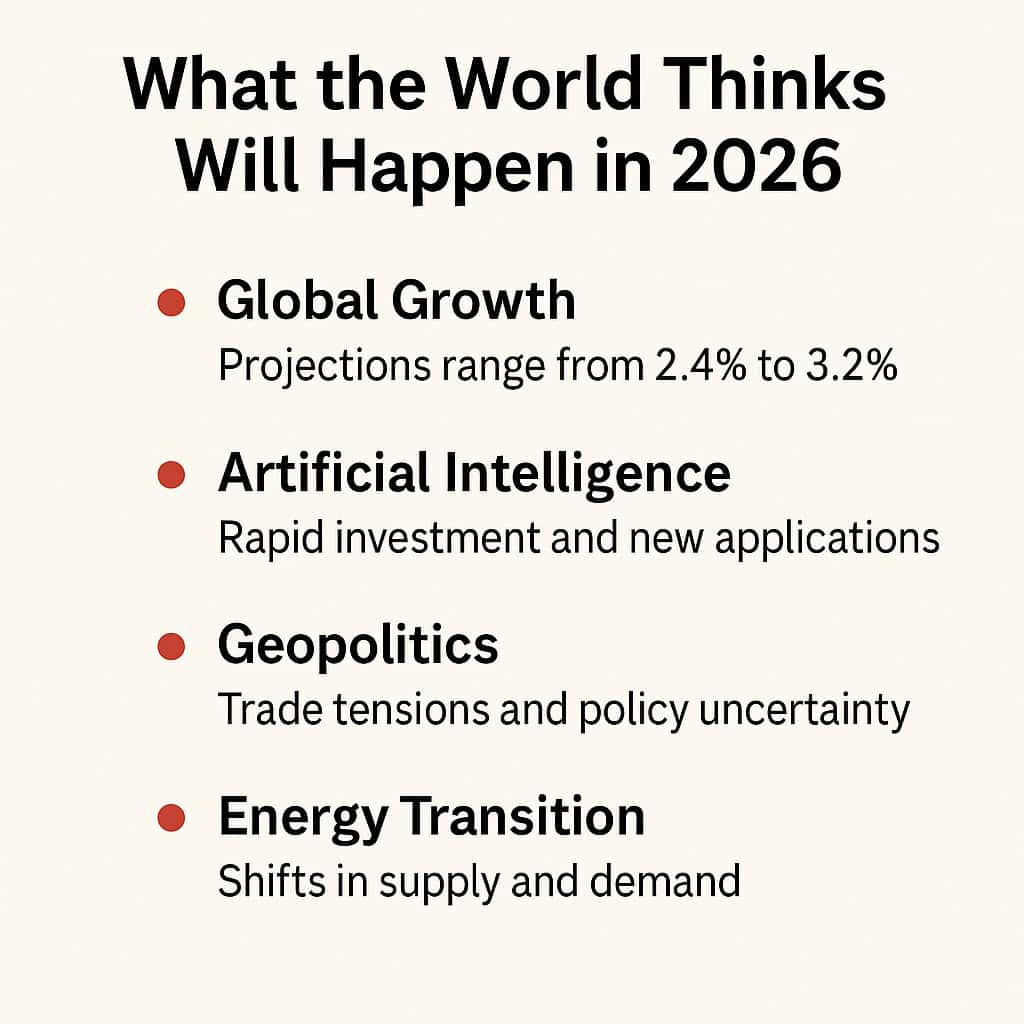
Predictions, Predictions, Predictions and more Predictions – The following information is summarized from a variety of global sources that we often use for this newsletter. All this analysis comes from online sources published in December 2025.
Global / Macro Outlooks for 2026
Morgan Stanley — “2026 Economic Outlook: Moderate Growth” projects global GDP growth at **~ 3.2% in 2026** (after ~ 3% in 2025), with resilience from consumption and capital spending.
OECD — According to the December 2025 Economic Outlook: global growth is expected to ease from 3.2% in 2025 to 2.9% in 2026, with a modest rebound to 3.1% in 2027.
UNCTAD — Projects a weaker global performance: **~ 2.6% growth in 2025–26**, down from 2.9% in 2024.
The Conference Board — Their “Global Growth Forecast Update” foresees global real GDP growth around 2.9% in 2026, after 3.1% in 2025.
Oxford Economics — In “Three key trends to watch in the global economy in 2026,” they forecast **~ 2.7% world GDP growth** in 2026, noting growing divergence between regions underneath that aggregate figure.
Alternative Views — Resilience, Disparities & Risks
CaixaBank Research — In its “World economy in 2026: resilience, transition or disruption,” the report argues that despite geopolitical uncertainty and supply-shock risks, the global economy is showing “greater-than-expected resilience,” with ~3% business-cycle speed likely.
S&P Global Ratings — Their “Global Economic Outlook Q1 2026” expects modest global growth (real GDP growth forecast ~2% in 2025 and 2026), but suggests that potential “AI tailwinds” may help avoid deeper slowdown.
RBC Global Asset Management — In its 2026 outlook, estimates U.S. GDP growth of about 2.2% in 2026, positioning it as slightly above the long-term average but below pre-pandemic highs, which may influence global demand dynamics.
Regional Spotlight — What’s Expected in Key Economies
International Monetary Fund (IMF) — In the latest “World Economic Outlook” update: global growth projected at 3.1% in 2026, down from 3.2% in 2025, with advanced economies ~1.5% and emerging economies just above 4%.
S&P Global (regional breakdown) — Their November 2025 update lifts growth forecasts for 2025–27 for several regions, including a positive reassessment for mainland China in 2026.
Invesco — Their “2026 Annual Investment Outlook” argues global capital markets and economic policies are entering a phase of “resilience and rebalancing,” suggesting potential upside for those who navigate carefully.
What This (Probably) Means
There is no single consensus — forecasts for 2026 range widely: from as low as ~2.6% (UNCTAD) to ~3.2% (Morgan Stanley).
Many analyses note structural divergence: developed economies likely remain sluggish, emerging / Asian economies likely carry the bulk of global growth.
Risks and “X-factors” — trade/tariff tensions, geopolitics, policy uncertainty, and uneven recovery from post-pandemic dislocations. And do not fiorget the ‘Oval Office Factor’. On the flip side, AI-driven investment and new capital cycles get cited as potential growth boosters.
The 2026 global growth outlook is described by some firms as “resilient” despite shocks; for others, “fragile,” pointing to downside risks if structural headwinds worsen.
=============================================================================================
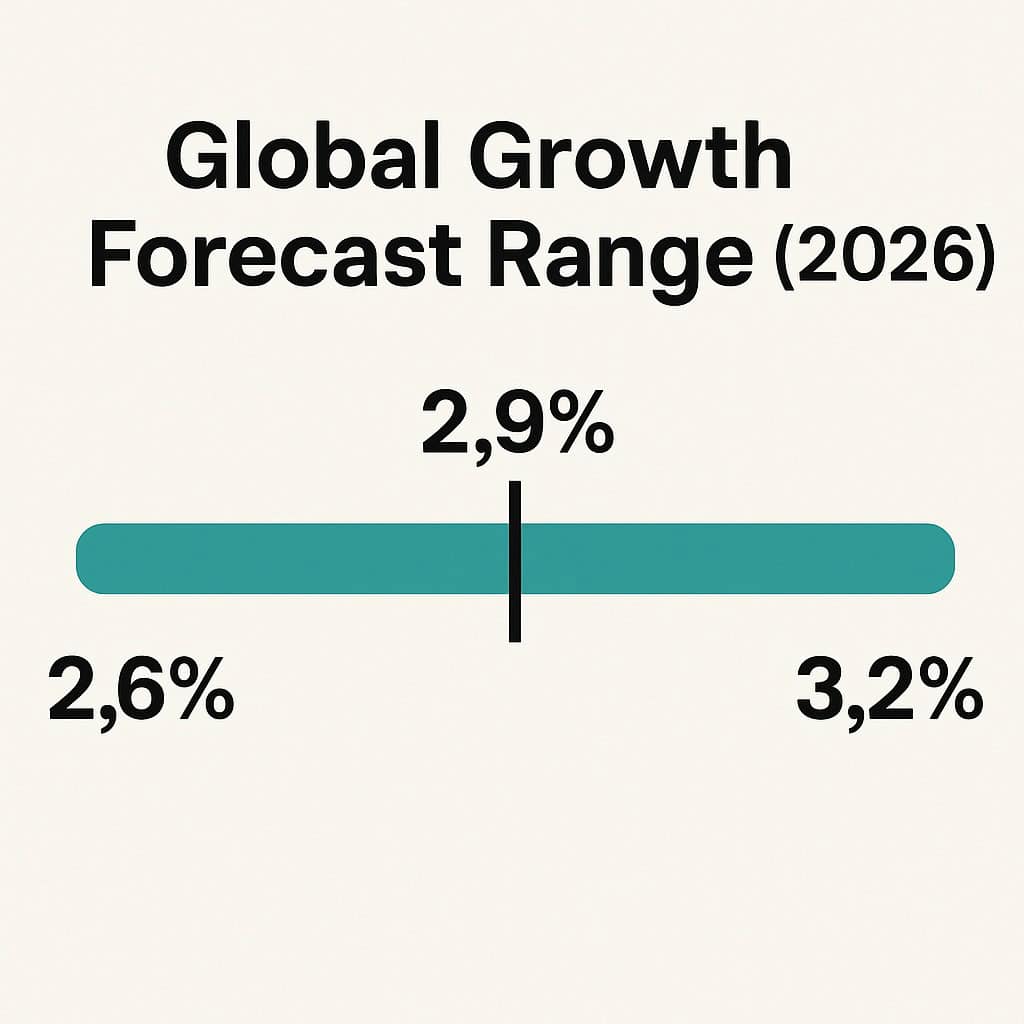
What the Economist, EIU & FT say about global growth in 2026
Economist Intelligence Unit (EIU) – In a recent report titled “Global outlook: Looking ahead to 2026”, EIU forecasts global growth to slow to ~ 2.4% in 2026. The report highlights increasing geopolitical risk, policy uncertainty, trade-protectionism and fragility in global trade, which all weigh on global economic growth.
The Economist – The section titled “The World Ahead 2026” outlines broad macroeconomic and structural themes expected in 2026: changes in trade complexity, commodity-price volatility, interest-rate dynamics, etc. However — The Economist does not publish a fixed global-GDP growth rate forecast for 2026 (at least none publicly available in that section). Their outlook is more qualitative than a point-estimate.
Financial Times (FT) – The FT offers analysis and commentary rather than a fixed aggregated global-growth forecast for 2026. For example, in a recent FT article reflecting on the global economy, the authors describe the global economy as “resilient yet fragile,” commenting on headwinds and structural risks. A FT analysis often draws (or critiques) forecasts from organizations such as International Monetary Fund (IMF) or OECD, citing their growth-rate numbers — but FT itself does not always publish its own independent, firm-number 2026 global-GDP forecast in recent public articles.
And what do these normally very astute sources project for their 2026 global GDP growth number?
Economist Intelligence Unit (EIU) — “Global outlook: Looking ahead to 2026” ~ 2.4% global growth in 2026
The Economist — “The World Ahead 2026” Structural / thematic outlook; no fixed GDP number
Financial Times — “The paradox of the resilient, fragile global economy” & related FT commentary Qualitative analysis highlighting risks and structural constraints — no standalone global-growth number
===============================================================================================
And What About AI in 2026? In 2026, AI is no longer just a technology trend—it becomes a geopolitical and operational risk that global businesses must actively manage. Uneven adoption across countries, AI systems that increasingly act on their own, and competition for chips, energy, and talent push AI governance, workforce redesign, and resilience planning to the center of business strategy.
Adoption accelerates—but unevenly: Advanced economies pull further ahead, widening digital and productivity gaps (IMF, OECD).
https://www.imf.org/en/Topics/artificial-intelligence | https://www.oecd.org/digital/artificial-intelligence/
Agentic AI raises governance risk: AI systems increasingly act across workflows, elevating oversight, liability, and control issues (McKinsey, Gartner).
https://www.mckinsey.com/capabilities/quantumblack/our-insights | https://www.gartner.com/en/articles/ai-trends
Compute becomes strategic infrastructure: Chips, data centers, and energy shape national competitiveness (WEF).
https://www.weforum.org/topics/artificial-intelligence
Workforce disruption intensifies: Job redesign and AI governance skills become critical (OECD).
https://www.oecd.org/employment/ai-and-work
================================================================================================

“Prediction Consensus: What the Experts See Coming in 2026 – We analyzed over 2,000 predictions from articles, reports, podcasts, and interviews to see what experts are predicting for the coming year. Below, we dig into a few of the top themes. For the seventh straight year, we’ve sifted through the forecast landscape to bring you the Prediction Consensus, a synthesis of what analysts, thought leaders, and industry experts expect for the year ahead. This year, we analyzed over 2,000 individual predictions from a wide variety of sources including Morgan Stanley, Goldman Sachs, the IMF, The Economist, Deloitte, Microsoft, Gartner, and dozens more. By mapping where these forecasts overlap, we’ve distilled the noise into 25 high-conviction themes displayed in our “Bingo Card” format, with the number of dabs reflecting the volume of supporting predictions.”, Visual Capitalist, December 18, 2025
=============================================================================================
“9 AI Predictions Every Business Leader Should Know For 2026 – According to an 800-person Wharton study, the use of AI by leaders weekly increased by 10% in 2025. Eighty-two percent of those leaders reported using GenAI once a week, and 46% said they use it daily. However, a November 2025 McKinsey studyshowed that only 39% of organizations from a study of 1,753 people said that AI is contributing to their EBIT, and less than 5% of their EBIT can be directly connected to AI adoption. 2026 may be the year more organizations demand more measurable resultsfrom AI.With the pace of AI adoption, innovation, and productization increasing steadily, there are so many directions that it can take us in 2026. To get a glimpse of what we can expect, Anne T. Griffin asked three people from the world of AI and tech that are building AI or are constantly on top of the latest products and startups about their predictions for AI in the new year.”, Forbes, December 22, 2025
================================================================================================
The Chapman University Economic Forecast – Real (U.S.) GDP growth of 2.0% in 2026 (vs. 1.8% in 2025). The anticipated growth is driven by record-setting investments in artificial intelligence (AI) infrastructure and sustained consumer spending from a $55 trillion surge in household wealth since 2020. These are just a few elements powering the U.S. economy into 2026, despite ongoing uncertainty around tariffs and interest rates. Recent increases in tariffs, the highest in nearly a century, are likely to raise costs for certain imported products. This could affect both businesses that rely on overseas materials and consumers who may see higher prices on everyday goods. “As we look ahead to 2026, investors will need to navigate a landscape shaped by both new opportunities and persistent risks,” said Fadel Lawandy, Director of the C. Larry Hoag Center for Real Estate and Finance at Chapman University. ‘Staying disciplined and avoiding overexposure to any single sector will be key to managing volatility and capturing long-term growth.’”, From the December 11, 2025, Economic Forecast presented at Chapman University, Orange, California by Dr. Jim Doti and Argyros College for Business professors Fadel Lawandy, and Raymond Sfeir. Compliments of Robert R. Selway, SVP, Relationship Banking, First Foundation
=============================================================================================
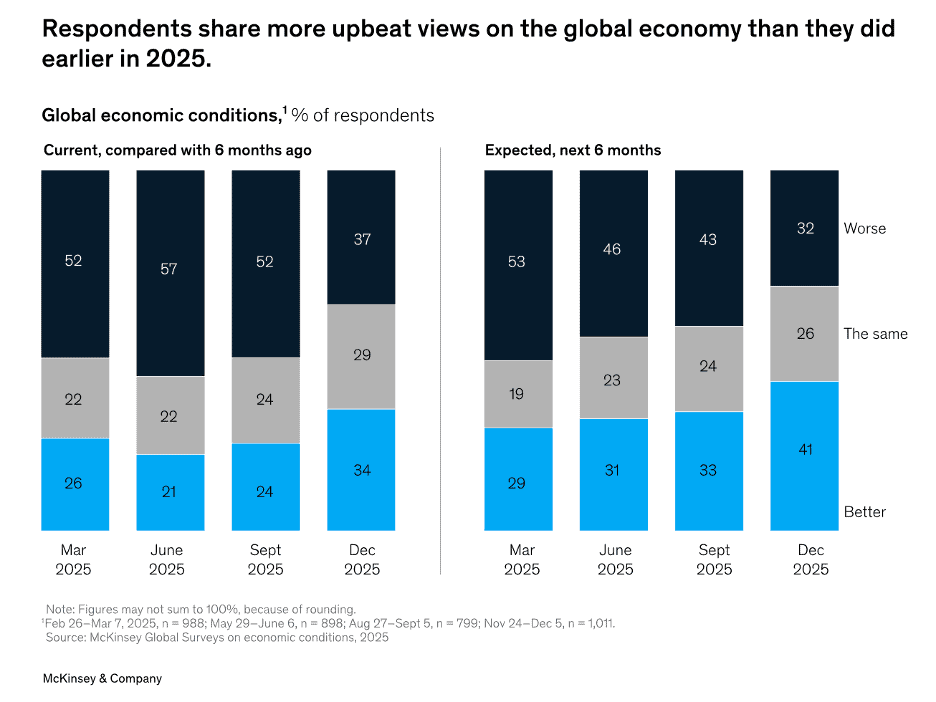
“Economic conditions outlook, December 2025 – In a reversal from earlier in the year, economic sentiment turns more optimistic, with declining focus on trade policy and growing confidence in companies’ prospects. After three quarters of largely negative assessments of current global conditions, respondents now report more even-keeled views of the present economy as well as increased optimism for the future. In the latest survey, respondents are about equally likely to say conditions have improved or worsened.”, McKinsey & Co., December 18, 2025
++++++++++++++++++++++++++++++++++++++++++++++++++++++++++++++++++++++++++++++++++++++++++++
Global Supply Chain, Energy, Commodities, Inflation, Taxes, Tariffs & Trade Issues
“Tariffs and Franchising: What the New U.S. Trade Landscape Means for Franchisors and Franchisees– The U.S. tariff landscape has shifted sharply throughout 2025. For franchised businesses, especially restaurants, retail chains, and service-oriented franchises that rely on imported equipment, smallwares, merchandise, and certain ingredients, the combination of new proclamations, sector-specific tariff rate increases, and active litigation produces a mix of immediate cost pressure and legal uncertainty. Recent legal and policy developments continue to affect the factors driving commercial decisions and the practical steps franchisors and franchisees should take now.”, Franchising.com, December 17, 2025. An article by Joyce Mazero, Josh Goldberg and Alissa Chase all with the Polsinelli law firm.
============================================================================================
““Global Outlook – Trade, AI, and the Energy Transition – Global trade has been surprisingly resilient, despite the volatile trade policy environment. Air cargo came to everybody’s rescue as a critical enabler of rapid adaptation, ensuring that goods arrived ahead of announced tariff deadlines and facilitating the swift rerouting of China’s exports to alternative markets. While artificial intelligence and the associated trade flows are an opportunity for air cargo, it is much less helpful for the global energy transition. Growing electricity demand from data centers is increasing competition for limited renewable energy, making it harder to secure affordable inputs for Sustainable Aviation Fuel (SAF). For 2026, we forecast a 4.9% YoY growth in passenger traffic (measured in RPK), led by the Asia Pacific region’s expansion by 7.3%.”, IATA, December 2025
===============================================================================================
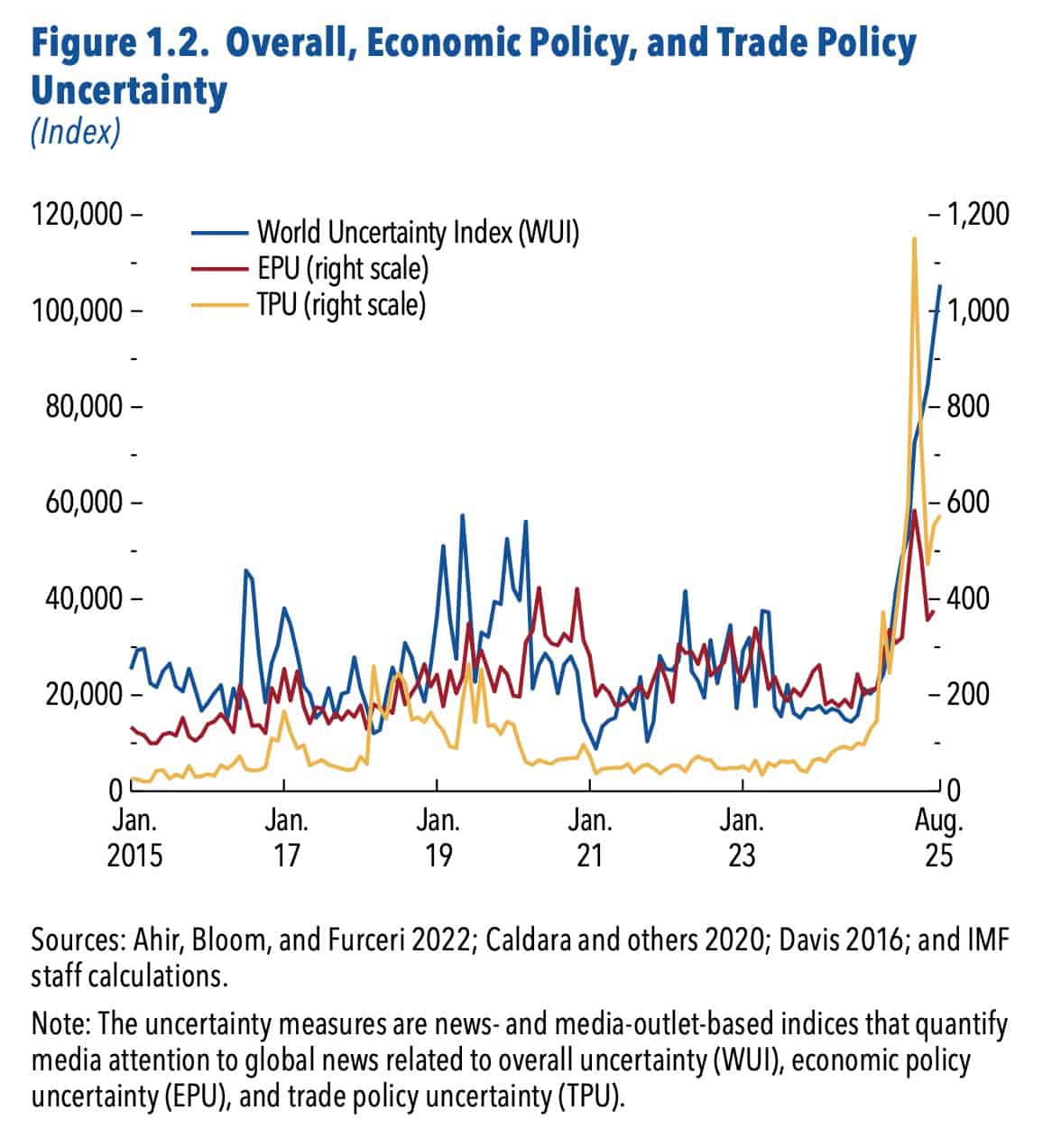
“WORLD ECONOMIC OUTLOOK: Global Economy in Flux, Prospects Remain Dim – In April of this year, the United States announced the imposition of sizable tariffs against most of its trading partners, in a major departure from trade policy rules and norms. Six months later, where do we stand? The good news is that the negative impact on the global economy is at the modest end of the range. Thanks to the agility of the private sector, which front-loaded imports in the first half of the year and speedily reorganized supply chains to redirect trade flows, the negotiation of trade deals between various countries and the US and the overall restraint from the rest of the world, which by and large kept the trading system open, global growth is now projected at 3.2 percent this year and 3.1 percent next year.”, International Monetary Fund report, October 2025
=============================================================================================
“Economic Outlook 2026 – An adaptive economy: tariffs, technology, transformation – In 2026, the policy changes that grabbed headlines in 2025 will exert their force on economies around the world. While deepening global fragmentation presents challenges, increasing AI adoption presents opportunities. Over 2026, the data will unveil how the global economy has shifted from these accelerating forces. The Mastercard Economics Institute (MEI) expects global real GDP growth to moderate to 3.1% in 2026 from an expected 3.2% in 2025; the global expansion is set to continue, underpinned by technological adaptation and flexible economies.
MEI expects moderately stronger growth in the US but a deceleration in the Chinese Mainland and across Latin America with Europe continuing to reveal a bifurcated story, this time along the lines of fiscal policy. On the inflation front, MEI expects an easing of global inflation to 3.4% in 2026 from the expected 3.9% in 2025. The critical factor remains tariffs, with the US navigating upward price pressures while other economies will experience lower inflation due to an increase in Chinese imports, lower commodity prices and currency shifts.
The global consumer will remain savvy, focusing on tech-enabled and value-conscious spending. MEI expects consumers to prioritize “meaningful moments” such as travel and live events while remaining price sensitive for many necessary goods.”, Mastercard Economics Institute, December 9, 2025
+++++++++++++++++++++++++++++++++++++++++++++++++++++++++++++++++++++++++++++++++++++++++++++
Global & Regional Travel News
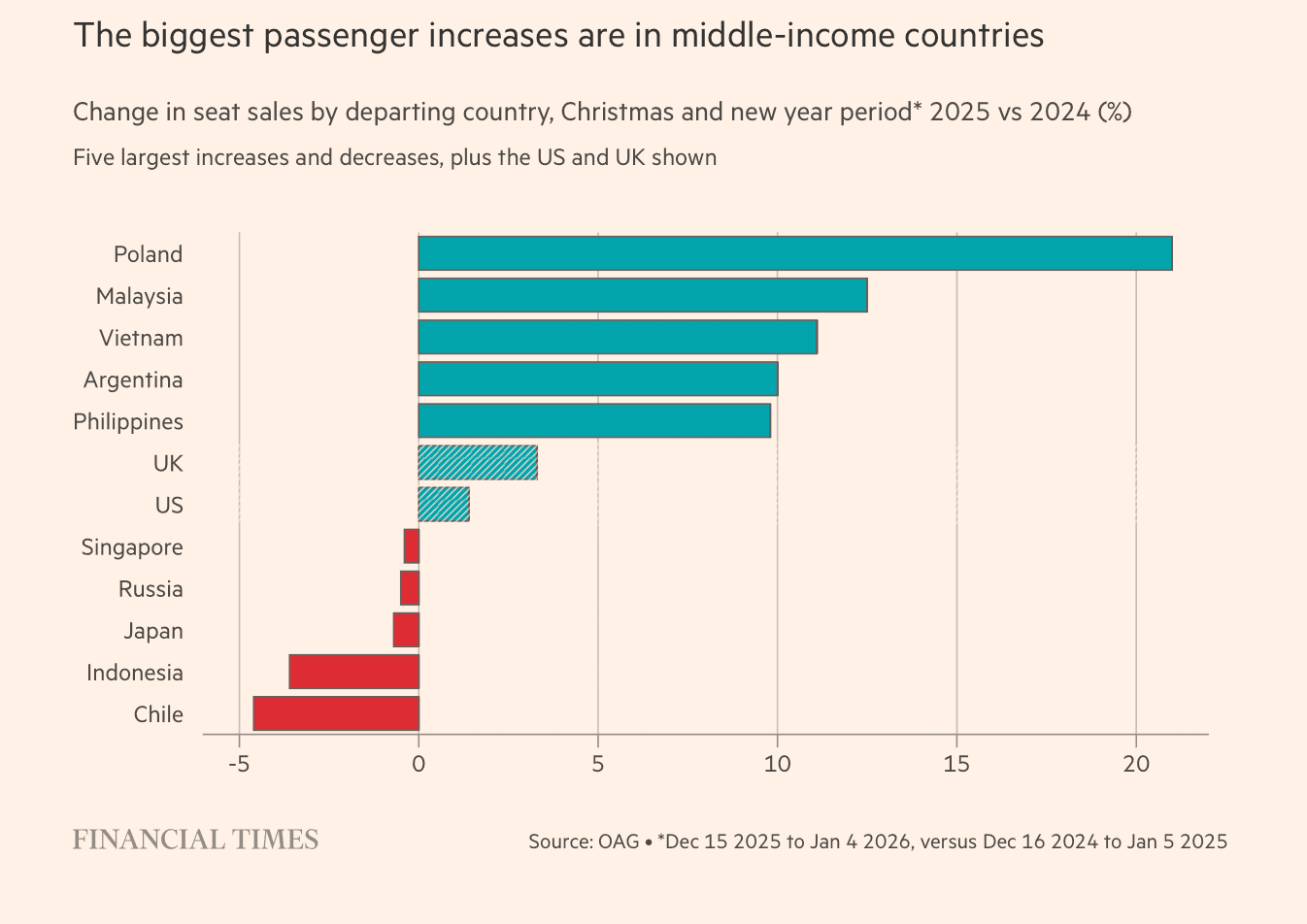
“Bumper Christmas for air travel as 300mn take to the skies – Airlines on track for the biggest holiday season getaway in history as industry braces for record demand. Strong growth in demand from China, India, Brazil and Mexico is expected to drive the increase. The recovery demonstrates the rising demand for air travel, which was badly hit after the Covid-19 pandemic. More than 5.2bn passengers are expected to fly during 2026, industry group Iata forecast, in spite of trade tensions and economic concerns.”, The Financial Times. December 18, 2025
++++++++++++++++++++++++++++++++++++++++++++++++++++++++++++++++++++++++++++++++++++++++++++++
Book Review

In Designing Hope: Visions to Shape Our Future, design futurist Sarah Housley challenges the prevailing cultural narrative of a dystopian future by urging us to reclaim imagination and optimism about what lies ahead. Housley, who spent more than a decade leading consumer technology forecasting at WGSN and now runs her own futures consultancy, argues that contemporary culture too often frames the future through the lenses of crisis and risk instead of possibility. Instead of fearing what’s next, she suggests, we need to build plural, hopeful futures that inspire action and creative problem-solving.
Using her expertise in trend forecasting, Housley presents four emerging visions of the future that represent plausible, diverse ways societies might evolve. These futures span ecological integration and multispecies design, wellbeing and sustainable economies, renewable coexistence with nature, and immersive technological worlds where digital and physical environments blend. Each scenario is rooted in existing innovations, artistic thinking, and early prototypes — not distant science fiction.
Crucially, Designing Hope isn’t just descriptive; it’s participatory. The book includes practical exercises to help readers imagine and articulate their own preferred futures, encouraging creativity, narrative building, and commitment to action. Housley’s central message is that hope must be coupled with agency: by broadening the stories we tell about what’s possible, individuals and organizations can orient strategy toward constructive and inclusive outcomes rather than paralysis.
Five Key Takeaways for Global Business Leaders
Hope is a strategic resource – Cultivating optimism sharpens vision and drives innovation in long-range business planning.
Multiple plausible futures exist, not a single inevitable outcome — Embrace scenario thinking in strategy formulation.
Future trends emerge from today’s patterns – So analyzing early signals can inform better investment and innovation decisions.
Futures thinking must be inclusive — diverse perspectives yield richer, more resilient strategic narratives.
Actionable imagination matters – Transforming hopeful futures into reality requires exercises that build commitment and operational follow-through.
+++++++++++++++++++++++++++++++++++++++++++++++++++++++++++++++++++++++++++++++++++++++++++

+++++++++++++++++++++++++++++++++++++++++++++++++++++++++++++++++++++++++++++++++++++++++++++
Country & Regional Updates
China
“Retailers beat a hasty retreat from mainland China due to consumption competition woes – Hong Kong retailer Mannings will cease online operations from December 26 and close its physical stores after January 15. Mainland China’s highly competitive retail landscape has taken its toll on one of Hong Kong’s largest health and beauty chains, which has decided to exit the market. Analysts said retailers across the board have found the going tough on the mainland, with a slowdown in consumer spending compounding matters. ‘Severe competition in China’s retail sector and shifting consumer spending on online platforms have forced bricks-and-mortar stores to change their business models,’ said Gary Ng Cheuk-yan, a senior economist at Natixis Corporate and Investment Bank. ‘It is now less viable to maintain physical stores as demand does not justify the rent and wage costs.’ Beauty chain Sa Sa International shut all 18 physical stores on the mainland in June this year, ending its 20-year presence.”, The South China Morning Post, December 17, 2025. Compliments of Paul Jones, Jones & Co., Toronto
=============================================================================================
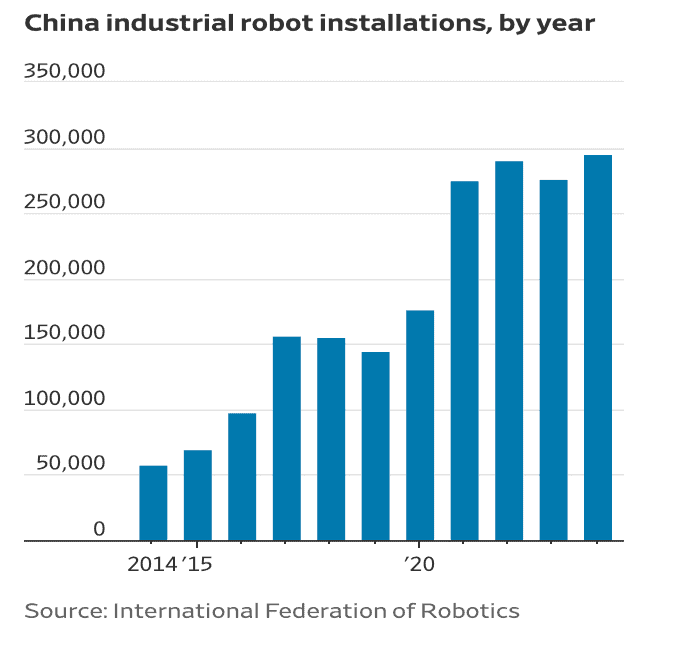
“Robots and AI Are Already Remaking the Chinese Economy – To blunt Trump’s push to reclaim global manufacturing, China’s factories and ports are learning to make and export more goods faster, cheaper and with fewer workers. At one of China’s biggest ports, shipping containers whiz about on self-driving trucks with virtually no workers in sight, while the port’s scheduling is run by AI. China installed 295,000 industrial robots last year, nearly nine times as many as the U.S. and more than the rest of the world combined, according to the International Federation of Robotics. Of 131 factories and industrial sites recognized by the World Economic Forum globally for lifting productivity through cutting edge technologies such as AI, 45 are in mainland China, while three are in the U.S.”, The Wall Street Journal, November 24, 2025
=============================================================================================
Indonesia
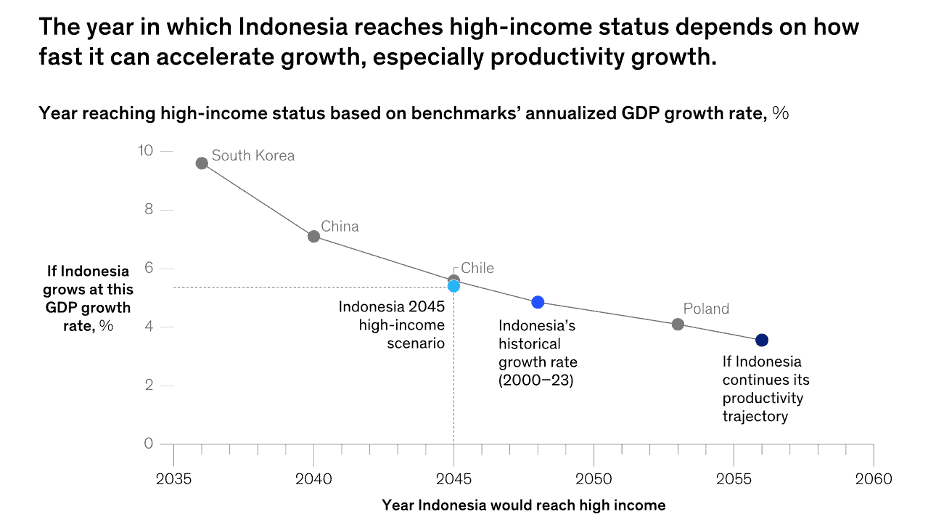
“Productivity and prosperity – If Indonesia is to meet an ambition of becoming a high-income economy by 2045, productivity growth would need to be the primary driver of its 5.4 percent annual GDP growth. The contribution from population and labor force participation factors would be lower in the years ahead, likely accounting for about 0.5 percentage points of GDP growth—less than one-third of what it has been since 2000 (1.8 percent). The balance would need to come from productivity growth, which would have to increase 1.6 times from the 3.1 percent CAGR that Indonesia achieved between 2000 and 2023 to 4.9 percent.”, McKinsey & Co., December 15, 2025
============================================================================================
Latin America

“BofA Sees Rate Cuts Fueling Latin America Equity Sales in 2026 – Bank of America Corp. expects Latin America’s equity capital markets to gain steam next year despite presidential elections in Brazil, Colombia and Peru stirring up market volatility. Augusto Urmeneta, BofA’s president for Latin America, said interest rates are expected to drop, and activity in Argentina, Chile, Peru and Mexico will probably be stronger. Equity issuance in Latin America rose 16% this year to $8 billion, and Urmeneta expects to see more follow-on and block-trade activity, particularly in the first half of the year, as companies access the equity capital markets for liquidity.”, Bloomberg, December 19, 2025
===========================================================================================
Japan
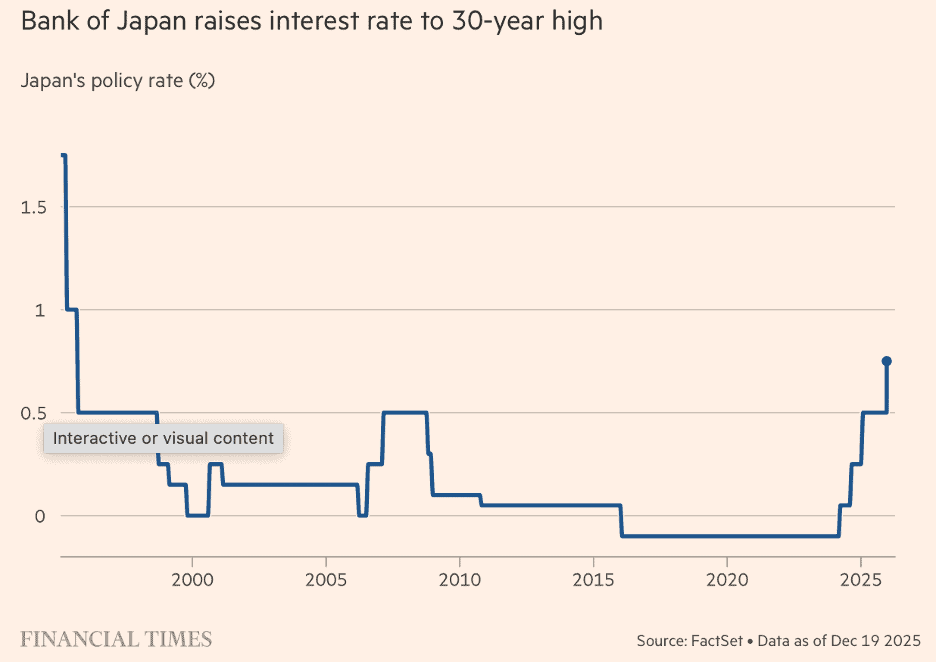
“Japan raises interest rates to highest level in 30 years – Yields on 10-year government bonds hit highest level since 1990s after central bank’s fourth rate increase. Japan’s benchmark government bond yields hit their highest level since 1999 after the central bank pushed up short-term interest rates to address rising prices and wages. The Bank of Japan raised its policy rate by 0.25 percentage points to “around 0.75 per cent”, a three-decade high, and signalled its readiness to continue monetary tightening if conditions are right. The rate increase, a unanimous decision by the bank’s Policy Board, was the fourth under governor Kazuo Ueda, continuing a “normalisation” process he launched last year.”, The Financial Times, December 18, 2025
===========================================================================================
Turkey
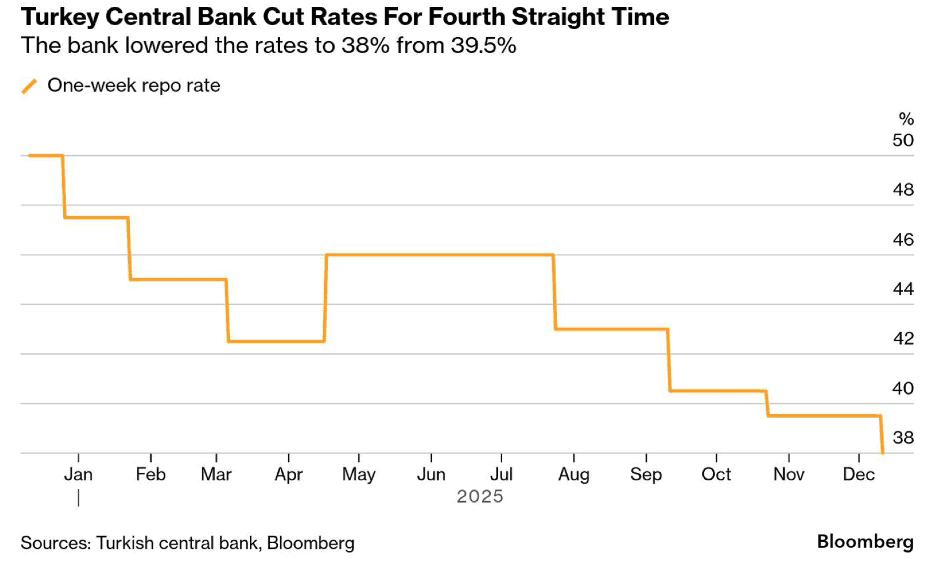
“Turkey Steps Up Rate-Cut Pace After Softer Inflation Data – Turkey’s central bank cut interest rates for the fourth time in a row, following favorable inflation data, lowering the one-week repo rate to 38% from 39.5%. The Monetary Policy Committee said consumer inflation was lower than expected due to a downward surprise in food prices, but emphasized caution due to broad expectations of price rises. Investors are now on the lookout for the government’s decision on the minimum-wage increase, expected later this month, which has major implications for domestic demand, corporate-pricing behavior and the inflation trajectory.”, Bloomberg, December 11, 2025
============================================================================================
United States
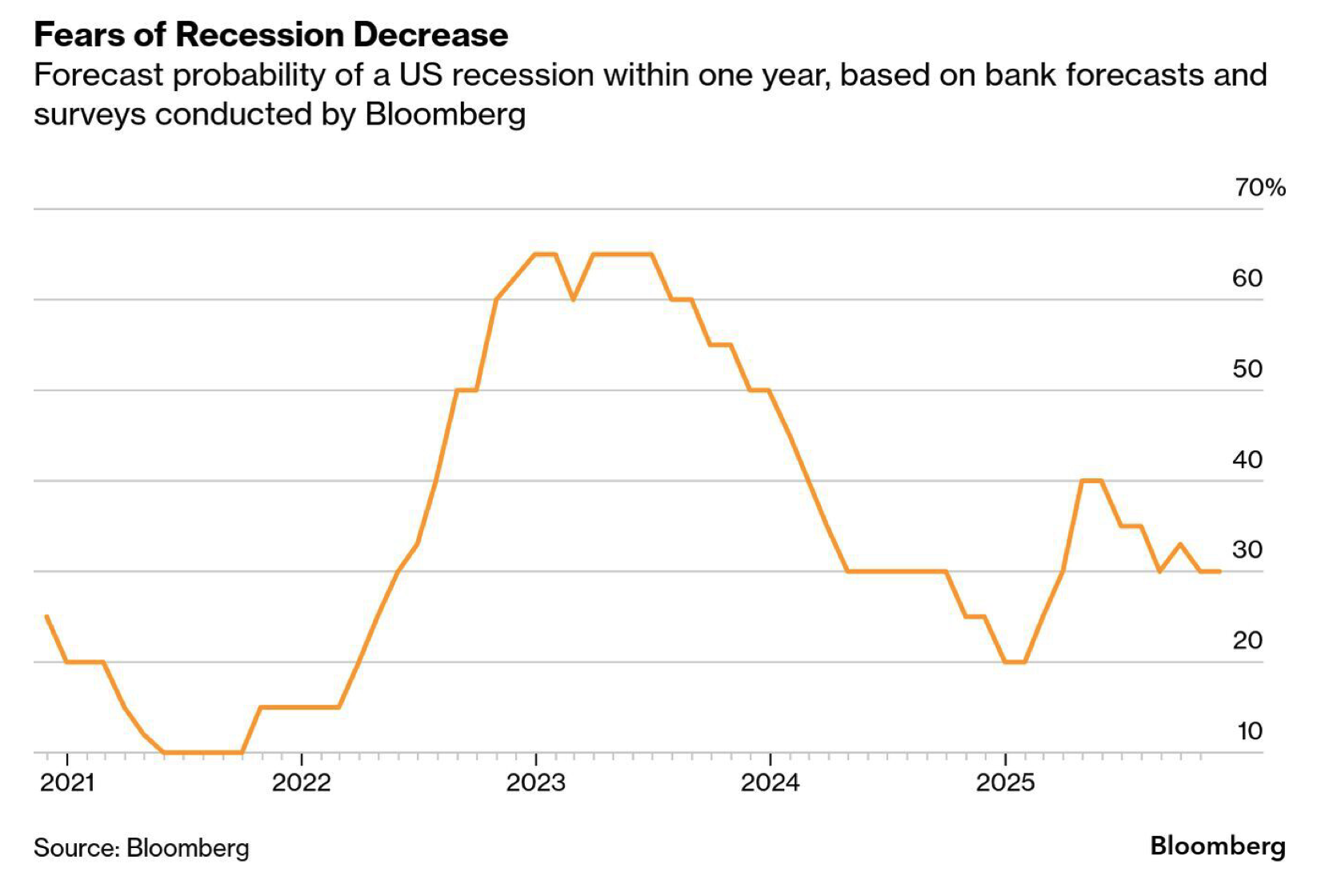
“Risks of a US downturn in the coming year have receded, thanks largely to the AI boom – The US economy has been in something of a Through the Looking Glass era for the past few years: Nothing is as it seems. At several points, tried-and-true recession indicators have flashed red. But even as some parts of the economy grew tremendously in 2025, other parts looked alarmingly weak. Hiring stagnated, the housing market stayed in a deep freeze, inflation began creeping up, and consumers’ expectations soured (though they continued to spend money). As we march into 2026, the questions loom: Where is this economy headed? Analysts Bloomberg surveyed are also tepidly optimistic, forecasting 2% gross domestic product growth and a 30% chance of recession.”, Bloomberg, December 15, 2025
++++++++++++++++++++++++++++++++++++++++++++++++++++++++++++++++++++++++++++++++++++++++++

The Accredited Franchise Supplier certification
+++++++++++++++++++++++++++++++++++++++++++++++++++++++++++++++++++++++++++++++++++++++++++++
Global Brand & Franchise Sector News
“From Starbucks to Burger King: Western food giants are selling large stakes to Chinese private equity funds – Chinese private equity firms tend to move fast, revamping menus, adjusting prices and scaling rapidly, including into lower-tier cities. Their readiness to shake up management and stronger ties to local suppliers, distributors, landlords and regulators also make divesting more appealing. China subsidiaries of multinational brands have also become prized targets for financial sponsors eager to deploy idle capital after years of tepid dealmaking. Foreign food-and-beverage chains once thrived in China without adapting much — premium Western products practically sold themselves. Today, decisions made from distant headquarters no longer cut it. Starbucks is selling a 60% stake in its China unit to Boyu Capital in a $4 billion deal, projecting its value will more than triple over the next decade, including licensing fees to the Seattle-based giant. CPE Capital is investing $350 millionin Burger King’s China operations, taking an 83% stake. General Mills is reportedly considering selling its Haagen-Dasz stores in China. Swedish oat milk brand Oatly Group AB has also been reportedly exploring divesting its China business.”, CNBC, December 17, 2025
=============================================================================================
“California Pizza Kitchen sells itself – Convive Brands will take over the global operator and master franchisor of the 120-unit pizza chain in a transaction backed by Bain Capital. California Pizza Kitchen has entered an agreement to be acquired by Consortium Brand Partners, Eldridge Industries, Aurify Brands and Convive Brands, according to an emailed press release. The financial terms of the acquisition were not disclosed, but Bain Capital is backing the transaction with a debt and equity investment. The transaction is expected to close this month. Convive, a multi-brand restaurant platform, will take over as global operator and master franchisor for CPK, with Jon Weber, CEO of Convive, serving as CPK’s CEO.”, Restaurant Dive, December 16, 2025
================================================================================================
“Fast food giant planning to open 30 new UK restaurants a year despite a ‘challenging’ economic backdrop – The new restaurants will focus on ones that it will run itself, rather than by franchisees. Burger King UK plans to open 30 new restaurants every year, despite “softer” consumer sentiment and pressure from higher wages and taxes. The fast food group revealed the plans on Thursday as it revealed stronger revenues amid a “challenging” economic backdrop. In its latest results, Burger King reported there have been ‘further signs of improvement’ across the business this year and pointed towards a slowdown in inflation.”, The Sun UK, December 11, 2025
=============================================================================================
“India Welcomes First International Moe’s Casa Mexicana – Unify Foodworks launches U.S. brand’s global expansion, restaurant celebrates grand opening on December 6 in Gurugram. Moe’s Casa Mexicana™, the global evolution of the popular U.S. fast casual chain Moe’s Southwest Grill®, is entering the Indian market with franchise partner Unify Foodworks. The brand’s international flagship restaurant will celebrate with a grand opening on December 6, 2025, at Elan Miracle with a second location set to open at Ambience Mall Vasant Kunj. Unify Foodworks also operates Carvel®, a leading ice cream brand.”, Franchising.com, November 24, 2025
==============================================================================================
“School of Rock Celebrates Grand Opening of First Location in the United Kingdom – The United Kingdom’s deep musical roots, from the Beatles and the Rolling Stones to Queen and The Clash, make it a particularly consequential market for School of Rock. The Twickenham location is poised to honor this legacy by inspiring the next generation of British musicians through the school’s proven, performance-based methodology. The expansion into the UK is led by Matías Puga Hamilton, the Master Franchisee for Latin America and the United Kingdom. Puga has already established a thriving network of more than 24 School of Rock locations across Chile, Peru, Colombia, Mexico, Argentina, Ecuador, Paraguay and Uruguay.”, Franchising.com, November 13, 2025
==============================================================================================
“Expansion Beyond Borders: How to Successfully Launch Franchising in the Middle East – The next big wave of business growth isn’t happening at home; it’s unfolding across borders. Franchising has already enabled small businesses to scale quickly and reach new audiences, and that same momentum is now propelling brands toward global horizons. With nearly 90 percent of companies planning to expand into different-language markets in the coming years, international growth is no longer a bold move; it’s becoming the new baseline for success. For brands ready to evolve, global growth delivers far more than increased revenue. It’s an opportunity to build worldwide recognition, spark innovation, and strengthen long-term competitive advantages.”, Franchising.com, December 12, 2025.This article is by Josh York, the CEO and founder of GYMGUYZ.
=============================================================================================
“Crossing the Pond: The Two-Way Flow of Restaurant Franchising Between Europe and the U.S. – For decades, “crossing the pond” meant restaurant giants from the United States exporting their playbooks to Europe. But the flow is now moving in both directions. A new generation of brands, from European café and casual dining concepts to U.S. fast casual and QSR innovators, is redefining what international growth looks like across the Atlantic. The story is no longer about global dominance; it’s about fit – understanding when, where, and how a brand’s DNA can thrive in a fundamentally different market. Both regions share enormous consumer spending power and mature infrastructure, yet their market structures, regulatory systems, and dining cultures could hardly be more different.”, Franchising.com, December 12, 2025. Article by Rebecca Viani is partner with WhiteSpace Partners, a London-based firm.
++++++++++++++++++++++++++++++++++++++++++++++++++++++++++++++++++++++++++++++++++++++++++++++
To receive our biweekly newsletter in your email every other Tuesday, click here – https://insider.edwardsglobal.com
+++++++++++++++++++++++++++++++++++++++++++++++++++++++++++++++++++++++++++++++++++++++++++++++
Our Mission, Information Sources & Who We Are
Our biweekly global business update newsletter focuses on what is happening around the worldthat impacts new trends, health, consumer spending, business investment, the franchise sector, economic development, and travel. We daily monitor 30+ countries, 40+ international information sources and six business sectors to keep up with what is going on in this ever-changing business environment. And our GlobalTeam™ on the ground covering 25+ countries provide us with updates about what is actually happening in their specific countries. We do not get involved in or report on politics!
+++++++++++++++++++++++++++++++++++++++++++++++++++++++++++++++++++++++++++++++++++++++++++
William “Bill” Edwards: CEO & Global Trade Advisor “Is Uniquely Qualified to Steer Sr. Executives Successfully Through the Complex Waters of Going Global”. With five decades of successful international business experience spanning virtually every corner of the world and many business sectors, Bill Edwards understands the global business landscape like no other. He has been a County Master Franchisee in five countries in Asia, Europe, and the Middle East; the Senior VP for a franchisor operating in 15 countries and a full-service global management consultant since 2001 helping 40+ franchisors expand into new countries. Bill knows how to turn the challenges in taking a brand global into opportunities.

For a complimentary 30-minute consultation on how to take your business into new countries successfully. For a complimentary call with Bill Edwards click on the QR code or contact Bill at bedwards@edwardsglobal.com and +1 949 375 1896
And download our latest chart ranking 40+ countries as places to do business, used by many companies for strategic planning, at this link:
Our latest GlobalVue™ 40 country ranking
Biweekly Global Business Newsletter Issue 149, Tuesday, December 9, 2025
“The future of trade will belong to the economiesthat move the fastest, not the largest.”
Welcome to the 149th Edition of the Global Business Update – The final weeks of 2025 bring a world economy marked by uneven momentum, persistent uncertainty, and several deep structural shifts reshaping global business. A new report on Geopolitical Megatrends highlights the accelerating forces now moving beneath the surface of daily events — durable, long-term transformations at the intersection of geography, economics, technology, and power.
Growth remains mixed across major markets as inflation edges higher in many developed economies and policy uncertainty continues to influence investment decisions. The U.S. government shutdown, U.S.–China tariff dynamics, and energy-driven inflation shifts in Europe all contribute to a business environment defined by volatility rather than stability. The upcoming 2026 review of the USMCA USA-Mexico-Canada trade agreement is already prompting vigorous debate on the future of North American integration.
McKinsey’s analysis of “business arenas” underscores how quickly competitive landscapes are shifting: only one company appears on both the 2005 and 2025 lists of the world’s most valuable firms. Productivity trends tell a similar story, with China’s long surge moderating, Ireland’s tax-driven distortions widening, and Saudi Arabia grappling with a slow transition away from hydrocarbons.
Global freight rates have spiked sharply amid geopolitical disruptions, China is deepening export ties with Southeast Asia in response to U.S. tariffs, and Vietnam has emerged as a major U.S. supplier despite rising trade frictions. But coffee prices are starting to come down!
This edition’s book review highlights a “Borderless Business: How Smart Entrepreneurs Expand Globally”, by Dr Raymond Hopkins, who draws on 30+ years of hands-on experience in global contracting and international trade to deliver a practical, actionable playbook for entrepreneurs seeking to grow beyond their home markets. Rather than selling theory, Hopkins offers real-world frameworks grounded in decades of negotiating complex contracts, managing supply chains, and adapting to diverse regulatory, cultural and economic environments.
++++++++++++++++++++++++++++++++++++++++++++++++++++++++++++++++++++++++++++++++++++++++++++++
To receive our biweekly newsletter by email every other Tuesday, click here https://insider.edwardsglobal.com
+++++++++++++++++++++++++++++++++++++++++++++++++++++++++++++++++++++++++++++++++++++++++
The mission of this newsletter is to use trusted global and regional information sources plus our network of 20+ in-country Associates to update our global readers on key global and local trends that can impact the success of their businesses at home and abroad. We subscribe to about 40 international information sources to keep our readers up to date on the world’s business. We do not get involved with or report on politics!
PLEASE NOTE: Some of the information sources that we provide links to in our newsletter require a paid subscription to directly access them. Clicking on a link may not give the reader access to the content.
Edited and curated by: William (Bill) Edwards, CEO & Global Business Advisor, Edwards Global Services, Inc. (EGS), Irvine, California, USA. Contact Bill with questions, comments and contributions. Bedwards@edwardsglobal.com, +1 949 375 1896
Link to our current and past newsletters: https://edwardsglobal.com/geowizard/
+++++++++++++++++++++++++++++++++++++++++++++++++++++++++++++++++++++++++++++++++++++++++
First, A Few Words of Wisdom From Others For These Times
“The future of trade will belong to the economies that move the fastest, not the largest.”, 2025 Global Competitiveness Forum
“A leader is one who knows the way, goes the way, and shows the way.”, John C. Maxwell.
“Treat people well, it’s the only investment that never loses value.”, Justin Wright
+++++++++++++++++++++++++++++++++++++++++++++++++++++++++++++++++++++++++++++++++++++++++++
Highlights in issue #149:
Top 12 Geopolitical Megatrends Insights for Businesses & Governments Leaders
Productivity of the World’s Largest 30 Economies (2005-2025)
Robusta Coffee Falls on Ample Supply From Top Grower Vietnam
Costco Joins Companies Suing for Refunds If Trump’s Tariffs Fall
2026 Travel Trends – An evolving travel and loyalty industry
Franchise Global News Section: Chick-fil-a®, Denny’s® and Wingstop®
++++++++++++++++++++++++++++++++++++++++++++++++++++++++++++++++++++++++++++++++++++++++++
Interesting Data, Articles and Studies
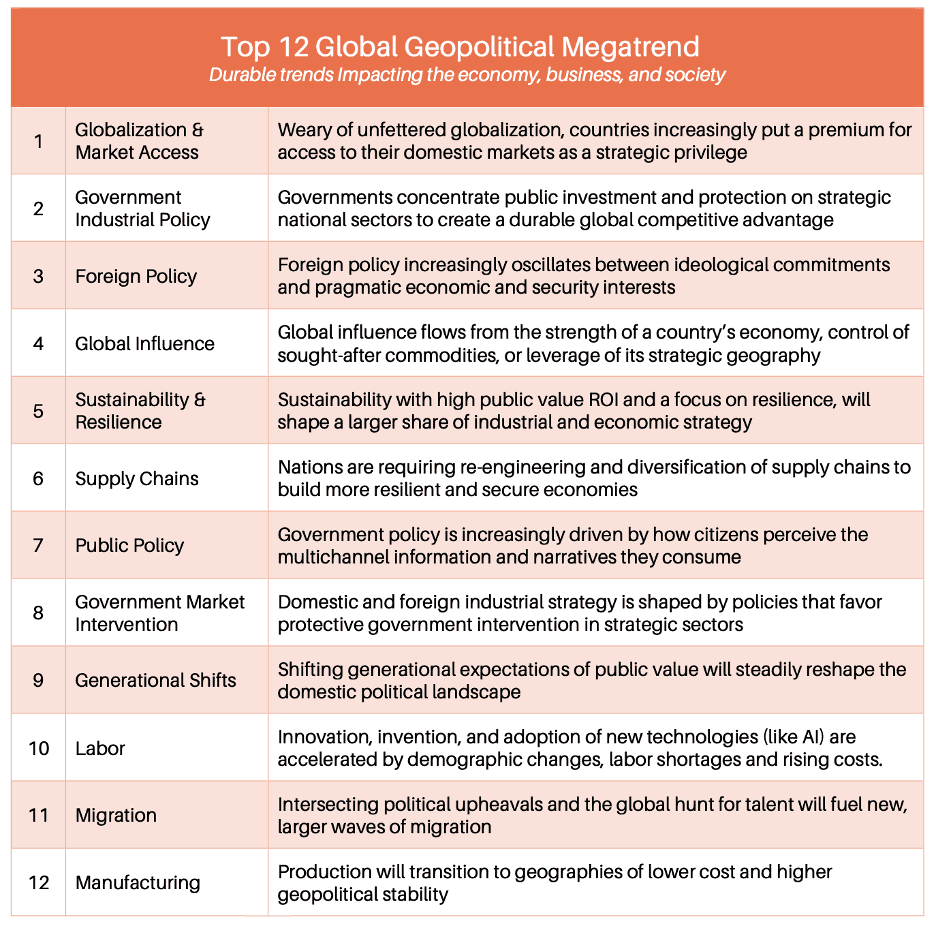
“Top 12 Geopolitical Megatrends Insights for Businesses & Governments Leaders – We live in an age defined not by calm progress, but by constant motion, churn, and noise. Information is everywhere. Scarce is wisdom and judgement. The ability to pull insight from complexity in our environment is now one of the essential skills of leadership. When John Naisbitt first used the word “megatrends,” he named the powerful forces moving beneath daily events. Today those forces are faster, more tightly linked, and harder to ignore. The twelve megatrends in this report are durable, structural shifts at the intersection of geography, economics, and power.”, Report and analysis by Dr. John Pournoor, Government Analytica®.
=============================================================================================
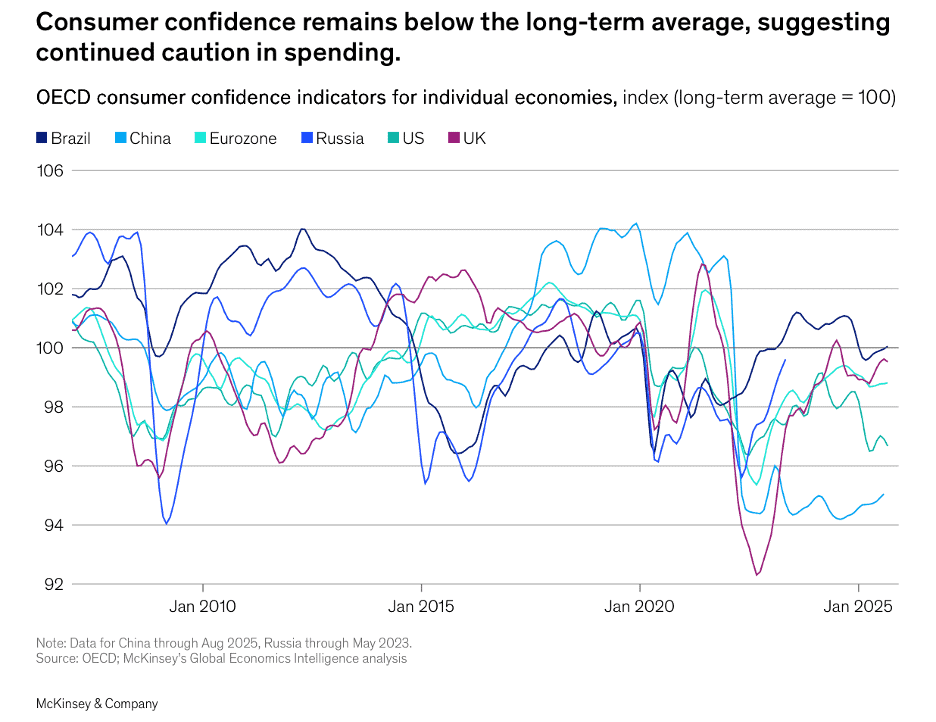
“Global Economics Intelligence executive summary, October 2025 – Global growth remains uneven amid policy uncertainty and trade realignments. US government shutdown adds downside risk, while US–China tariff talks and gradually easing inflation offer some optimism. Inflation among developed economies continues to accelerate and is moving away from the targets set by most central banks. In the US, the consumer price index (CPI) rose 3.0% for the 12 months ending September, after increasing 2.9% over the 12 months ending August. Core inflation was slightly up, to 3.0% (annualized). In the eurozone, headline inflation ticked up to 2.2% in September, but the rise was entirely driven by a smaller annual decline in energy prices. Core inflation remained stable at 2.3% for the fourth consecutive month. In the UK, it’s a different story: inflation remains elevated. Headline CPI inflation reached 3.8% in September, one of the highest rates among developed economies, largely driven by transportation and hotels/recreation prices.”, McKinsey & Co., November 25, 2025
===============================================================================================
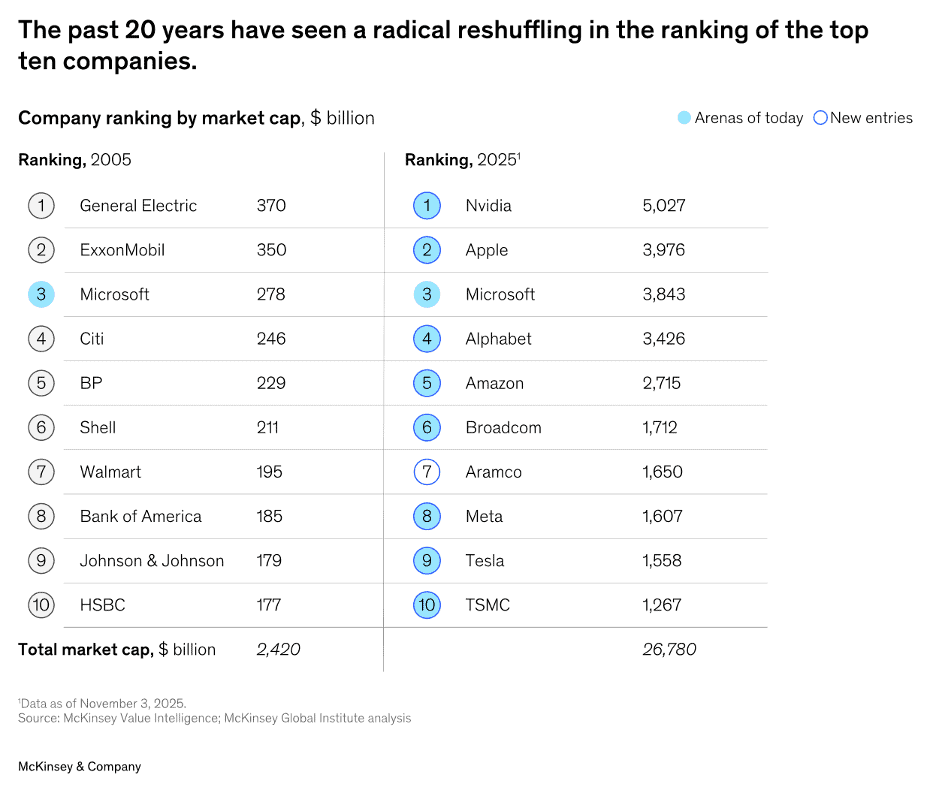
“The power of arenas – Arenas are industries that transform the business landscape. The industrial landscape has shifted dramatically over the past 20 years. Just look at the top ten most valuable companies in 2005 and 2025. Only one company appears on both lists. And the rest of the 2025 leaders are worth about ten times more than the 2005 leaders they replaced.”, McKinsey & Co., November 20, 2025
=============================================================================================
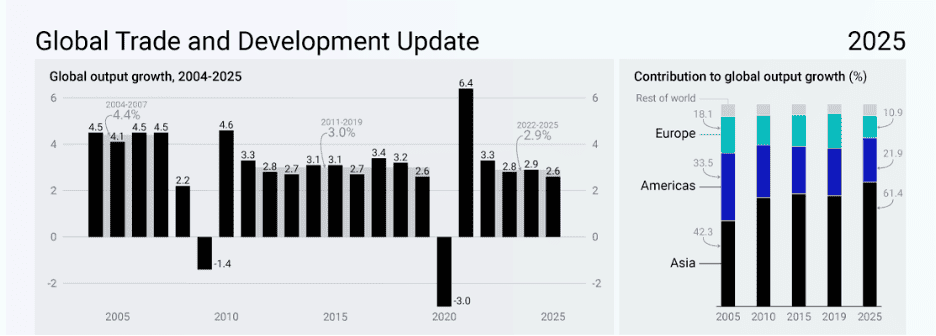
“Global Growth Continues Its Descent – A U.S. import surge lifted world trade at the start of the year, but it’s over now. According to the latest U.N. Trade and Development Report, global economic sentiment remains negative. Output growth is still slowing, and the dominant trend is prolonged uncertainty as economies struggle to adjust to shifting external conditions. It also underscores a widening gap between global trade and global finance, a sign of deeper structural imbalances.”, Geopolitical Futures, December 5, 2025
============================================================================================
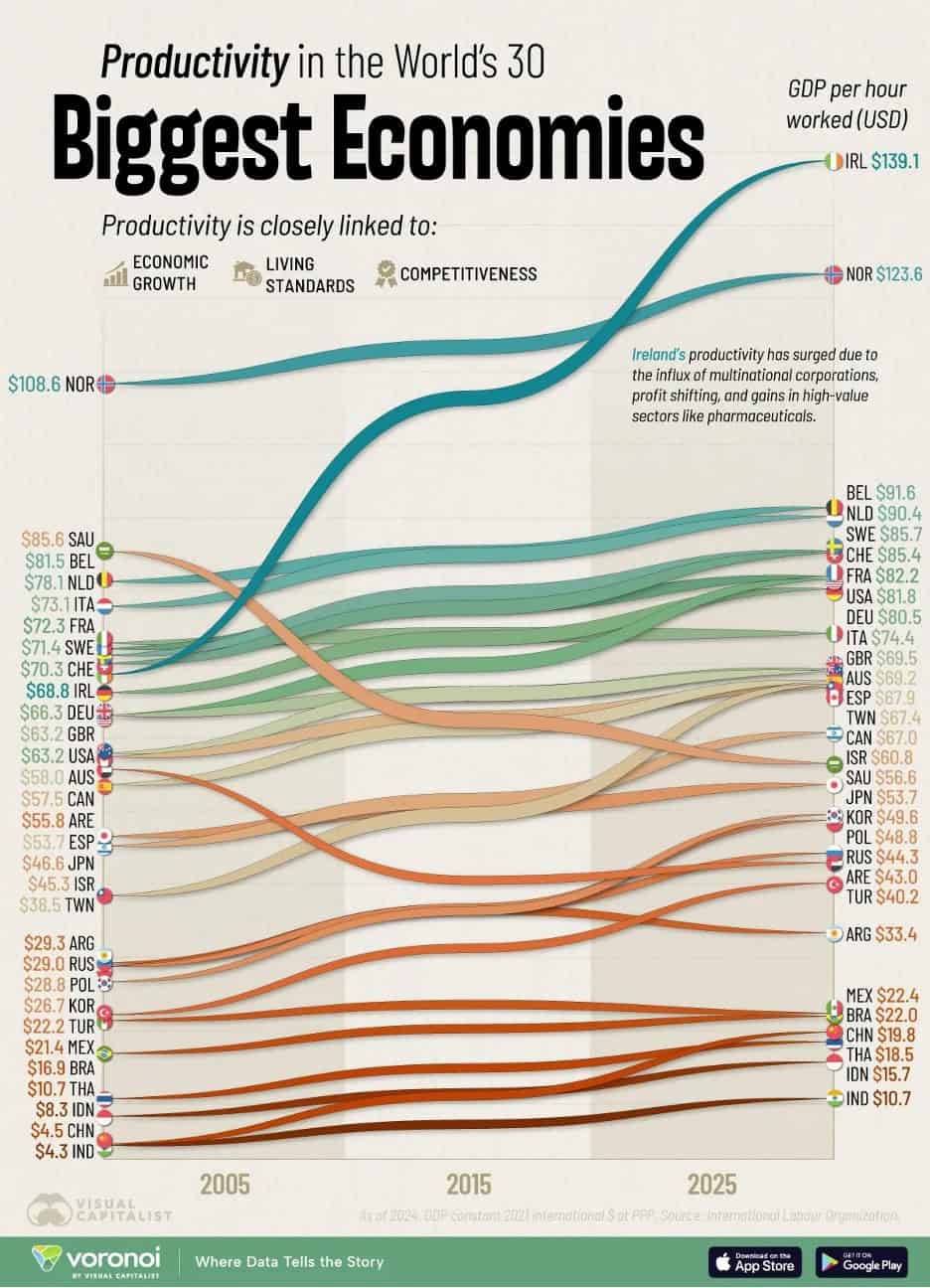
“Productivity of the World’s Largest 30 Economies (2005-2025) – China’s productivity has surged by about 340% since 2005, driven by rapid industrial upgrades and investment in technology. However, growth has slowed in recent years. Ireland’s productivity appears high due to a tax system that lets global tech and pharma firms book profits and intellectual property earnings in the country, even though most of the money goes back to their parent companies. Saudi Arabia’s productivity has declined over the past two decades, mainly due to lower oil prices in the mid-2010s and OPEC+ production cuts that limited output. Non-oil sectors are growing, but the economy still depends heavily on hydrocarbons.”, International Labour Organization, November 27, 2025
++++++++++++++++++++++++++++++++++++++++++++++++++++++++++++++++++++++++++++++++++++++++++++
Global Supply Chain, Energy, Commodities, Inflation, Taxes, Tariffs & Trade Issues
“The Debate Over a USMCA Overhaul in 2026 Kicks Off in Washington – The deal Trump negotiated in his first term comes up for review in 2026 and a contentious debate is under way. Policy leaders and business groups began a three-day hearing to air their concerns about the $2 trillion deal on Wednesday in Washington, kicking off a mandated review period ahead of July 1. ‘Mexico and Canada, together, are now America’s largest customers, largest investors and most important suppliers all in one,’ said former Ways & Means Chair Kevin Brady, who is set to testify Thursday. ‘Our argument is going to be: No trade agreement is ever perfect, especially one with such large economies so closely integrated,’ Brady said Wednesday. ‘The review is an opportunity to continue to strengthen the agreement, to look for ways to improve it.’”, Bloomberg, December 4, 2025
=================================================================================================
“Costco Joins Companies Suing for Refunds If Trump’s Tariffs Fall – Costco Wholesale Corp. is suing the Trump administration to ensure eligibility for refunds if the US Supreme Court strikes down the president’s global tariffs policy. The company filed a complaint in the US Court of International Trade due to uncertainty that refunds will be guaranteed for all businesses that have been paying duties if the Supreme Court declares the tariffs unlawful. Costco argues that it needs a court intervention immediately because Customs and Border Protection denied its request to extend the schedule for finalizing tariff determinations under Trump’s use of the International Emergency Economic Powers Act.”, Bloomberg, December 1, 2025
===============================================================================================
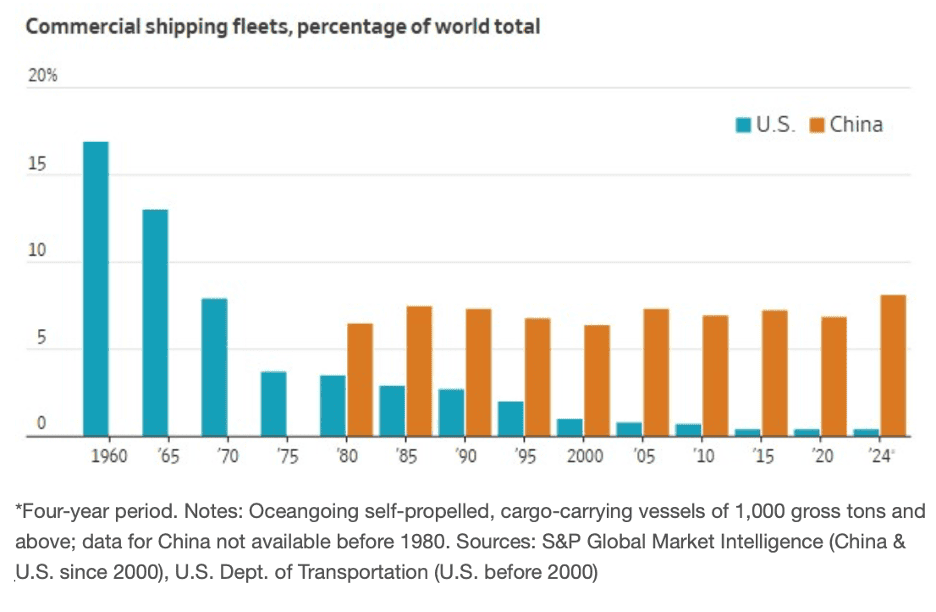
“U.S. Jobs at Sea Go Begging – Very little cargo currently moves on American-flagged ships, partly because of staffing, and shipping companies, which are generally required to hire Americans, say they are starved of crews. Yet, despite high pay and generous perks, maritime jobs go begging, the WSJ’s Daniel Michaels writes. The U.S. employs an estimated 10,000 commercial sailors, a number that has fallen sharply over recent decades as America outsourced much of its shipping demands to China and other countries. Shipping companies have begun offering fat signing bonuses. To retain hires, they are lifting salaries while improving onboard gyms, connectivity and cuisine. As AI threatens more office jobs, hands-on work like sailing is increasingly appealing, especially to the mechanically inclined, though many young people aren’t aware that the jobs exist.”, The Wall Street Journal, December 2025
============================================================================================
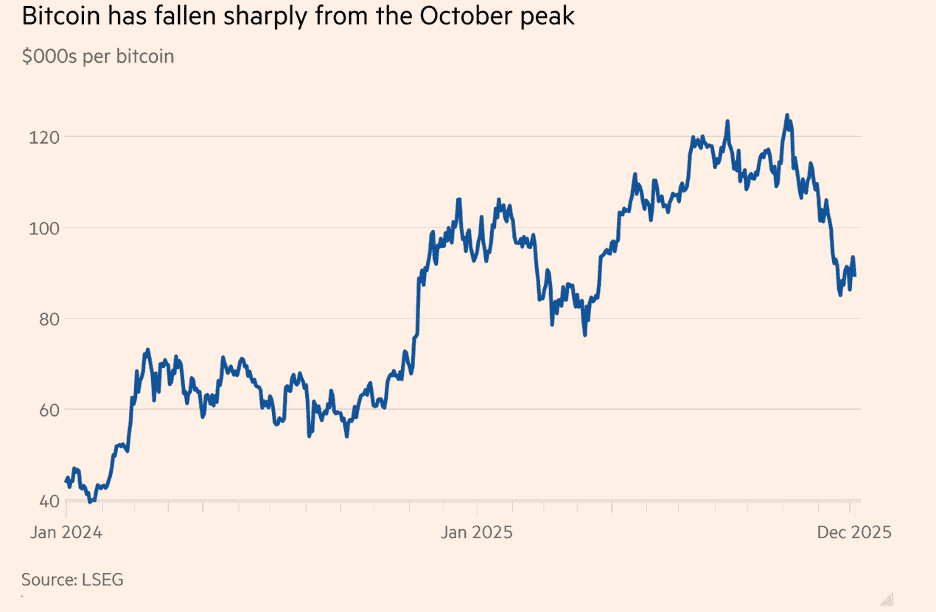
“Crypto’s rocky year – The industry was hugely optimistic when Donald Trump returned to the White House. But bitcoin has fallen by a quarter in two months. Explanations for the sell-off — more than $1tn has been erased from the combined capitalisation of about 18,000 digital tokens over the past two months — range from uncertainty surrounding the path of US interest rates to concerns about lofty tech stock valuations that have spilled over into other risky assets. ‘Unlike prior crashes, driven primarily by retail speculation, this year’s downturn has occurred amid substantial institutional participation,’ said Deutsche Bank analysts Marion Laboure and Camilla Siazon.”, The Financial Times, December 5, 2025
=============================================================================================
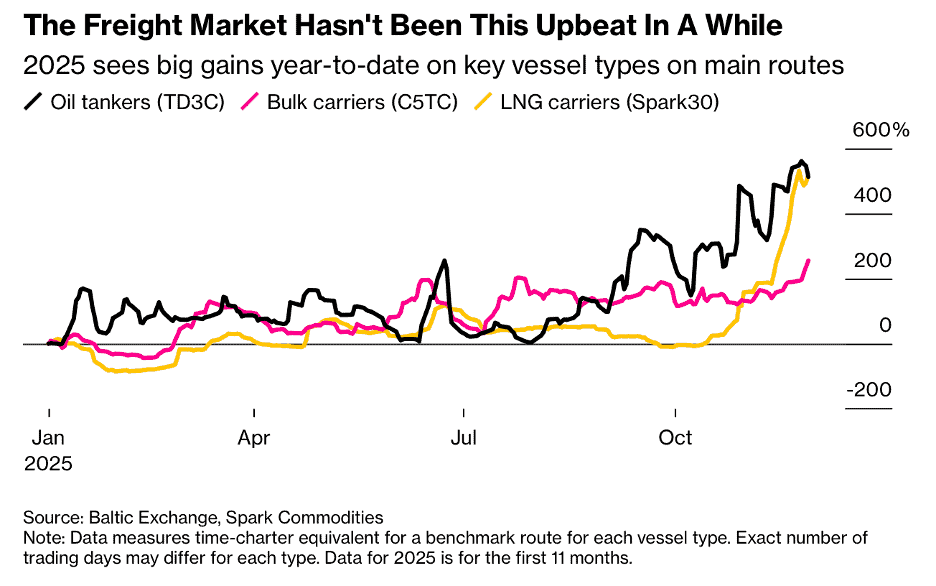
“Ship Rates Spiking 467% Marks Upended Trade Across Commodities – Conflicts, sanctions, and swelling output upending global supply lines. Daily earnings to transport crude have seen the biggest jump this year, while rates to ship liquefied natural gas and commodities such as iron ore have increased more than fourfold and twofold, respectively. Shipping executives expect tightness in the market to continue at least through early next year, with vessels spending more time at sea transporting cargo and contributing to the spike in freight costs. For crude tankers, rates rallied following a ramp-up in Middle Eastern production, along with higher Asian demand for their barrels after US sanctions on two Russian oil giants. Meanwhile, the cost to ship LNG from the US to Europe recently climbed to the highest level in two years as new projects in North America tied up more vessels to deliver the fuel. More broadly, hostilities around key routes have contributed to an overall increase in costs.”, Bloomberg, December 3, 2025
============================================================================================
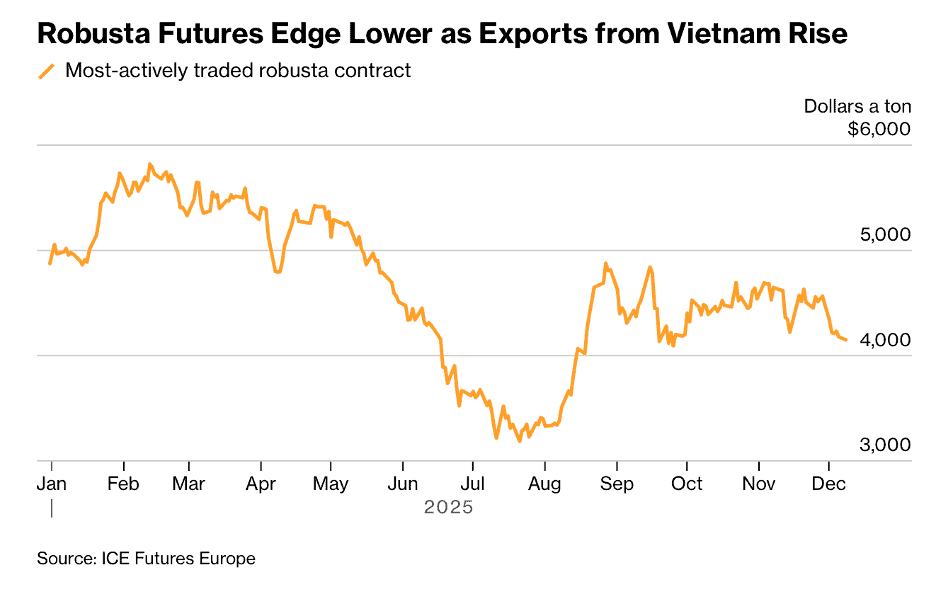
“Robusta Coffee Falls on Ample Supply From Top Grower Vietnam – The market has been pressured recently by expectation that Vietnam will deliver its biggest crop in four years despite heavy rains. The country’s November coffee exports were seen climbing almost 40% from a year earlier to 88,000 tons, according to the National Statistics Office. Shipments for the January-November period were up 15%.”, Bloomberg, December 8, 2025
==============================================================================================
“Navigating Non-Tariff Barriers and Global Trade Challenges – The Global Chamber® Export-Import Forum, moderated by Anita Rodal, featured Bill Edwards, CEO and Global Trade Advisor at Edwards Global Services (Your newsletter Editor!!!), in a dynamic and highly informative discussion on international trade challenges and non-tariff barriers (NTBs) that impact businesses especially small to medium-sized enterprises (SMEs). Bill emphasized that while tariffs are often discussed in trade policy, non-tariff barriers — including certification requirements, labeling regulations, customs procedures, and shifting political environments — often create even greater obstacles for small exporters. ‘About half of all non-tariff barriers serve legitimate public purposes,’ Bill explained, ‘But the other half can act as discriminatory trade barriers — depending on market.’”, Global Chamber, October 23rd. Please go to this link for the YouTube webinar:
https://www.youtube.com/watch?v=i7_pH5kSF6Q
+++++++++++++++++++++++++++++++++++++++++++++++++++++++++++++++++++++++++++++++++++++++++++++
Global & Regional Travel News
“2026 Travel Trends – An evolving travel and loyalty industry – New technology, a changing economic landscape, shifting consumer behaviors and fierce brand competition: Travel and loyalty look markedly different today than 10 years ago — and the evolution of the industry doesn’t show signs of slowing down. That’s why it’s more important than ever that savvy travelers stay updated on changing government and industry policies. It also remains vital to be flexible when planning travel and to take advantage of all the tools that can help improve the experience (without breaking the bank). Here are the top trends TPG experts are seeing across the industry — and what they mean for travelers in 2026.”, The Points Guy, December 2025
+++++++++++++++++++++++++++++++++++++++++++++++++++++++++++++++++++++++++++++++++++++++++++++++
Book Review
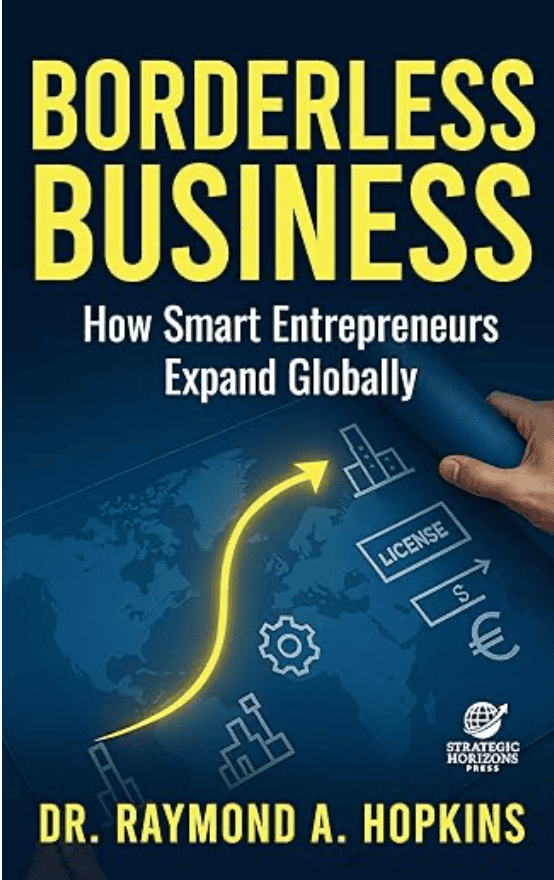
“Borderless Business: How Smart Entrepreneurs Expand Globally”, Dr Raymond Hopkins. In “Borderless Business”, Dr. Raymond Hopkins draws on 30+ years of hands-on experience in global contracting and international trade to deliver a practical, actionable playbook for entrepreneurs seeking to grow beyond their home markets.
Rather than selling theory, Hopkins offers real-world frameworks grounded in decades of negotiating complex contracts, managing supply chains, and adapting to diverse regulatory, cultural and economic environments.
Through detailed guidance on market evaluation, entry strategy, product and pricing adaptation, compliance, logistics, and global partnerships — as well as the integration of technology and AI — the book shows how nimble companies can transform from domestic players into global competitors.
Whether you’re a startup ready to export or an established business seeking international scale, Hopkins argues that borderless business is not optional — it’s the modern path to resilience, growth, and long-term competitiveness.
Five Key Takeaways for Global Business Leaders
Global expansion must be intentional and strategic — not accidental. Success starts with rigorous market evaluation and selection, not a “spray and pray” approach.
Entry strategy matters. Exporting, licensing, joint-ventures or direct investment — the right model depends on the product, market conditions, and long-term vision.
Adaptation is essential. Products, pricing, positioning — all must be tailored to local market needs and expectations rather than simply transplanted from home markets.
Technology (including AI) is now a core enabler of borderless growth. From supply-chain optimization to compliance, digital tools reduce friction for companies scaling globally.
Risk, compliance, and cultural awareness can make or break expansion. Success requires navigating regulation, logistics, partnerships, and relationships — not just chasing opportunity.
+++++++++++++++++++++++++++++++++++++++++++++++++++++++++++++++++++++++++++++++++++++++++++
+++++++++++++++++++++++++++++++++++++++++++++++++++++++++++++++++++++++++++++++++++++++++++++
Country & Regional Updates
Canada
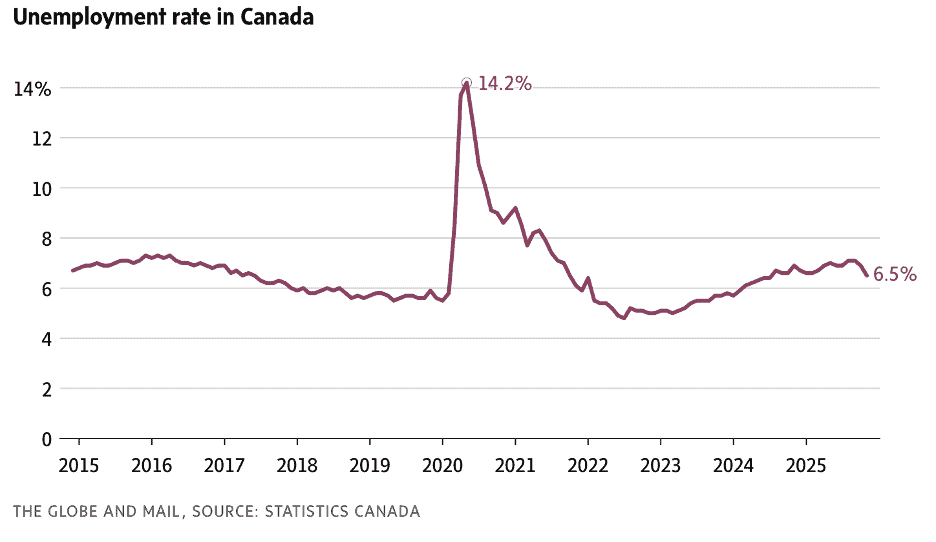
“Canada’s jobless rate falls to 6.5% driven by rise in part-time, youth employment – Canadian employment surged in November for the third consecutive month as young people picked up tens of thousands of positions, with the results easily outperforming tepid predictions from economists. The country’s unemployment rate fell to 6.5 per cent in November from 6.9 per cent in October, Statistics Canada reported Friday in its Labour Force Survey. The decrease was fuelled by growth in part-time jobs, and a corresponding decline in the youth unemployment rate, which reached a four-year peak in September of this year. Over all, the economy added 54,000 jobs in November, bringing the cumulative increase in jobs for September through November to 181,000.”, The Globe and Mail, December 5, 2025
===========================================================================================
China
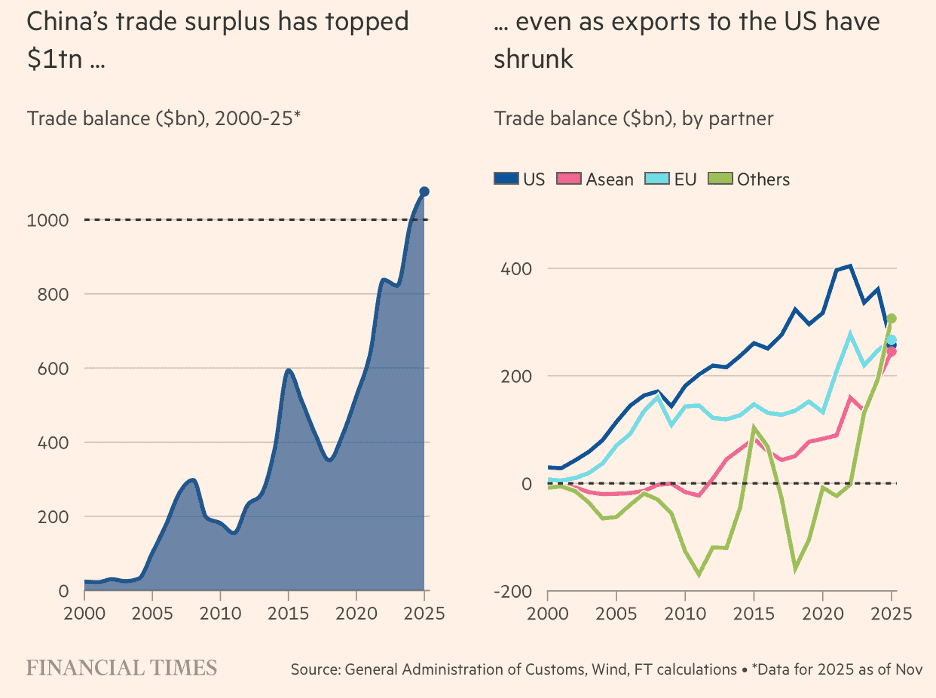
“China’s trade surplus tops US$1tn for first time – Exports soar despite tensions between Washington and Beijing. China’s trade surplus in goods has surpassed $1tn this year for the first time, as exports boomed despite US President Donald Trump’s tariff war. In the first 11 months of this year, China’s trade surplus in dollar terms was $1.076tn, according to data released on Monday by the country’s customs administration, which covers goods but not services. China’s trade surplus in goods for the full year in 2024 was just shy of $1tn.”, The Financial Times, December 8, 2025
=============================================================================================
Eurozone Countries
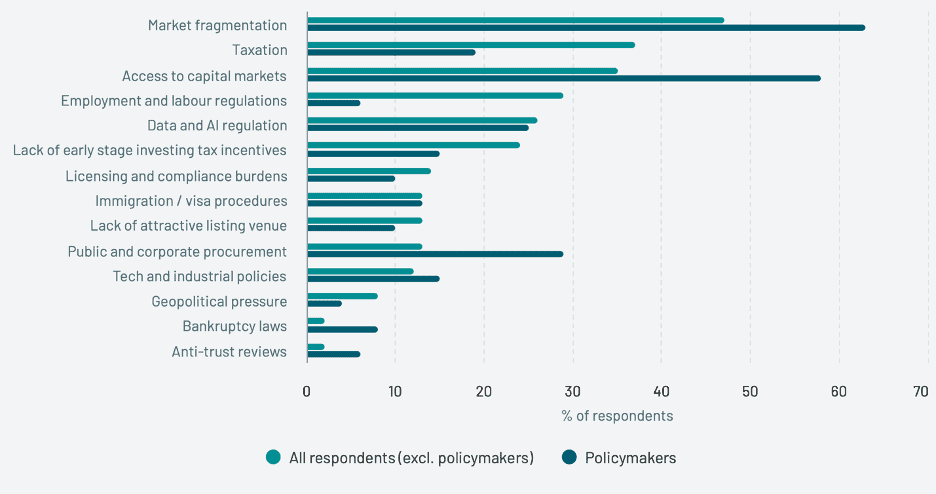
“State of European TECH 25 – The continent’s tech ecosystem has reached a certain level of maturity, but long-term competitiveness depends on whether it can turn its promise into global strategic assets. Europe effectively stands at a crossroads. We don’t lack talent or innovation — what Europe does lack is alignment between ambition and commitment. The policy barriers holding the ecosystem back. It’s overwhelmingly clear what the (European) ecosystem needs. Fifty percent are calling for the end of the market fragmentation, unencumbered access to capital markets, and changes to taxation. Policymakers themselves are indexing strongly on the top two — but show less appetite to reform taxation and employment and labour regulations, even though nearly one in three respondents overall rank these as a high priority.”, Atomico, December 2025
============================================================================================
Malaysia
“Anwar to Cut Small Business Costs After Poor Poll, Bernama Says – Malaysian Prime Minister Anwar Ibrahim announced measures to help reduce cost burdens for small and medium enterprises. Anwar has raised the threshold to exempt businesses from an e-invoicing initiative by the Inland Revenue Board to 1 million ringgit (US$243,267) in annual revenue from 500,000 ringgit, Bernama said. He also doubled government funds to expedite tax refunds to small businesses, to 4 billion ringgit from 2 billion ringgit, according to the report.”, Bloomberg, December 6, 2025
===========================================================================================
United States
“U.S. Manufacturing Contracts for Ninth Straight Month – Tariffs, which have increased costs for sourcing materials, continue to weigh on U.S. producers. U.S. manufacturing activity contracted for the ninth consecutive month in November, with the ISM’s PMI at 48.2, down from 48.7 in October. Manufacturers attribute the decline largely to tariffs, which have increased costs for sourcing materials and created uncertainty regarding duty levels. A separate S&P Global survey showed manufacturing PMI at 52.2, a slight decrease from 52.5 in October, with slowed demand growth, especially in export markets. ‘It really is all about tariffs,’ said ISM Chair Susan Spence. ‘We do not see anything on the horizon that’s going to turn this ship.’”, The Wall Street Journal, December 1, 2025
=============================================================================================
Vietnam
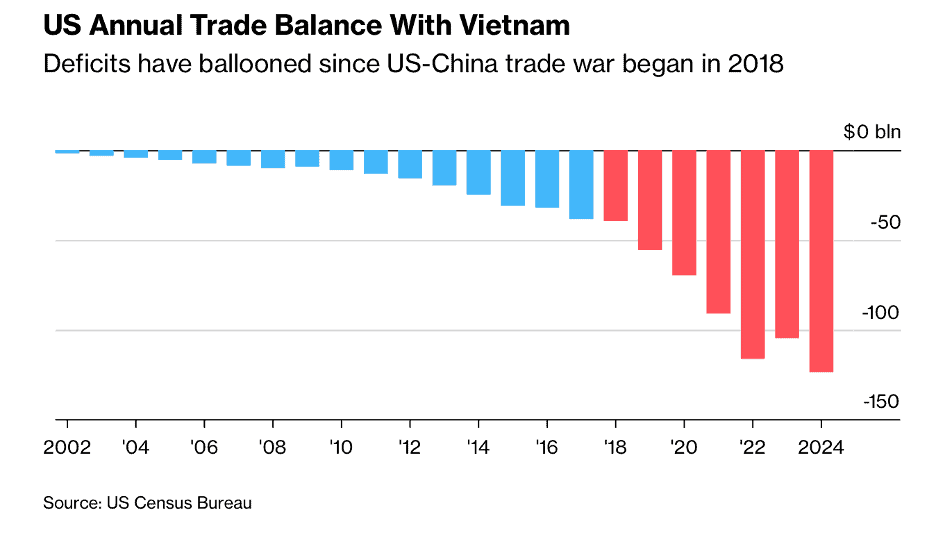
“Vietnam’s US Exports Jump, Surplus Rises Despite Tariffs – The Southeast Asian nation, which ships everything from footwear to furniture to America, reported a trade surplus with the US of $121.6 billion in the first 11 months of 2025, up 27.5% from a year earlier, according to data released by the National Statistics Office in Hanoi Saturday. Exports to the US climbed to $138.6 billion in the first 11 months, that’s up 27.3% from a year prior, data from the statistics office showed. Vietnam has repeatedly promised to buy more big-ticket American items in a bid to reduce its ballooning trade imbalance with the US, which last year was the third-largest behind only China and Mexico.”, Bloomberg, December 5, 2025
++++++++++++++++++++++++++++++++++++++++++++++++++++++++++++++++++++++++++++++++++++++++++
The Accredited Franchise Supplier certification
+++++++++++++++++++++++++++++++++++++++++++++++++++++++++++++++++++++++++++++++++++++++++++++
Global Brand & Franchise Sector News
“Wingstop hits 3,000th restaurant milestone – The company has expanded its global footprint by 50% in the past two years. The company said it is growing at a record pace, opening nearly 800 restaurants and expanding its global footprint by 50% in the past two years. During its most recent quarter, Wingstop opened 114 restaurants. Wingstop has also recently entered six new markets, including Australia, Bahrain, Kuwait, Puerto Rico, Saudi Arabia, and The Netherlands, giving it a presence in 47 U.S. states and 15 countries. The chain is expecting to enter Thailand, Italy, and Ireland soon as well.”, National Restaurant news, November 26, 2025
==================================================================
“Get Ready, America: Here Come China’s Food and Drink Chains – China’s fast-food and beverage brands have an opportunity to expand in the United States and escape cutthroat competition at home. The economic relationship between the United States and China is as fraught as it has been in recent memory, but that has not stopped a wave of Chinese food and beverage chains from moving aggressively into the United States for the first time. Chinese tea shops in New York and Los Angeles are offering consumers drinks topped with a milk or cheese foam. Fried chicken sandwich joints are trying to lure diners in California with affordable fast food. Restaurant and drink brands, some with thousands of stores in China, are taking root in American cities to escape punishing competition at home.”, The New York Times, December 1, 2025. Compliments of Paul Jones, Jones & Co., Toronto
==============================================================================================
“Restaurant Brands International: International Business Still Shines; Shares Fairly Valued – While the restaurant backdrop remains sour, RBI’s growth story remains intact. A strong suite of global brands, stepped-up investment, and a well-capitalized franchise base have propelled global system sales growth to 8% over the last three years, outpacing the global industry’s 5.5% rate.”, Morningstar, November 28, 2025
============================================================================================
“10 Up-And-Coming Chain Restaurants We’ll See Everywhere In 2026 – These booming restaurant chains — from coffee shops to smoothie cafes and more — are thankfully nowhere near suddenly shutting down or facing financial woes, unlike other popular chains that faced bankruptcy in 2025. In fact, the following spots will probably be popping up in your neighborhood by next Christmas.”, Tasting Table, November 29, 2025
=============================================================================================
“Can Denny’s bounce back from the doldrums? As private-equity investors spend $620M to buy the brand and take it private, a lot is riding on the deal – For decades, Denny’s was the iconic U.S. diner destination — the go-to spot for cheap coffee, late-night meals and highway-side comfort. But that’s all changed in the past few years. While the helpings are still generous, the once-ubiquitous chain has been shrinking as Denny’s struggles with rising menu prices, declining customer traffic and a wave of restaurant closures. Now Denny’s is being sold to a consortium of private-equity and franchise investors in a $620-million deal that will take the brand private.”, Moneywise, November 29, 2025
=============================================================================================
“Chick-fil-A is making a major change to 425 restaurants nationwide – Chick-fil-A’s big shift for hundreds of restaurants nationwide will reshape its business forever. Chick-fil-A is converting its licensed locations, found on college campuses, in hospitals, and at theme parks (excluding airports), to its owner-operator model. Under this franchise system, operators run the restaurant, manage daily operations, and share profits with the company, while Chick-fil-A retains ownership of the business assets.”, The Street, December 5, 2025
++++++++++++++++++++++++++++++++++++++++++++++++++++++++++++++++++++++++++++++++++++++++++++++
To receive our biweekly newsletter in your email every other Tuesday, click here – https://insider.edwardsglobal.com
+++++++++++++++++++++++++++++++++++++++++++++++++++++++++++++++++++++++++++++++++++++++++++++++
Our Mission, Information Sources & Who We Are
Our biweekly global business update newsletter focuses on what is happening around the worldthat impacts new trends, health, consumer spending, business investment, the franchise sector, economic development, and travel. We daily monitor 30+ countries, 40+ international information sources and six business sectors to keep up with what is going on in this ever-changing business environment. And our GlobalTeam™ on the ground covering 25+ countries provide us with updates about what is actually happening in their specific countries. We do not get involved in or report on politics!
+++++++++++++++++++++++++++++++++++++++++++++++++++++++++++++++++++++++++++++++++++++++++++
William “Bill” Edwards: CEO & Global Trade Advisor “Is Uniquely Qualified to Steer Sr. Executives Successfully Through the Complex Waters of Going Global”. With five decades of successful international business experience spanning virtually every corner of the world and many business sectors, Bill Edwards understands the global business landscape like no other. He has been a County Master Franchisee in five countries in Asia, Europe, and the Middle East; the Senior VP for a franchisor operating in 15 countries and a full-service global management consultant since 2001 helping 40+ franchisors expand into new countries. Bill knows how to turn the challenges in taking a brand global into opportunities.
For a complimentary 30-minute consultation on how to take your business into new countries successfully. For a complimentary call with Bill Edwards click on the QR code or contact Bill at bedwards@edwardsglobal.com and +1 949 375 1896
And download our latest chart ranking 40+ countries as places to do business, used by many companies for strategic planning, at this link:
Our latest GlobalVue™ 40 country ranking