Biweekly Global Business Newsletter Issue 155, Tuesday, March 3, 2026

“The more you know about the past, the better prepared you are for the future.”
Welcome to the 155th Edition of the Biweekly Global Business Update – As we have learned once again over the past few days, we cannot control wars, elections, or geopolitical rivalry. We can control preparedness, financial discipline, partner selection, and long-term orientation. The companies that will thrive in this cycle will not be those that predicted events correctly. They will be those built to withstand them, those that are resilient. That is the task in front of us as global businesspeople.
We are operating in a different global environment than we were just a few years ago. Tariff policy remains fluid. AI is accelerating competitive cycles. Capital markets are repricing risk. Wars in Europe and the Middle East continue to affect energy markets, shipping routes, defense spending, and political alignment. Tensions in Asia remain unresolved. Geopolitical fragmentation is shaping supply chains, regulatory regimes, and capital flows in real time.
For those of us in global business, this is not background noise. It is the operating framework. The proper response is not optimism or pessimism. It is discipline and resilience.
Planning must be continuous. Static projections have limited value in a world of sanctions risk, tariff shifts, currency volatility, and regulatory change. Scenario modeling, downside preparation, and execution flexibility are now core management functions. No more 5-year strategic plans.
Geopolitical literacy has moved to the center of board-level decision-making. Active conflicts and regional instability influence insurance costs, logistics, commodity pricing, cybersecurity exposure, and capital access. Political risk can no longer be delegated or ignored.
Balance-sheet strength matters. Liquidity, conservative leverage, diversified sourcing, and regional redundancy are strategic assets in a conflict-prone, interest-rate-sensitive environment. As Winston Churchill once said, “However beautiful the strategy, you should occasionally look at the results.”
Markets will always react to headlines. Effective leadership does not. It evaluates exposure, recalibrates when necessary, and moves forward deliberately.
International expansion should be phased and intentional — city by city, partner by partner, capital deployed carefully. Lack of focus is punished quickly in volatile cycles.
This edition’s book review highlights: In “Overreach: How China Derailed Its Peaceful Rise” Dr. Susan L. Shirk (2022) delivers one of the clearest explanations of how China’s carefully managed “peaceful rise” shifted into a far more assertive global posture. For decades, China’s rise to power was characterized by its reassurance that this rise would be peaceful. Then, as Dr. Shirk, shows in this sobering, clear-eyed account of China today, something changed.
Drawing on decades of research and direct policy experience, she makes an important point: China’s current trajectory is not simply the product of one leader’s ambition. It reflects deeper institutional dynamics, domestic political pressures, bureaucratic competition, and rising nationalism that gradually reduced strategic restraint.
++++++++++++++++++++++++++++++++++++++++++++++++++++++++++++++++++++++++++++++++++++++++++++++
To receive our biweekly newsletter by email every other Tuesday, click here https://insider.edwardsglobal.com
+++++++++++++++++++++++++++++++++++++++++++++++++++++++++++++++++++++++++++++++++++++++++++++
The mission of this newsletter is to use trusted global and regional information sources plus our network of 20+ in-country Associates to update our global readers on key global and local trends that can impact the success of their businesses at home and abroad. We subscribe to about 40 international information sources to keep our readers up to date on the world’s business. We do not get involved with or report on politics!
PLEASE NOTE: Some of the information sources that we provide links to in our newsletter require a paid subscription to directly access them. Clicking on a link may not give the reader access to the content.
Edited and curated by: William (Bill) Edwards, CEO & Global Business Advisor, Edwards Global Services, Inc. (EGS), Irvine, California, USA. Contact Bill with questions, comments and contributions. Bedwards@edwardsglobal.com, +1 949 375 1896
Link to our current and past newsletters: https://edwardsglobal.com/geowizard/
+++++++++++++++++++++++++++++++++++++++++++++++++++++++++++++++++++++++++++++++++++++++++
First, A Few Words of Wisdom From Others For These Times
“The more you know about the past, the better prepared you are for the future.”, Theodore Roosevelt
“The essence of strategy is choosing what not to do.”, Michael Porter
“However beautiful the strategy, you should occasionally look at the results.”, Winston Churchill
+++++++++++++++++++++++++++++++++++++++++++++++++++++++++++++++++++++++++++++++++++++++++++
Highlights in issue #155:
The World’s Richest Countries vs. the Happiest Countries
Global Worries, Local Priorities
Transforming Europe: Bold moves to lift a continent
Vietnam is on track to overtake Canada as a source of U.S. imports
Where Food Inflation Will Hit Hardest in 2026
Global Cash Is Fueling a Historic Start for Latam Stocks
Argentina’s Economy Expands More Than Expected After Midterm Election
Franchise Global News Section: Applebee’s®, KFC® and Papa John’s®
++++++++++++++++++++++++++++++++++++++++++++++++++++++++++++++++++++++++++++++++++++++++++++
Interesting Data, Articles and Studies
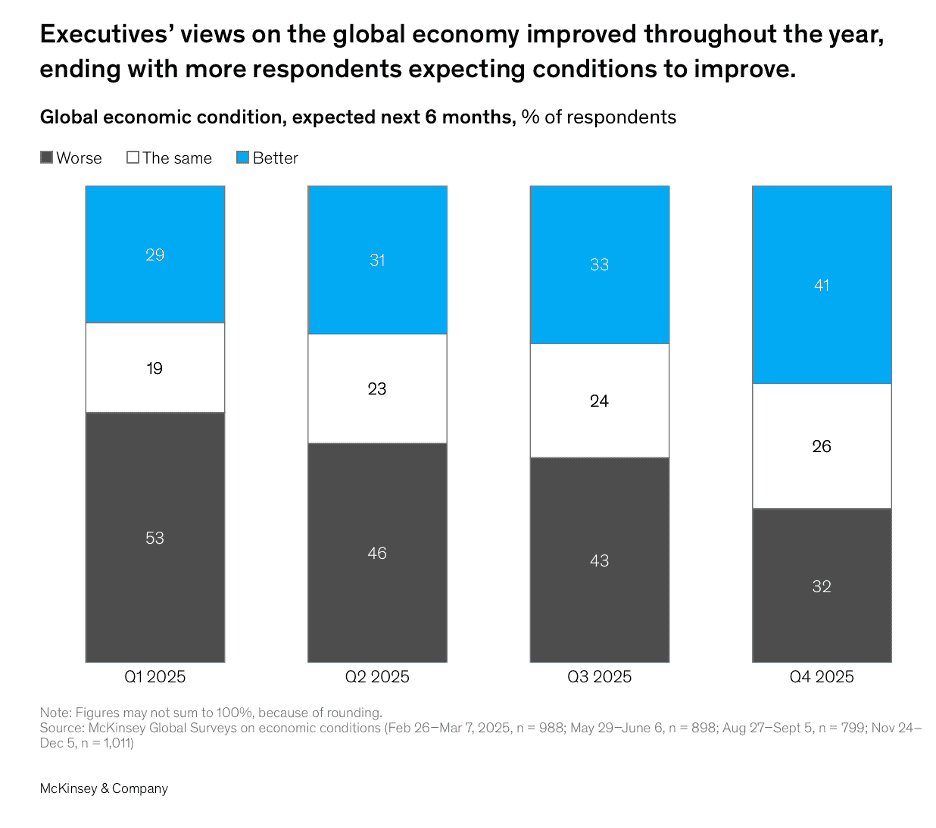
“Global Economics Intelligence executive summary, January 2026 – Overall global economic sentiment is improving, with businesses more positive about future growth in line with the IMF’s upward growth revisions; several central banks cut interest rates in December. After a year dominated by concerns over trade and global turbulence, businesses are entering 2026 with more optimism—despite continued uncertainty. Indeed, business sentiment was more buoyant in the final quarter of 2025 than in previous quarters, according to the recent McKinsey Global Survey on economic conditions. Executives were more upbeat about future economic expectations than they had been in previous 2025 surveys, with respondents expressing the brightest near-term expectations of the year—this in comparison with three previous quarters of largely negative assessments of current global economic and trade conditions.”, McKinsey & Co., February 24, 2026
Editor’s Note: This survey was published before the Iran event that started on February 28th.
===============================================================================================
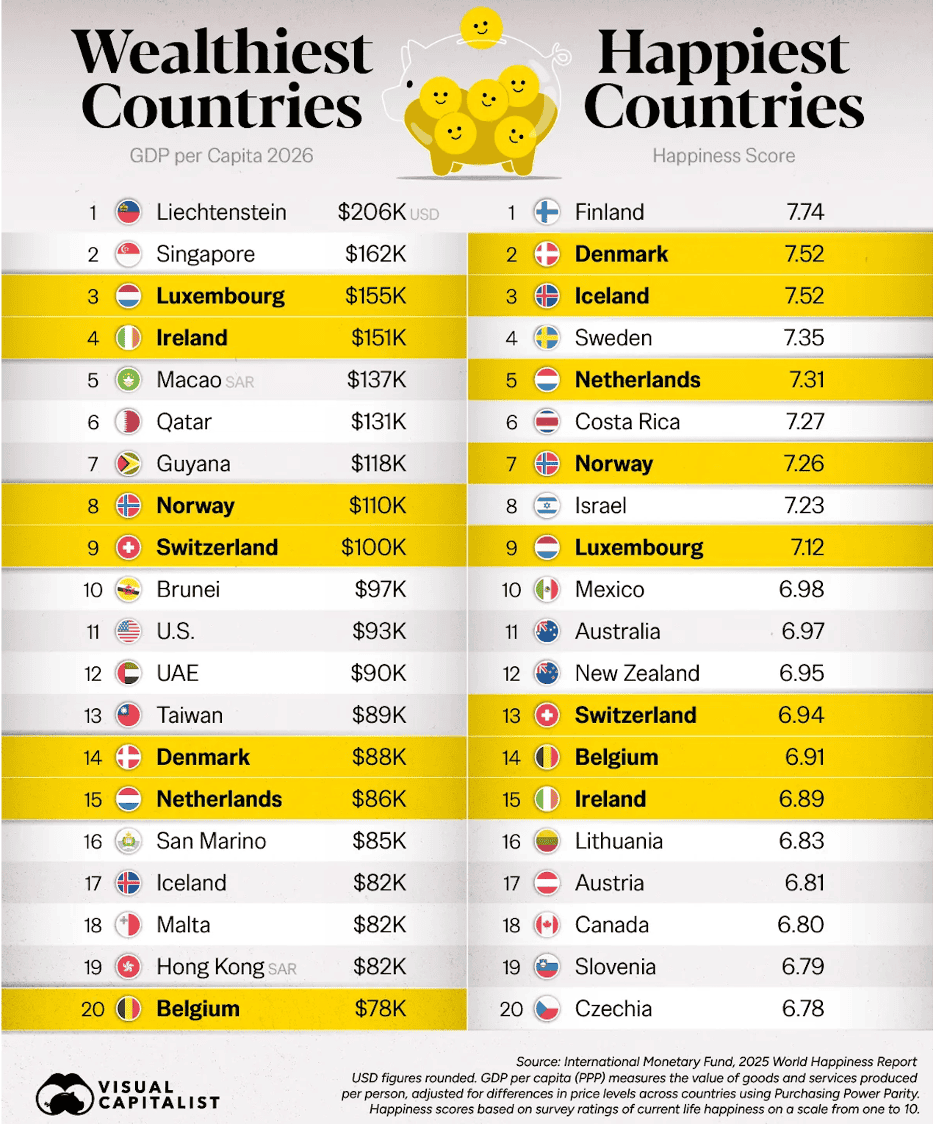
“The World’s Richest Countries vs. the Happiest Countries – Several Nordic countries rank among both the richest and happiest in the world. Some ultra-wealthy nations, including Singapore and Qatar, do not make the top 20 for happiness. Only a handful of countries appear near the top of both rankings. The world’s richest countries generate staggering income per person. But when it comes to life satisfaction, some of the wealthiest nations fall surprisingly short. This graphic compares GDP per capita (PPP), based on IMF data, with happiness scores from the World Happiness Report, which asks people to rate their lives on a scale from 0 to 10.”, Visual Capitalist, International Monetary Fund and the World Happiness Report, February 27, 2026
============================================================================================
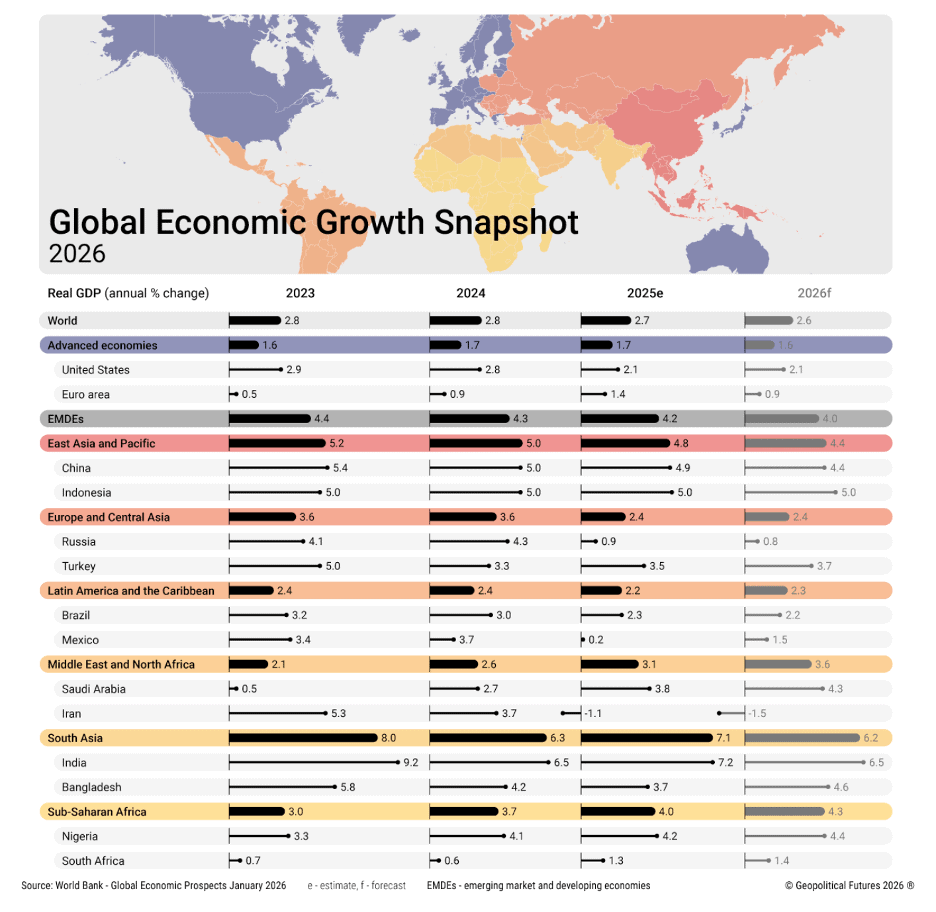
“Global Growth Expected to Slow in 2026 – 2025 could have been worse. According to the World Bank’s Global Economic Prospects report, the global economy in 2025 demonstrated greater resilience than expected, given trade tensions and political uncertainty, thanks to stronger-than-expected growth in the largest economies. To some extent, the surge of trade before the U.S. tariff hikes, as well as gradual monetary easing, supported economic activity. However, the World Bank does not see this hopeful trend continuing in 2026. As the favorable factors supporting the largest economies fade, the lagging impact of new trade barriers will come to the fore. This points to a continuation of trade tensions and policy uncertainty, leading the World Bank to forecast a decline in the rate of real GDP growth in several regions and economies.”, Geopolitical Futures, February 20, 2026
===============================================================================================
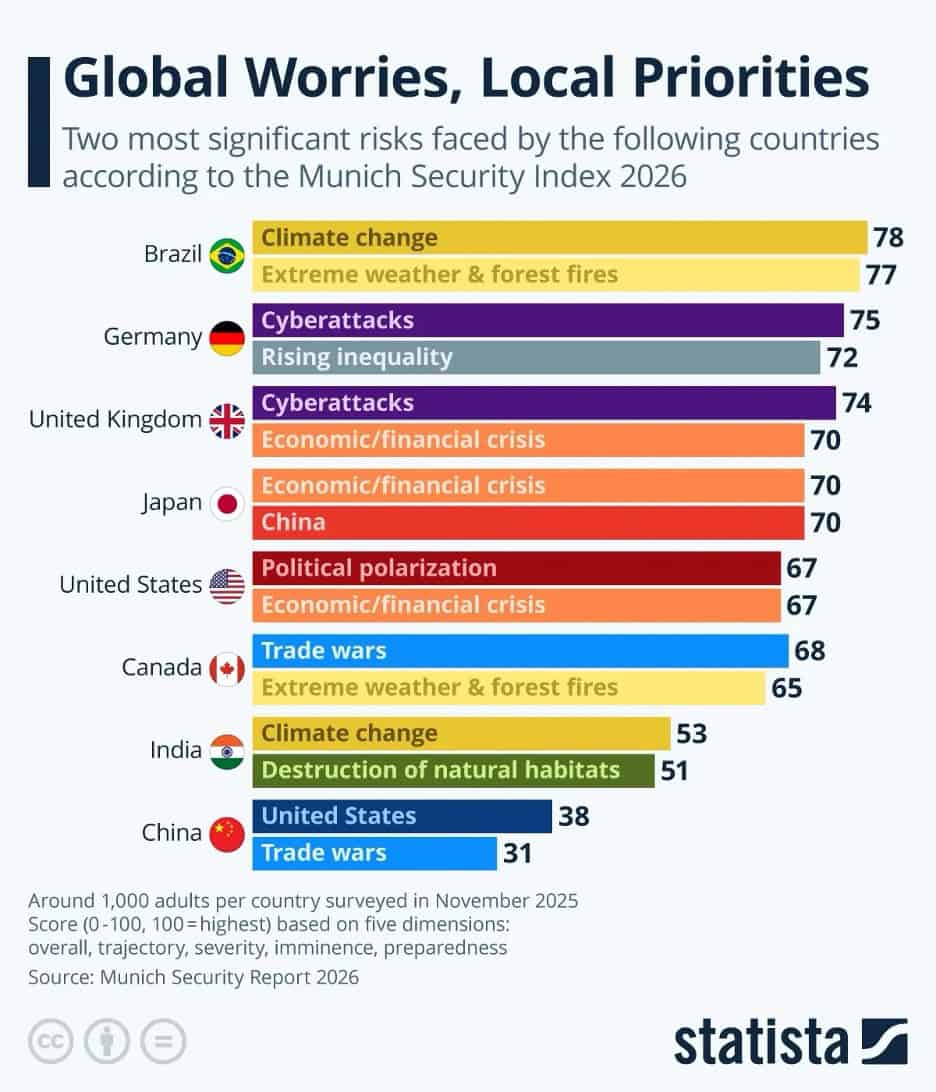
“Global Worries, Local Priorities – The Munich Security Index 2026 has unveiled divergence in the most pressing risks perceived by populations across the globe. Based on a survey of around 1,000 adults per country conducted in November 2025, the report highlights how different nations prioritize threats, ranging from climate change to geopolitical tensions. The index scores obtained (0 to 100) cover five dimensions of risks: overall impact, trajectory, severity, imminence and preparedness. In Brazil, concerns about climate change (index score=78), extreme weather and forest fires (77) top the list…. Similarly, India ranks climate change (53) and the destruction of natural habitats (51) as its primary worries….For Germany and the United Kingdom, cyberattacks (75 and 74, respectively) emerge as the foremost concern….Meanwhile, economic and financial crises are a shared priority in Japan (70), the United Kingdom (70) and the United States (67), while political polarization (67) is also seen as a major risk in America.”, Munich Security Report 2026, February 15, 2026
Editor’s Note: This report was released prior to the late February 2026 Iran conflict start
+++++++++++++++++++++++++++++++++++++++++++++++++++++++++++++++++++++++++++++++++++++++++++++++
Global Supply Chain, Energy, Commodities, Inflation, Taxes, Tariffs & Trade Issues
“Trump spares EU and UK from higher tariff rates for now – Tariffs on exports to the United States will remain at 10 percent. U.S. President Donald Trump has U-turned on his threat to raise his new global tariffs to 15 percent, sparing Britain and the European Union from higher rates. Trump’s decision not to follow through on the threat means continuity for British businesses. U.K. exports already faced 10 percent duties, plus Most Favored Nation (MFN) rates, under Trump’s “Liberation Day” tariffs.”, Politco EU, February 24, 2026
===============================================================================================
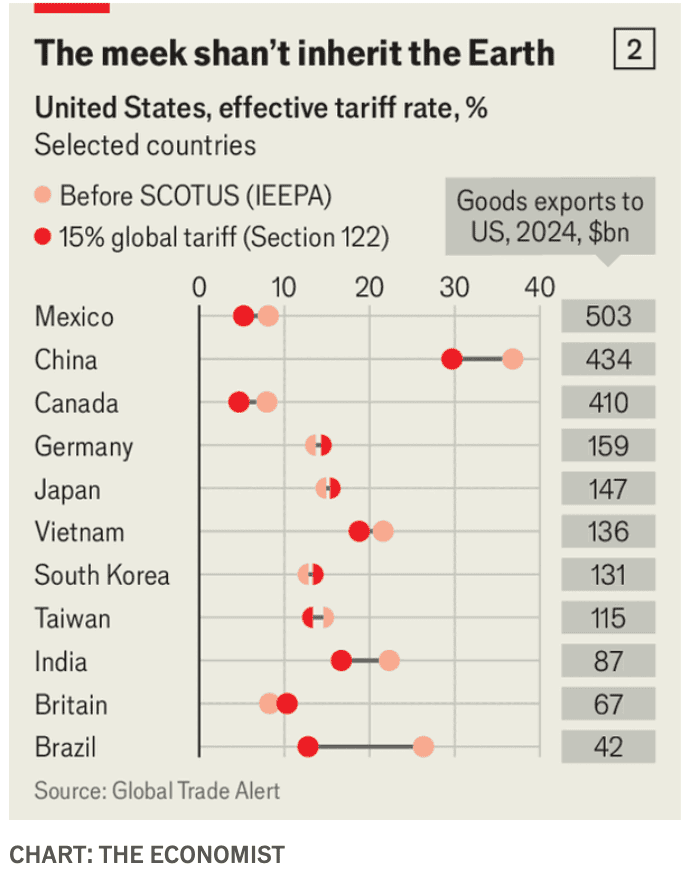
“America’s trade chaos is just beginning – Tariff wrangling will stretch through the rest of Donald Trump’s term, and beyond. On February 20th America’s Supreme Court struck down Donald Trump’s signature policy. The president claimed the International Emergency Economic Powers Act (IEEPA) of 1977 let him slap any tariffs he wanted on anyone for any length of time. The justices ruled 6-3 that Congress did not hide in IEEPA ‘a delegation of its birth-right power to tax within the quotidian power to ‘regulate’, as Chief Justice John Roberts wrote in the majority opinion. Within hours of the decision Mr Trump invoked Section 122 of the Trade Act of 1974, to levy 10% tariffs on all imports for 150 days from February 24th. The next day he said he would raise the level to 15%, the highest the law permits. Before the justices weighed in, America’s effective tariff rate was 13.7%, estimates the Yale Budget Lab. Swap IEEPA for Section 122 tariffs of 15% and this edges down to 12.2% (see chart 1). By comparison, the figure was 2-3% before Mr Trump took office for the second time in January 2025.”, The Economist, February 26, 2026
============================================================================================
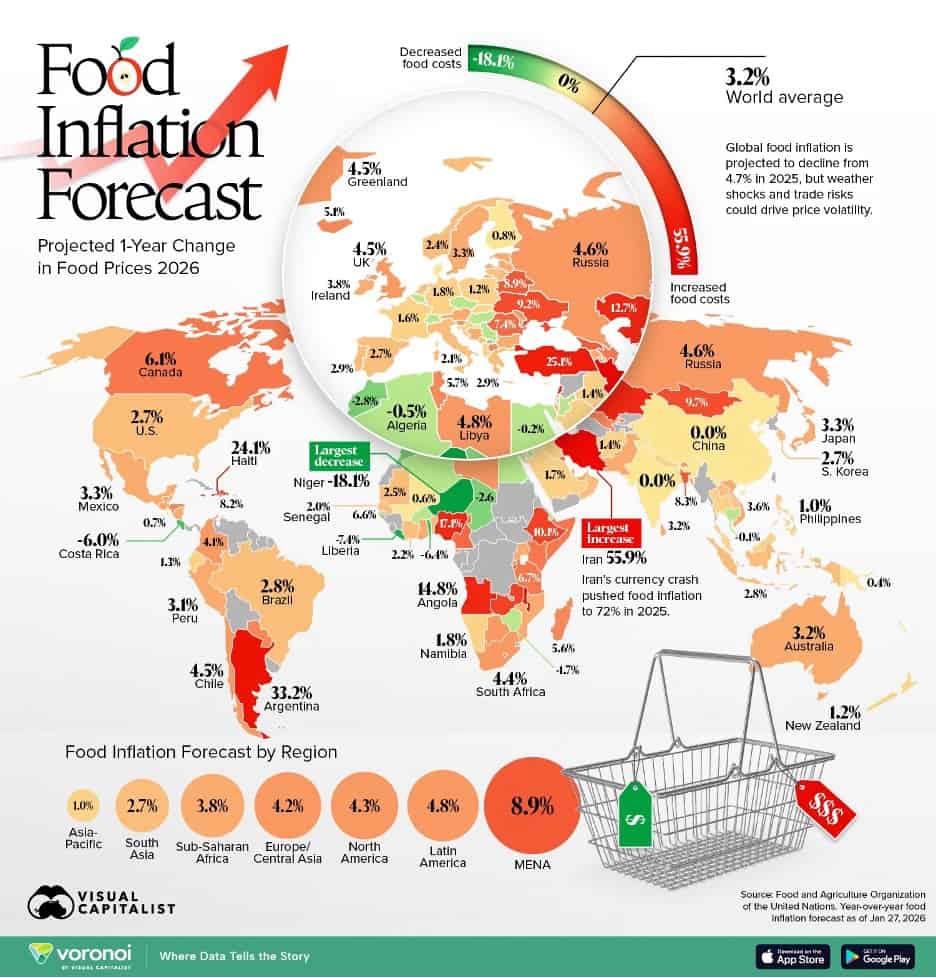
“Where Food Inflation Will Hit Hardest in 2026 – Iran tops the list with a projected 55.9% surge, far above the global average of 3.2%. Currency pressures and prior inflation spikes continue to ripple through food prices. Argentina (33.2%) and Türkiye (25.1%) rank second and third, continuing multi-year inflation trends in both economies. Countries like Malawi, Nigeria, Angola, Zambia, and Ethiopia all rank among the highest projected increases, underscoring ongoing food vulnerability in the region. Food prices remain one of the most persistent cost pressures for households worldwide. In 2026, grocery bills are projected to rise sharply in some countries, while remaining relatively stable in others. Food inflation is influenced by currency movements, commodity prices, trade disruptions, and domestic supply conditions. Countries experiencing currency depreciation or ongoing economic instability tend to see sharper increases in food costs.”, Visual Capitalist & Food and Agriculture Organization of the United Nations, February 25, 2026
===============================================================================================
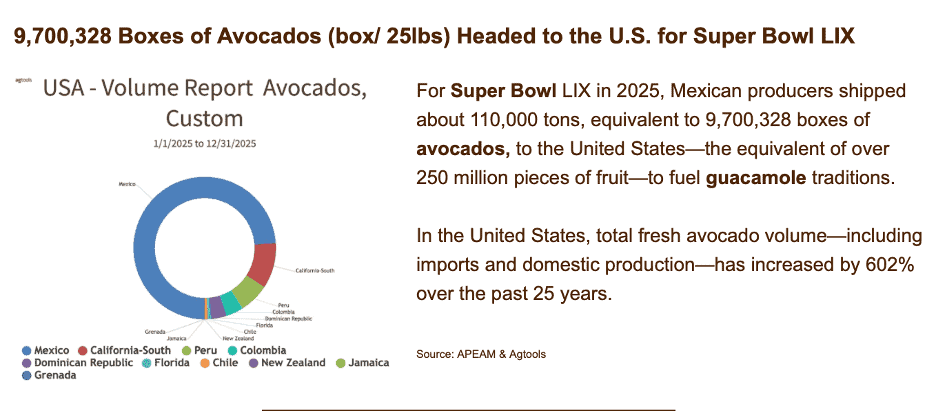
This really interesting infographic from 2025 is compliments of Martha Montoya, CEO of AgTools, Inc.
+++++++++++++++++++++++++++++++++++++++++++++++++++++++++++++++++++++++++++++++++++++++++++++++
Global & Regional Travel News
“Airspace closures across Middle East cause flight cancellations after strikes on Iran – The real-time flight tracking service FlightRadar24 showed airspace closures across the region on Saturday, including in the UAE, Qatar, Jordan, Iran, Iraq, Syria, Israel, Kuwait and Bahrain. Several major airports have suspended operations until further notice, including Dubai International Airport (DXB) — the world’s second busiest airport — Zayed International Airport (AUH) in Abu Dhabi and Hamad International Airport (DOH) in Doha. Though many other airports in the Middle East remain open, passengers should check with individual airlines for the latest updates before heading to the airport, as cancellations may vary. Both Gulf airlines and international carriers that fly through the region have issued travel waivers in light of the conflict, allowing passengers to easily change or cancel flights.”, The Points Guy, February 28, 2026
++++++++++++++++++++++++++++++++++++++++++++++++++++++++++++++++++++++++++++++++++++++++++++
Book Review
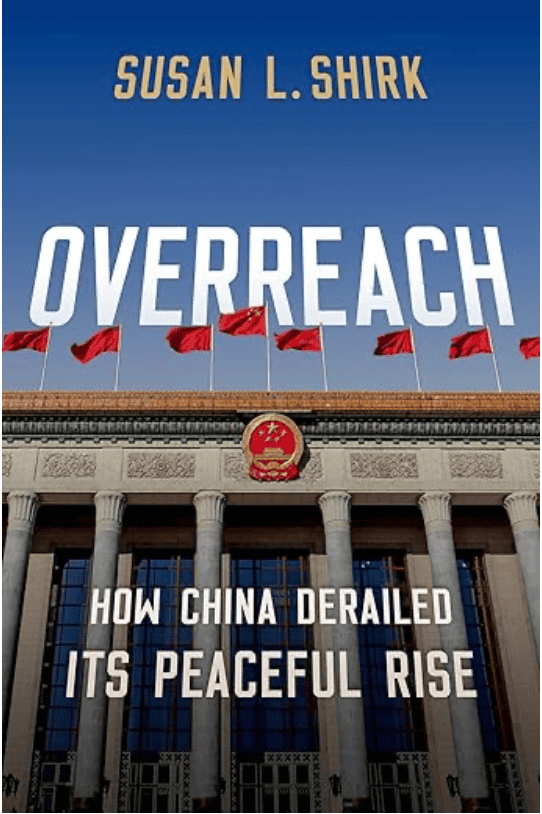
“In “Overreach: How China Derailed Its Peaceful Rise”, Dr. Susan L. Shirk, 2022, delivers one of the clearest explanations of how China’s carefully managed “peaceful rise” shifted into a far more assertive global posture. For decades, China’s rise to power was characterized by its reassurance that this rise would be peaceful. Then, as Susan L. Shirk, shows in this sobering, clear-eyed account of China today, something changed.
Drawing on decades of research and direct policy experience, she makes an important point: China’s current trajectory is not simply the product of one leader’s ambition. It reflects deeper institutional dynamics, domestic political pressures, bureaucratic competition, and rising nationalism that gradually reduced strategic restraint.
Shirk shows how China’s expanding economic and military power, combined with internal legitimacy concerns, produced policies that unsettled neighbors and hardened U.S. attitudes. Actions in the South China Sea, toward Taiwan, and through economic coercion accelerated distrust and fueled structural rivalry with the United States. What we are now experiencing is not a temporary diplomatic downturn. It is sustained strategic competition.
Her warning is equally important: misreading China’s internal drivers increases the risk of overreaction abroad — and miscalculation on either side. For global business leaders, that distinction matters. Today’s friction is rooted in long-term structural forces, not short-term political cycles.
That reality should shape how we assess risk, partnerships, supply chains, and long-term China exposure.
Five Takeaways for Global Business Leaders
1. China’s external behavior is heavily influenced by internal political dynamics.
2. Strategic rivalry with the United States is structural and likely enduring.
3. Economic interdependence no longer guarantees stability.
4. Domestic legitimacy pressures in Beijing affect global markets.
5. Miscalculation — more than ideology — is the principal risk to global business stability.
+++++++++++++++++++++++++++++++++++++++++++++++++++++++++++++++++++++++++++++++++++++++++++

+++++++++++++++++++++++++++++++++++++++++++++++++++++++++++++++++++++++++++++++++++++++++++++
Country & Regional Updates
Latin America
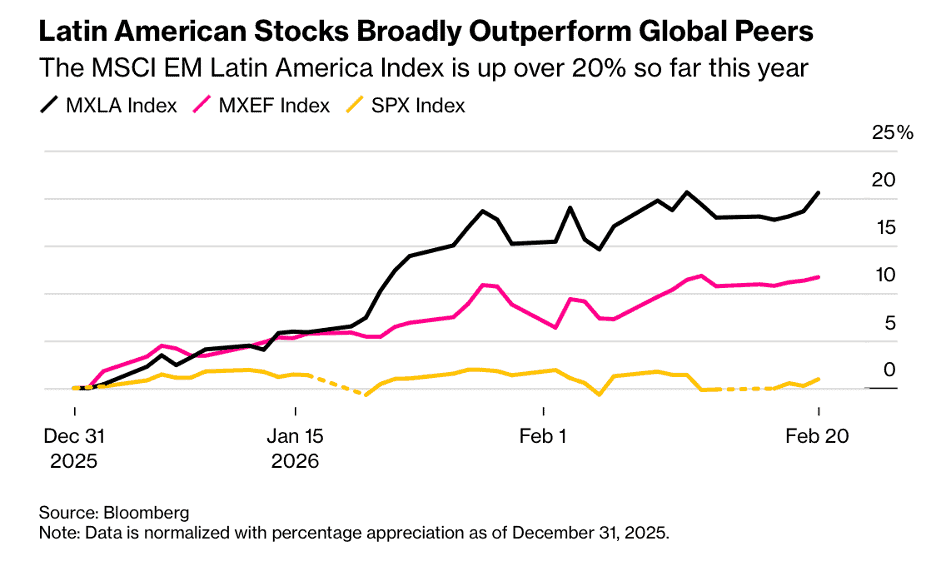
“Global Cash Is Fueling a Historic Start for Latam Stocks – Global investors are piling into Latin American stocks at the fastest clip in a decade, sending markets across the region to multi-year highs. The MSCI EM Latin America Index has jumped over 20% in 2026, marking the strongest start to the year since 1991, and has capped a ninth successive week of gains. Investors see potential for local policy shifts and lower interest rates ahead of presidential elections in Brazil and Colombia, and the strike-down of President Trump’s tariffs is another tailwind for the region’s equity revival.”, Bloomberg, February 22, 2026
=============================================================================================
Argentina
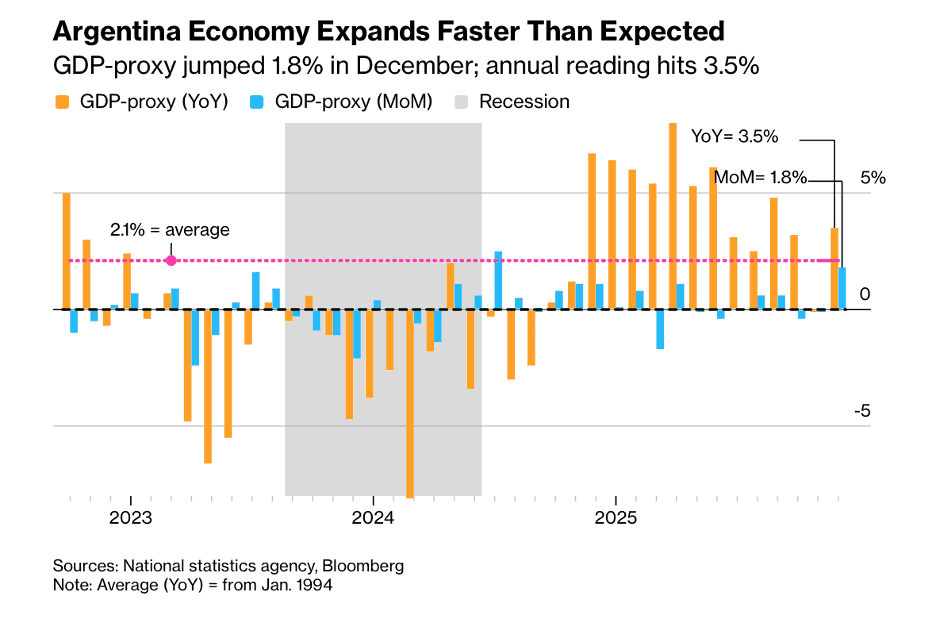
Argentina’s economy grew more than expected in December due in part to a historic wheat harvest that offset the fallout from a pivotal midterm election. From a year earlier, the economy grew 3.5%, far surpassing the estimate of zero growth from economists surveyed by Bloomberg. The data should provide some relief to President Javier Milei’s administration and bolster hopes for his macreoeconomic program. The farm and finance sectors contributed significantly to the economy’s growth in last year’s final month, while manufacturing and retail fell. Overall economic growth was slow last year as monthly activity expanded only 0.02% in the first 11 months of the year, according to a research note from Goldman Sachs Group Inc.”, Bloomberg, February 24, 2026
=============================================================================================
Southeast Asia
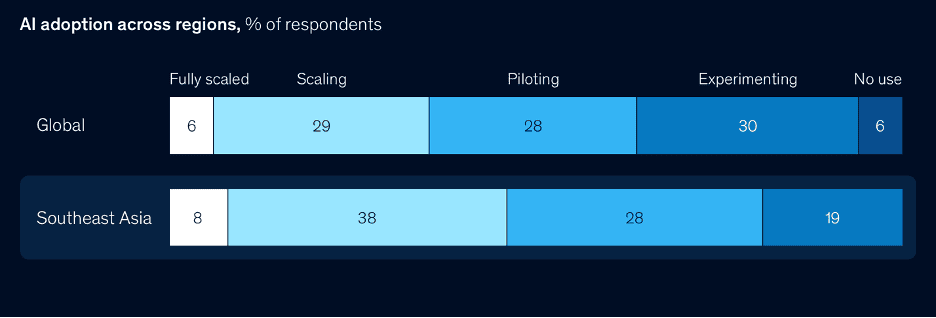
“AI in Southeast Asia: An era of opportunity – A region on the rise for
AI opportunities. AI adoption in Southeast Asia is at an inflection point—moving rapidly from exploration to deployment. With strong digital foundations, tech-savvy enterprises, and a young, connected population, the region’s major economies are accelerating toward global competitiveness. Nearly half of Southeast Asian companies surveyed have moved beyond AI pilots, putting the region slightly ahead of the global average. This momentum is driven by a mobile-first consumer base, skilled talent, and local solution providers—creating fertile ground for rapid AI scaling, despite limited policy intervention.”, McKinsey & Co., February 10, 2026
============================================================================================
Canada
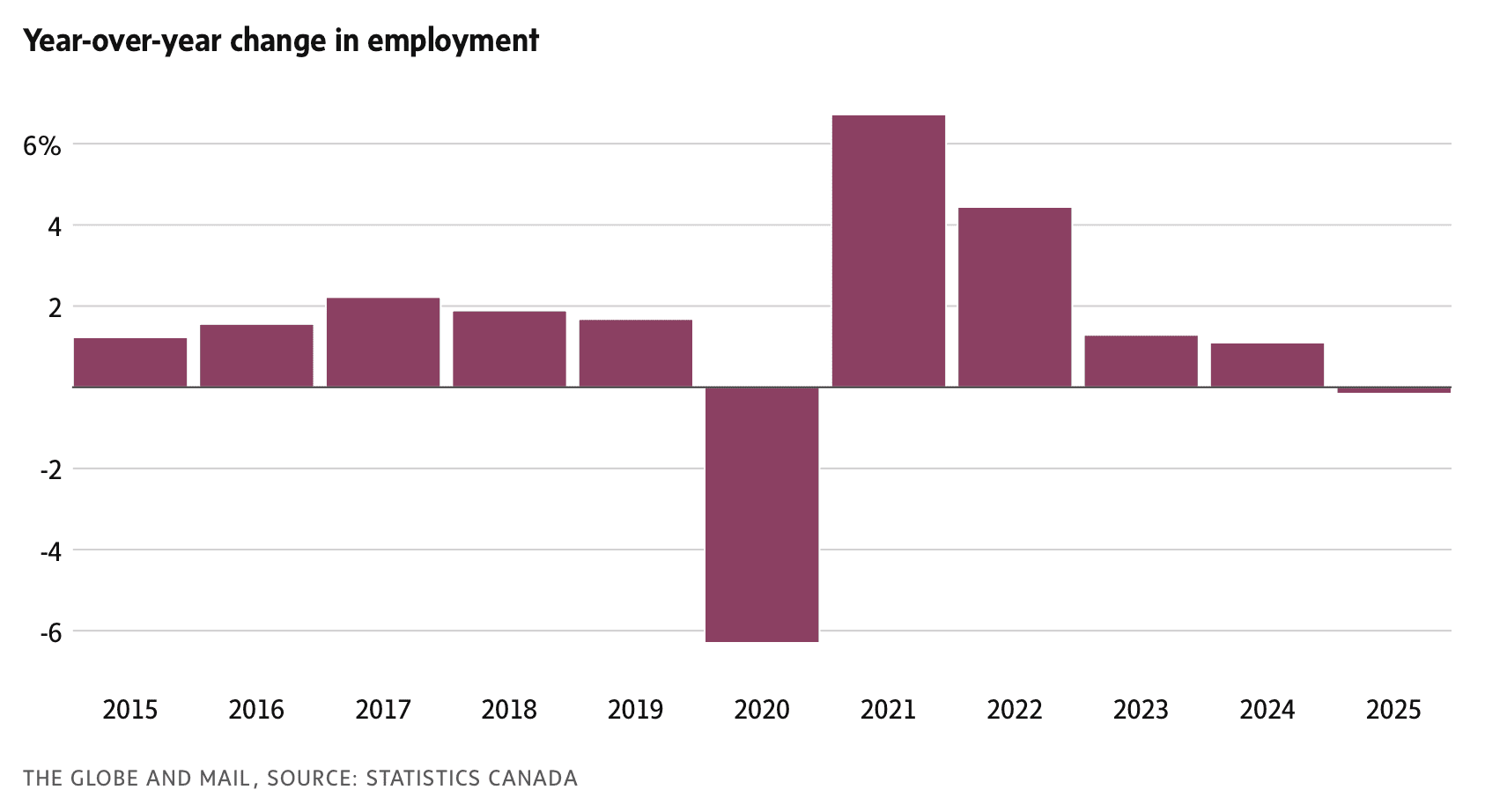
“Canadian job growth flatlines in 2025 on trade war, population slowdown – Canada’s job growth stalled in 2025 as key sectors of the economy, such as manufacturing, were hit hard by the trade war, weakening labour demand and prompting employers to shelve hiring plans. The number of employees nationwide receiving pay and benefits from an employer fell by 28,300 or 0.2 per cent last year, Statistics Canada reported on Thursday. At the same time, Canada’s population has started to decline because of major immigration policy changes that are aimed at reducing the number of temporary residents in the country.”, The Global and Mail, February 26, 2026
===========================================================================================
China
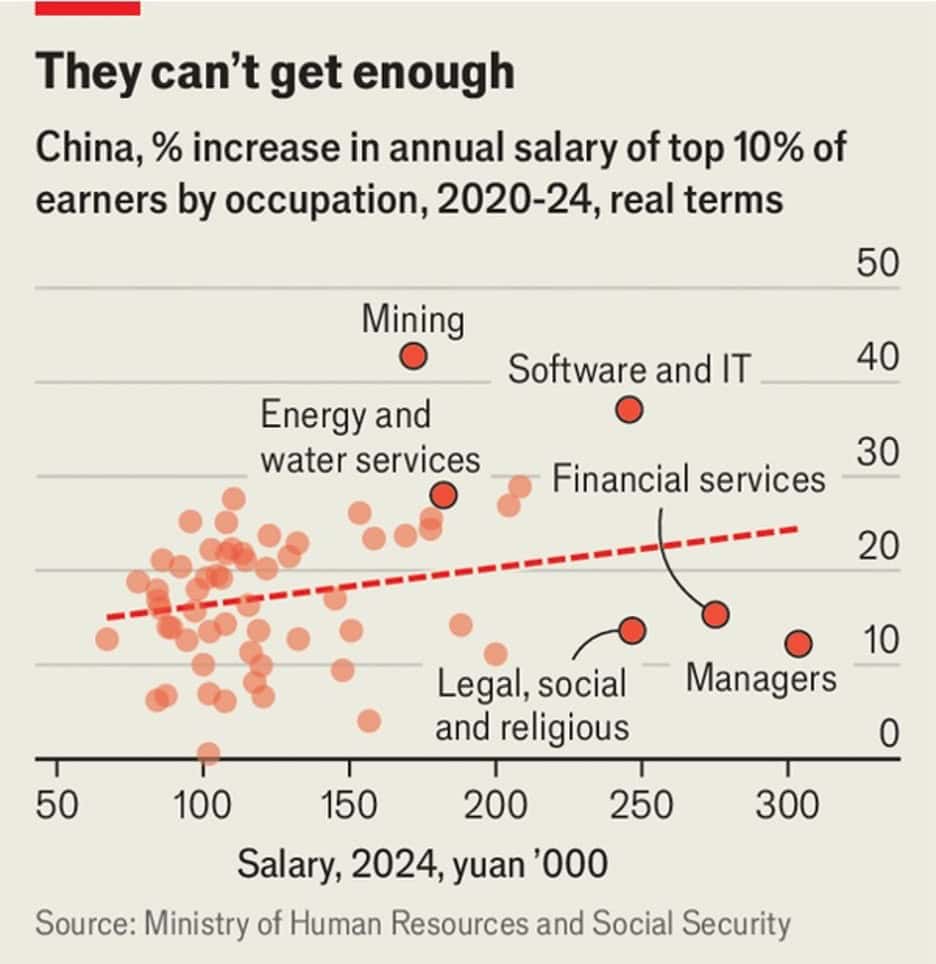
“How to get rich in modern China – Some of the country’s brightest are cashing in on a state-backed surge. A property bust and chronic deflation have eroded people’s assets, incomes and prospects. Residential property, where Chinese people store the bulk of their wealth, has lost a fifth of its value on average since 2021. Wage growth is weak. And youth unemployment is hovering around 17%. But in a sea of people losing, one group is winning. They are what Xi Jinping, China’s leader, calls nongchaoer: a Chinese term referring to those who “ride the tide” of great economic changes. Today that tide is flowing towards the strategic technologies, such as artificial intelligence and robotics, that dominate the country’s five-year plans for tech supremacy……Smart, young and sometimes from modest backgrounds, the nongchaoer do not flash their growing wealth.”, The Economist, February 24, 2026
============================================================================================
Europe
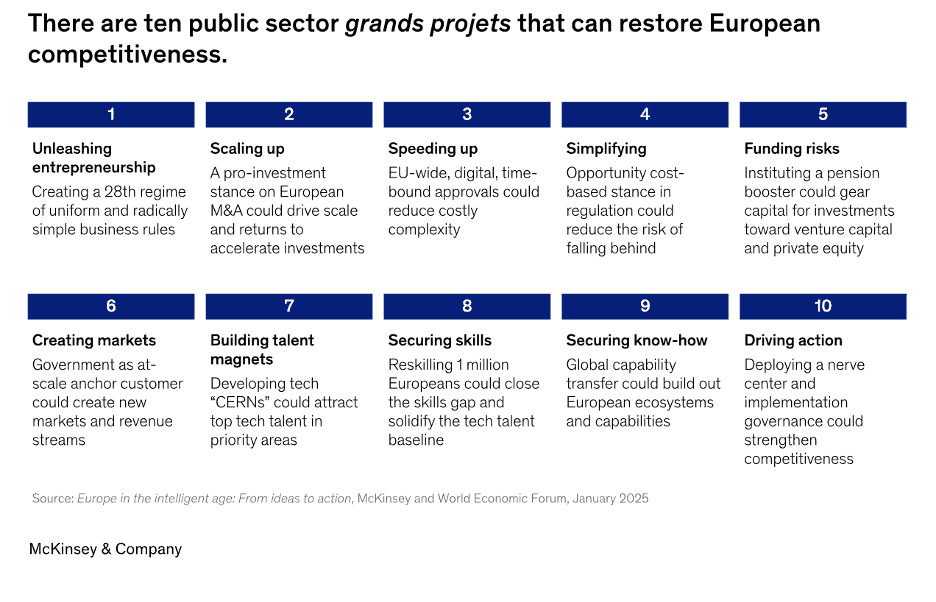
“Transforming Europe: Bold moves to lift a continent – Europe is starting to reform its investment environment, but there’s no time to lose. Standout companies can take the lead with bold strategic moves that drive their own performance—and a continent’s. This article extends our analysis of the critical contribution companies can make to a European economic renaissance, including through a more strategic approach to collaborating with the public sector to shape the investment environment. Such an economic renaissance would benefit everyone. As the McKinsey Global Institute argues in its new book, A Century of Plenty, it is economic growth and rising incomes that enable many of the things Europeans care about: better health and education outcomes, better physical and social infrastructure, investments into climate change mitigation and adaptation, and investments into security and sovereignty. With growing consensus on what’s needed, now’s the time for both sides to accelerate.”, McKinsey & Co., January 20, 2026
=============================================================================================
South Korea
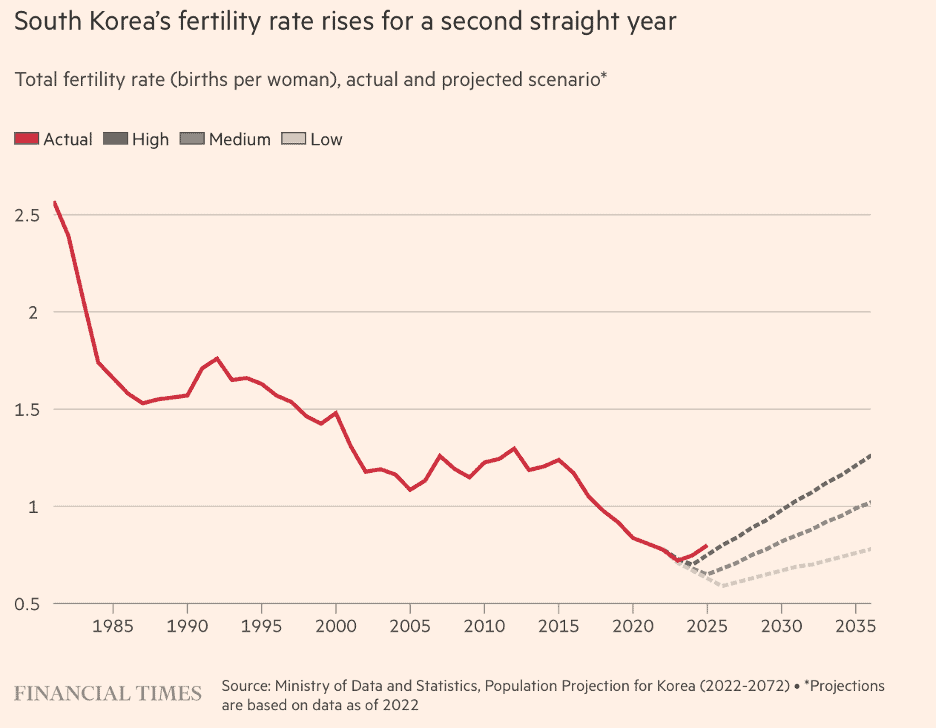
“South Korea baby bump grows – Fertility rate and total births rise for second year but experts say demographic outlook remains gloomy. Korea’s total fertility rate — the average number of children a woman is expected to have over her lifetime — climbed to 0.8 last year, up from 0.75 in 2024 and an all-time low of 0.72 in 2023, official data released on Wednesday showed. The figure was better than even the government’s most optimistic projections for 2025 but remains far below the 2.1 threshold that demographers consider necessary to maintain a stable population, absent net immigration. South Korea has been grappling with a long-term demographic crisis, as an ageing and shrinking population raises pensions and healthcare costs and hits projections for economic output.”, The Financial Times, February 24, 2026
============================================================================================
Turkey
“Turkey M&A Volume Surges as Mega Deals Rebound, Deloitte Says – A total of 450 transactions were completed in 2025, up 6% from 2024, with the total deal size increasing 88% to $16.2 billion. The upswing was driven by mega deals, with seven transactions valued at more than $500 million representing 44% of the total deal size. Financial investor activity more than doubled in Turkey in 2025, with total transaction value rising 109% to $4.6 billion. Larger deals were fueled in part by improving investor confidence, which eased the way for companies and financiers to revive previously postponed plans, Deloitte said. The largest deal of the past year was the $1.7 billion privatization of Turkey’s Vehicle Inspection Stations by the MOI Consortium.”, Bloomberg, February 23, 2026
=============================================================================================
United States
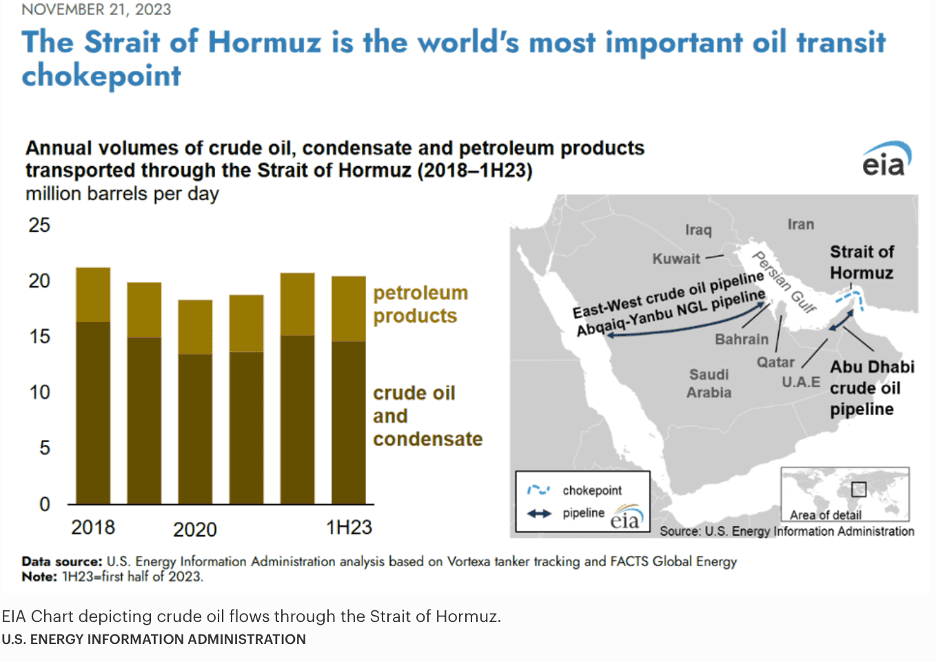
“Gasoline Prices Will Rise – But How High And For How Long? Amid the myriad uncertainties created by the new conflict in the Middle East region, the one thing we can be sure of is that gasoline prices at the pump will go up in the United States and around the world. The only real questions in that regard are: How high will they go, and how long will they linger? However, in this current conflict in which the United States and Israel are involved in a kinetic exchange with Iran, a single factor holds the key. That single factor is the Strait of Hormuz, the choke point at the mouth of the Persian Gulf through which 20-25% of global crude supply flows onto the global market every day, and whether Iran might mount a successful attack to shut that flow down.”, Forbes, February 28, 2026
=============================================================================================
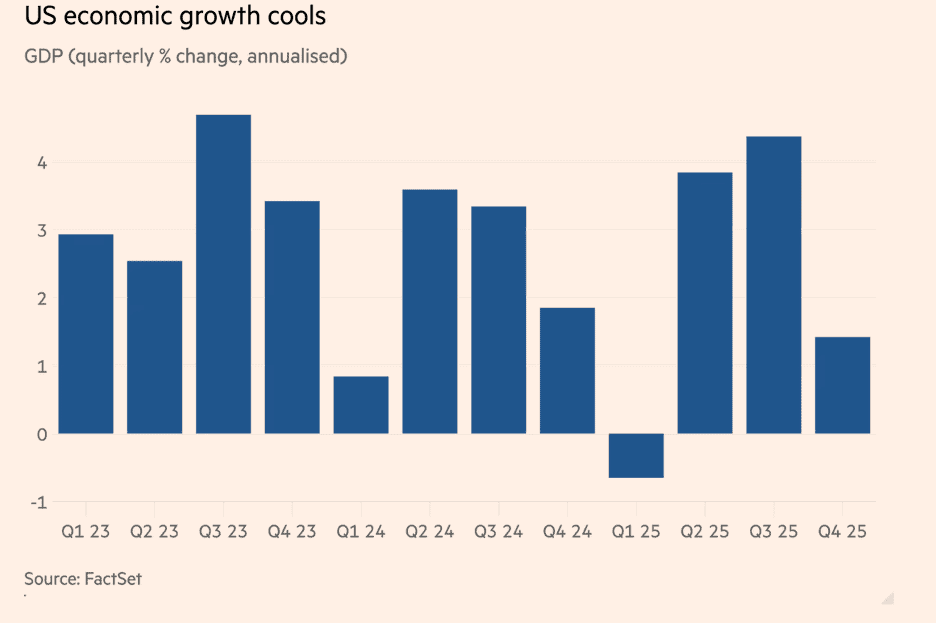
“US GDP growth falls sharply to 1.4% rate in fourth quarter – Figure hit by drop in government spending during federal shutdown comes in far below analysts’ expectations. Friday’s figure from the Bureau of Economic Analysis was sharply down from 4.4 per cent in the previous three-month period and fell well short of expectations of 2.8 per cent in a Bloomberg poll of economists. It comes after an unprecedented 43-day federal government shutdown in October and November that the BEA said knocked a point off growth. A slowdown in consumer spending also weighed on GDP, offset slightly by an uptick in business investment.”, The Financial Times, February 20, 2026
============================================================================================
Vietnam
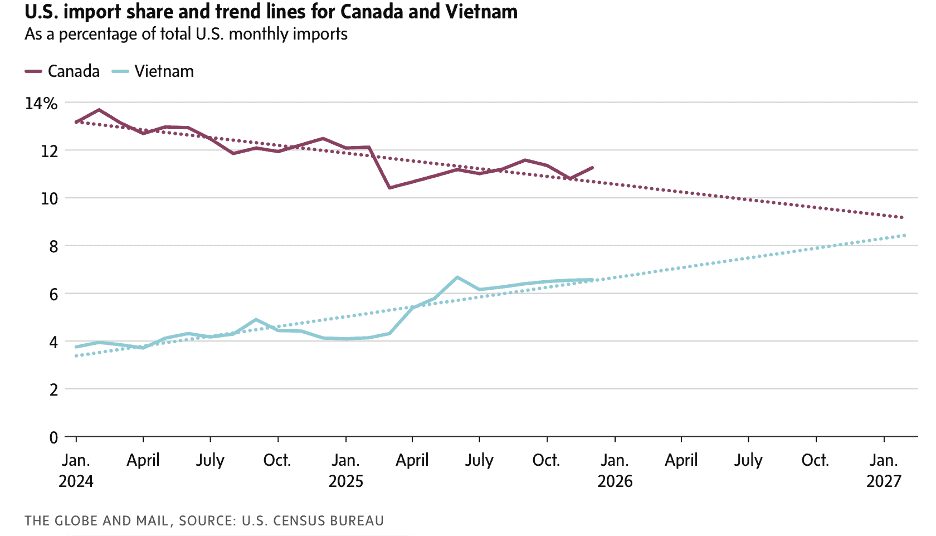
“Vietnam is on track to overtake Canada as a source of U.S. imports – While U.S. tariffs have hammered Canada’s export sector, Vietnam has emerged a surprising winner in the trade dispute, despite facing an effective tariff rate four times higher than that of Canada. In fact, if the current trajectory of U.S. imports holds, Vietnam could surpass Canada as a share of U.S. imports, highlighting the fraying trade links between Canada and the United States. Under the Trump 1.0 and Biden administrations, the U.S. sought to lessen its reliance on China for low-cost imports through the use of tariffs and other trade restrictions. As such, manufacturers shifted a lot of production to Vietnam instead. Last year, Vietnam’s exports to the U.S. soared 42 per cent to US$194-billion, while U.S.-bound shipments from Canada declined 7 per cent to US$383-billion.”, The Global and Mail, February 27, 2026
++++++++++++++++++++++++++++++++++++++++++++++++++++++++++++++++++++++++++++++++++++++++++++++

The Accredited Franchise Supplier certification
+++++++++++++++++++++++++++++++++++++++++++++++++++++++++++++++++++++++++++++++++++++++++++++
Global Brand & Franchise Sector News
“Papa Johns is closing 300 restaurants and cutting staff – The pizza chain’s North America same-store sales have fallen for seven of the past eight quarters. It is cutting 7% of its workforce while closing underperforming restaurants and eliminating menu items. Papa Johns CEO Todd Penegor also said that the chain is planning ‘at least $25 million in cost savings outside of marketing’ through 2027, with $13 million expected this year. Penegor said that the company is changing its organizational structure to ‘increase efficiency and simplify operations’. The company is dealing with a pizza market that has been weak for the past two years along with a fast-food environment that itself has been challenged as customers, burdened by inflation, reduce visits.”, Restaurant Business, February 26, 2026
================================================================================================
“KFC’s secret weapon in U.S. comeback could be its strength in global markets – The European market may especially hold clues to how the U.S. business can reassert its iconic status back home. KFC’s U.S. business closed 2025 on a high note, marking 1% same-store sales growth for the fourth quarter after enjoying 2% comps in the third quarter. The House That Colonel Sanders Built has roughly 34,000 locations worldwide that earned $36.4 billion in sales in 2025. Only 13% of its sales came from the U.S.; 27% came from China, 12% from Europe, and 11% from the rest of Asia. Latin America, which made up 8% of KFC’s sales last year, had the strongest growth with its 12% system sales increase, while Africa was the next-fastest growing market with 10% system sales growth in 2025. The U.S. was the only market with negative sales.”, NRN, February 17, 2026. Compliments of Paul Jones, Jones & Co., Toronto
=============================================================================================
“Dine Brands Increases Focus on Traffic, Value Amid Ongoing Consumer Caution – The company’s operational improvements across its business are boosting traffic and sales trends. ‘Guests remain highly intentional about how they spend their discretionary dollars,’ (Chief Executive John Peyton) said. ‘Value remains a critical driver in that decision-making.’ Against that backdrop, the owner of Applebee’s Neighborhood Bar + Grill and IHOP said it has doubled down on value, focusing on portion size, food quality and overall experience, in addition to price. Dine Brands has also emphasized shorter wait times and better service, manager visibility in dining rooms and improved off-premise order accuracy, alongside stepped-up marketing and new menu items. Dine Brands forecast a mid-single-digit increase in commodity costs at Applebee’s as well as a low-single-digit increase at IHOP.”, The Wall Street Journal, February 25, 2026
++++++++++++++++++++++++++++++++++++++++++++++++++++++++++++++++++++++++++++++++++++++++++++++
To receive our biweekly newsletter in your email every other Tuesday, click here – https://insider.edwardsglobal.com
+++++++++++++++++++++++++++++++++++++++++++++++++++++++++++++++++++++++++++++++++++++++++++++++
Our Mission, Information Sources & Who We Are
Our biweekly global business update newsletter focuses on what is happening around the worldthat impacts new trends, health, consumer spending, business investment, the franchise sector, economic development, and travel. We daily monitor 30+ countries, 40+ international information sources and six business sectors to keep up with what is going on in this ever-changing business environment. And our GlobalTeam™ on the ground covering 25+ countries provide us with updates about what is actually happening in their specific countries. We do not get involved in or report on politics!
+++++++++++++++++++++++++++++++++++++++++++++++++++++++++++++++++++++++++++++++++++++++++++
William “Bill” Edwards: CEO & Global Trade Advisor “Is Uniquely Qualified to Steer Sr. Executives Successfully Through the Complex Waters of Going Global”. With five decades of successful international business experience spanning virtually every corner of the world and many business sectors, Bill Edwards understands the global business landscape like no other. He has been a County Master Franchisee in five countries in Asia, Europe, and the Middle East; the Senior VP for a franchisor operating in 15 countries and a full-service global management consultant since 2001 helping 40+ franchisors expand into new countries. Bill knows how to turn the challenges in taking a brand global into opportunities.

For a complimentary 30-minute consultation on how to take your business into new countries successfully. For a complimentary call with Bill Edwards click on the QR code or contact Bill at bedwards@edwardsglobal.com and +1 949 375 1896
And download our latest chart ranking 40+ countries as places to do business, used by many companies for strategic planning, at this link: