Biweekly Global Business Update Newsletter
The Geowizard Biweekly Global Business Update Newsletter has moved to Substack
To read the full newsletter please visit the new location of our now 6-year-old biweekly newsletter at: https://geowizard.substack.com
Where did ‘Geowizard’ come from? Click here to find out:
+++++++++++++++++++++++++++++++++++++++++++++++++++++++++++++++++++++++++++++++++++++++++

+++++++++++++++++++++++++++++++++++++++++++++++++++++++++++++++++++++++++++++++++++++++++++++
William “Bill” Edwards: CEO & Global Trade Advisor “Is Uniquely Qualified to Steer Sr. Executives Successfully Through the Complex Waters of Going Global”. With five decades of successful international business experience spanning virtually every corner of the world and many business sectors, Bill Edwards understands the global business landscape like no other. He has been a County Master Franchisee in five countries in Asia, Europe, and the Middle East; the Senior VP for a franchisor operating in 15 countries and a full-service global management consultant since 2001 helping 40+ franchisors expand into new countries. Bill knows how to turn the challenges in taking a brand global into opportunities.

For a complimentary 30-minute consultation on how to take your business into new countries successfully. For a complimentary call with Bill Edwards click on the QR code or contact Bill at bedwards@edwardsglobal.com and +1 949 375 1896
And download our latest chart ranking 40+ countries as places to do business, used by many companies for strategic planning, at this link:
Our latest GlobalVue™ 40 country ranking
Biweekly Global Business Update Newsletter, Issue 158, Tuesday, April 14, 2026
Geopolitical instability overshadows all other perceived economic risks
Welcome to the 158th Edition of the Biweekly Global Business Update – Global business leaders are now operating in an environment where geopolitical risk is no longer a background variable. It is the primary driver of economic outcomes. From energy concentration to shifting trade geometry, the data in this issue reinforces a clear conclusion: the global business model is being structurally reshaped in real time.
This is our first issue to be published on Substack. In this issue we cover the following topics, among many others, focused on bringing the world’s current important business trends to our subscribers from our daily research into over 40 global business information sources:
- Half the World’s Oil Comes From Just Five Countries
- Geopolitics and the geometry of global trade: 2026 update
- Global economy to slow in 2026, and outlook clouded by war, other uncertainties
- CEOs Now Have to Predict the Unpredictable on Iran
- US oil exports to hit record as Iran war triggers race for supplies
- EU’s largest economies vs top US states: How do they compare in GDP?
- Oil-Rich Latin America Lures Traders Navigating War Jitters
- Global democracy is in better shape than you think
- Asia Is Open for Business, If You Know How to Read It
- “Genius at Scale: How Great Leaders Drive Innovation” – book review
========================================================================================
To read the full newsletter please visit the new location of our now 6-year-old biweekly newsletter at: https://lnkd.in/g6VcZQxA
And we are changing the name of the newsletter to Geowizard Global Business Update.
Where did ‘Geowizard’ come from? Click here to find out:
+++++++++++++++++++++++++++++++++++++++++++++++++++++++++++++++++++++++++++++++++++++++++
+++++++++++++++++++++++++++++++++++++++++++++++++++++++++++++++++++++++++++++++++++++++++++++
William “Bill” Edwards: CEO & Global Trade Advisor “Is Uniquely Qualified to Steer Sr. Executives Successfully Through the Complex Waters of Going Global”. With five decades of successful international business experience spanning virtually every corner of the world and many business sectors, Bill Edwards understands the global business landscape like no other. He has been a County Master Franchisee in five countries in Asia, Europe, and the Middle East; the Senior VP for a franchisor operating in 15 countries and a full-service global management consultant since 2001 helping 40+ franchisors expand into new countries. Bill knows how to turn the challenges in taking a brand global into opportunities.
For a complimentary 30-minute consultation on how to take your business into new countries successfully. For a complimentary call with Bill Edwards click on the QR code or contact Bill at bedwards@edwardsglobal.com and +1 949 375 1896
And download our latest chart ranking 40+ countries as places to do business, used by many companies for strategic planning, at this link:
Our latest GlobalVue™ 40 country ranking
Biweekly Global Business Update Newsletter, Issue 157, Tuesday, March 31, 2026
“The increase of disorder creates the demand for order.”
Welcome to the 157th Edition of the Biweekly Global Business Update – This issue updates our readers on oil import dependency by country, Internet freedom around the world, global AI adoption, global life expectancy, Strait of Hormuz, global LNG shipments, global fertilizer shipments, gold’s fall in 2026, global M&A deals, global jet fuel soars, surging Africa fuel imports, Asis crude oil imports, Canada and Cuba economic challenges, the USA’s competitive edge and where the USA exports. A special book review as always and franchise sector news about Jollibee®, Nothing Bundt Cakes®, Red Lobster® and Krispy Kreme®.
This edition’s book review highlights: “Story Business: Why Stories Rule the World and How They Can Reinvent Your Business” by Gavin McMahon. In Story Business, Gavin McMahon makes a compelling—and highly practical—argument that many global executives still underestimate: the companies that win are not always those with the best strategies, but those that tell the best stories.
A special letter to my 4,435 Current Subscribers:
For 6 years since the initial issue in March 2020, I have published this Bi-weekly Global Business Update Newsletter, sharing curated global intelligence with global business leaders who need to understand how international events affect their companies. Today marks my 157th edition. Thank you for being a subscriber!
In today’s environment of tariffs, geopolitical conflict, and rapidly shifting global alliances, timely global intelligence is not optional for internationally minded companies. It is essential. Given what the world is experiencing in global trade as I write this edition, my newsletter is far timelier than I thought would be when it started in the middle of COVID 6 years ago this month.
Every two weeks I review dozens of international sources and combine them with my own analysis of global trade, geopolitics, franchising, and economic trends. I also review a different book for each issue with takeaways for global businesspeople. The goal has always been straightforward: help executives see what is really happening around the world before it impacts their business. Not just what is on the evening news.
Over the past 156 editions, this newsletter has grown to more than 4,400 readers worldwide and is regularly cited and summarized by industry publications and senior international executives.
However, producing a high-quality global briefing requires a significant investment of time – 20-30 hours per edition – intense research, and access to numerous paid international information sources. After many years of publishing the newsletter as a complimentary resource, I will be moving the Bi-weekly Global Business Update Newsletter to a subscription model on Substack beginning with the 158th edition on April 14th.
For US$10 per month or US$100/year, subscribers will receive:
- 26 Bi-weekly Global Business Update Newsletter issues per year
- A quarterly proprietary Global Business Trends Report with analysis and forward-looking insights for 40 countries
- Continued access to the curated global intelligence many of you have relied on for 6 years
A brief word of background for those who may be newer readers: I have spent more than five decades working internationally, living in China, the Czech Republic, Hong Kong, Indonesia, Iran, and Turkey, and directing projects across many business sectors in more than 50 countries. I have developed and maintain an extensive networks of senior contacts. Today I serve as CEO and Global Advisor at Edwards Global Services and have helped over 50 companies expand into international markets. The perspective in this newsletter comes directly from that real-world experience working in global markets.
If the Bi-weekly Global Business Update Newsletter has helped you stay informed about global business and geopolitical trends, I hope you will consider becoming one of the founding subscribers who ensures its continuation.
Subscribe here: https://geowizard.substack.com/subscribe
Thank you for reading my newsletter and for your continued interest in using it to successfully navigate the ‘excessively interesting’ global business landscape we live in today.
Best regards,
William (Bill) Edwards
CEO & Global Business Advisor
Edwards Global Services, Inc.
bedwards@edwardsglobal.com
+++++++++++++++++++++++++++++++++++++++++++++++++++++++++++++++++++++++++++++++++++++++++++++
The mission of this newsletter is to use trusted global and regional information sources plus our network of 20+ in-country Associates to update our global readers on key global and local trends that can impact the success of their businesses at home and abroad. We subscribe to about 40 international information sources to keep our readers up to date on the world’s business. We do not get involved with or report on politics!
PLEASE NOTE: Some of the information sources that we provide links to in our newsletter require a paid subscription to directly access them. Clicking on a link may not give the reader access to the content.
Sunce March 2020, this newsletter has been assembled, edited and curated by: William (Bill) Edwards, CEO & Global Business Advisor, Edwards Global Services, Inc. (EGS), Irvine, California, USA and the EGS GlobalTeam™ in several countries. Contact Bill with questions, comments and contributions. Bedwards@edwardsglobal.com, +1 949 375 1896
++++++++++++++++++++++++++++++++++++++++++++++++++++++++++++++++++++++++++++++++++++++++++++
Here is a link to our current and past newsletters: https://edwardsglobal.com/geowizard/
+++++++++++++++++++++++++++++++++++++++++++++++++++++++++++++++++++++++++++++++++++++++++++++
First, A Few Words of Wisdom From Others For These Times
“The increase of disorder creates the demand for order.”, Adlai Stevenson
“Even if you are on the right track, you’ll get run over if you just sit there.”, Will Rogers
“Do what you can, with what you have, where you are”, President Theodore Roosevelt
+++++++++++++++++++++++++++++++++++++++++++++++++++++++++++++++++++++++++++++++++++++++++++
Highlights in issue #157:
The World’s Energy Safety Net Is Buckling
Freedom On The Internet Around The World
Six breakthrough business models reshaping (Asian) growth
Iran Conflict Sparks Global Rush For Critical Fertilizers
Gold’s Safe-Haven Status Is Failing Its Biggest Test
The Americas lead global trade deals
Franchise Global News Update Section: Jollibee®, Krispy Kreme®, Nothing Bundt Cakes® and Red Lobster®
++++++++++++++++++++++++++++++++++++++++++++++++++++++++++++++++++++++++++++++++++++++++++++
Interesting Data, Articles and Studies
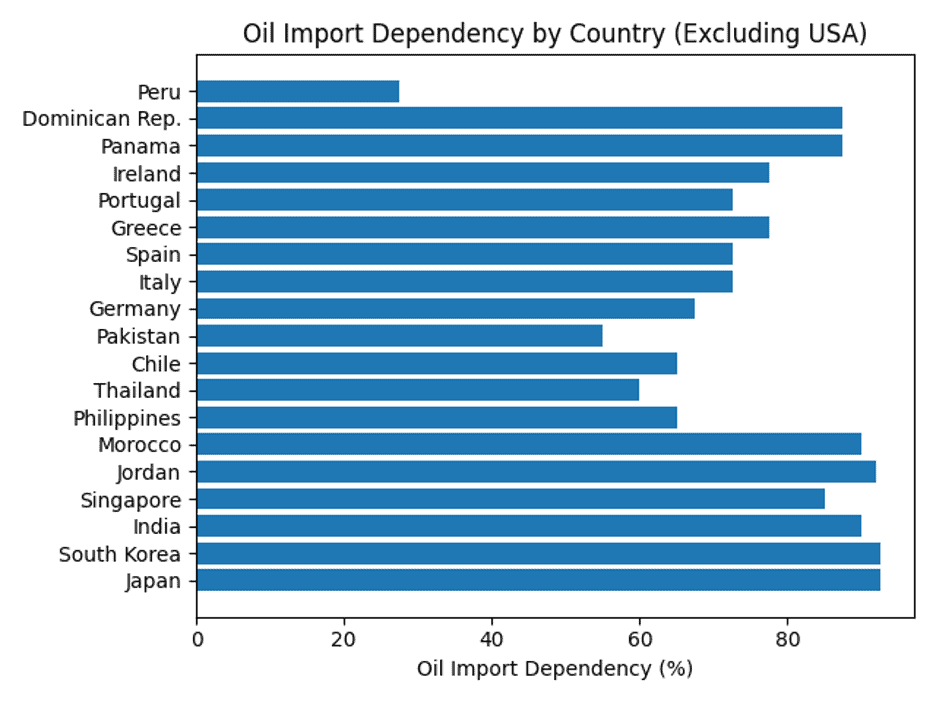
The chart shows the percentage of oil that is imported by these countries. This analysis is based on data from the International Energy Agency (IEA), U.S. Energy Information Administration (EIA), and Eurostat, March 20, 2026
Editor’s Note: Going forward there will be more of this basic research in the Edwards Biweekly Global Business Update Newsletter. This research is from several online data sources.
===============================================================================================
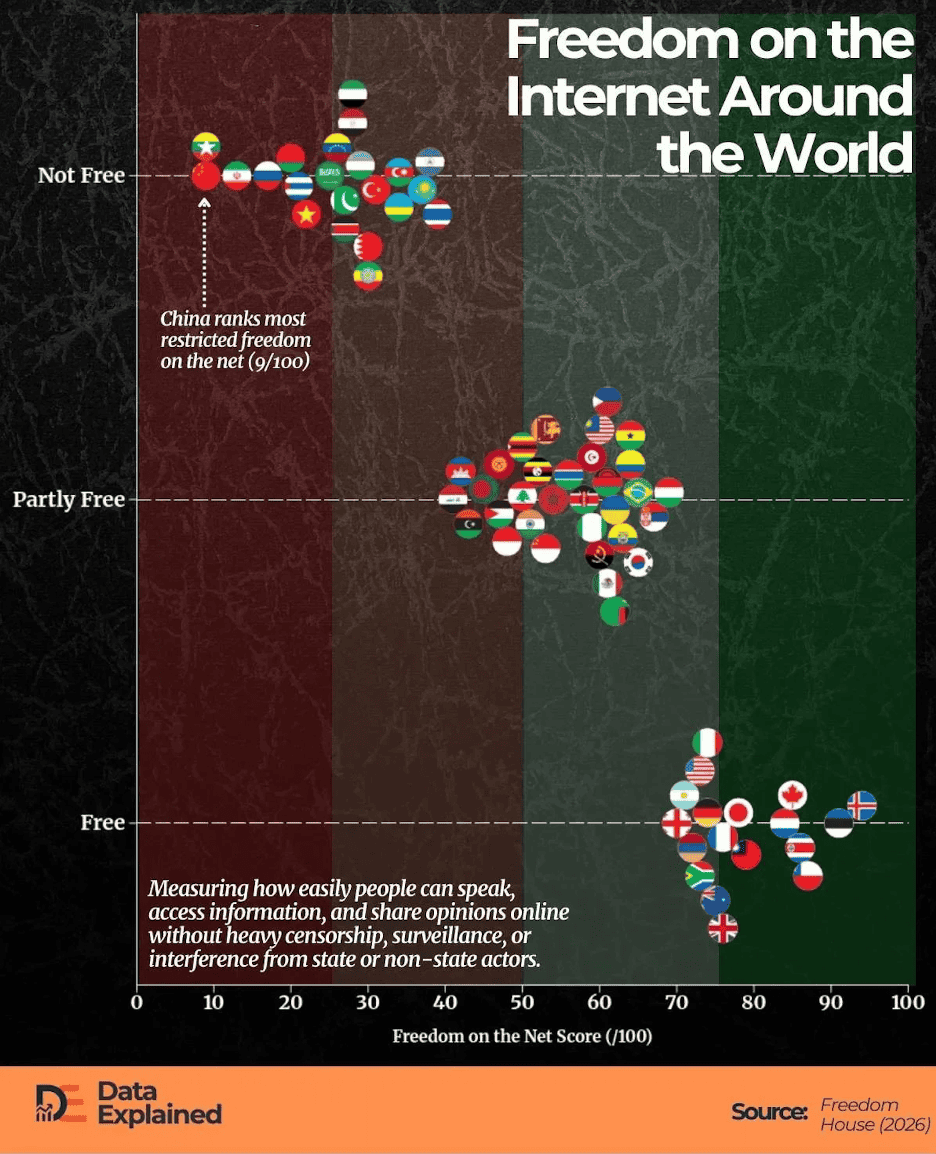
“Freedom On The Internet Around The World – Iceland Tops Global Internet Freedom; China, Myanmar Rank Lowest. The Internet Freedom Index measures how easily people can speak, access information, and share opinions online without heavy censorship, surveillance, or interference from state or non-state actors……“Freedom on the Net” tracks political and civil liberties in 70 countries, measuring internet freedom through classifications of “Free”, “Partly Free”, or “Not Free”. China and Myanmar are the most restricted, scoring 9/100 with no improvement from last year. South Korea is partly free at 65 and on a downward trend. India shows an upward climb at 51, indicating a recent improvement in digital rights.”, Visual Capitalist & Freedom House, March 17, 2026
============================================================================================
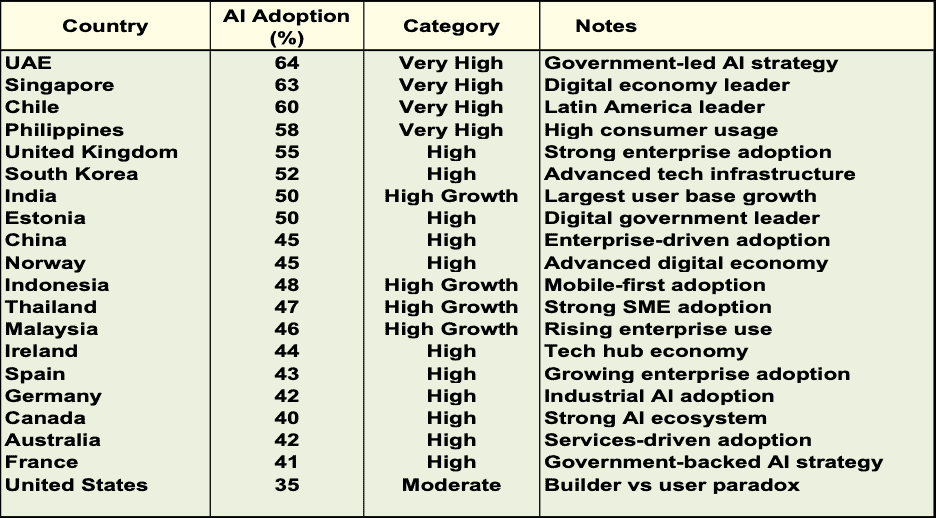
This analysis is based on data from Stanford’s AI Index, Microsoft’s global adoption studies, and McKinsey’s enterprise surveys. This analysis is focused on surveys of large enterprise companies in each country, March 28
============================================================================================
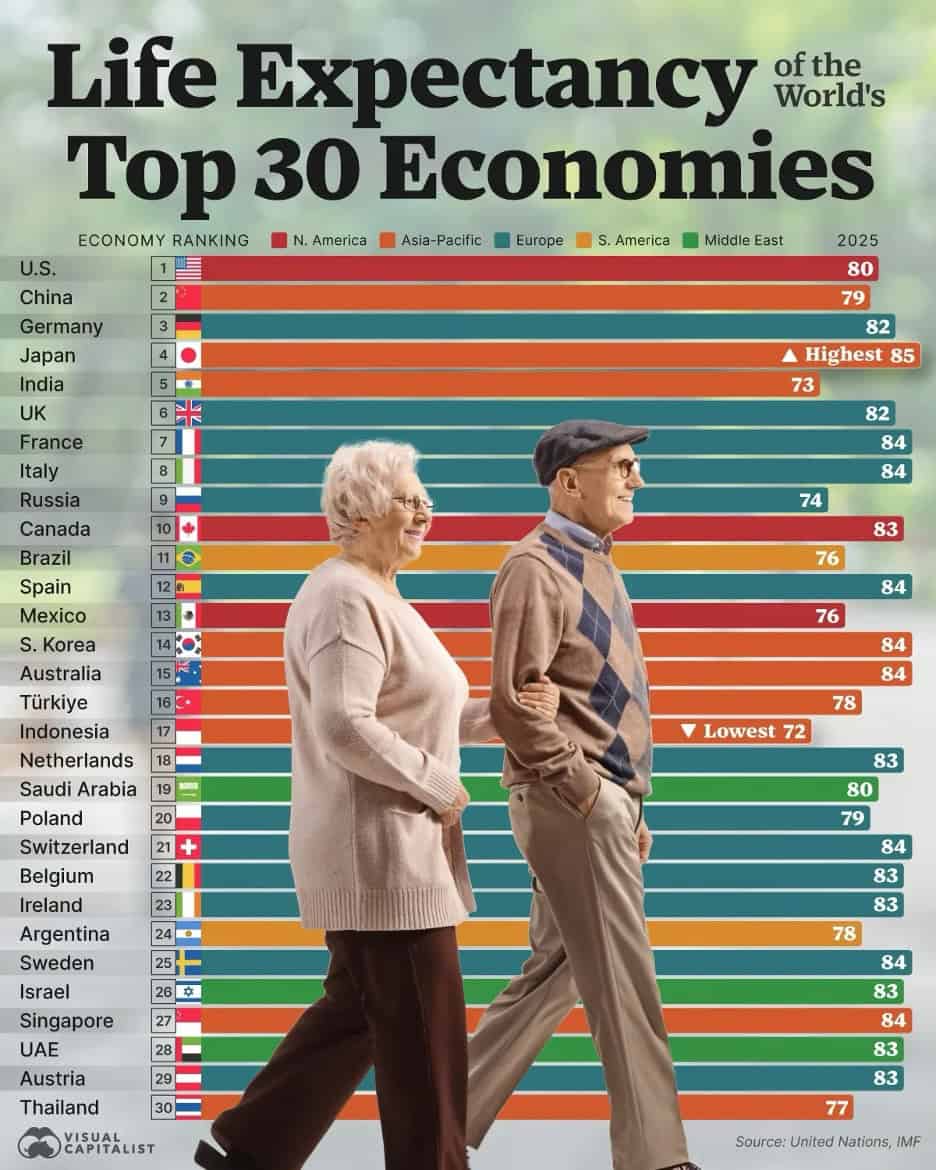
“Comparing Life Expectancy in Major Economies – This graphic shows life expectancy by country across the world’s 30 largest economies, based on data from the United Nations. GDP data was drawn from the International Monetary Fund. Japan has the highest life expectancy among the world’s largest economies, at 85 years. Indonesia, ranked 17th globally by GDP in 2025, has the lowest life expectancy at 72 years.”, Visual Capitalist and the United Nations and the IMF, January 27, 2026
==============================================================================================
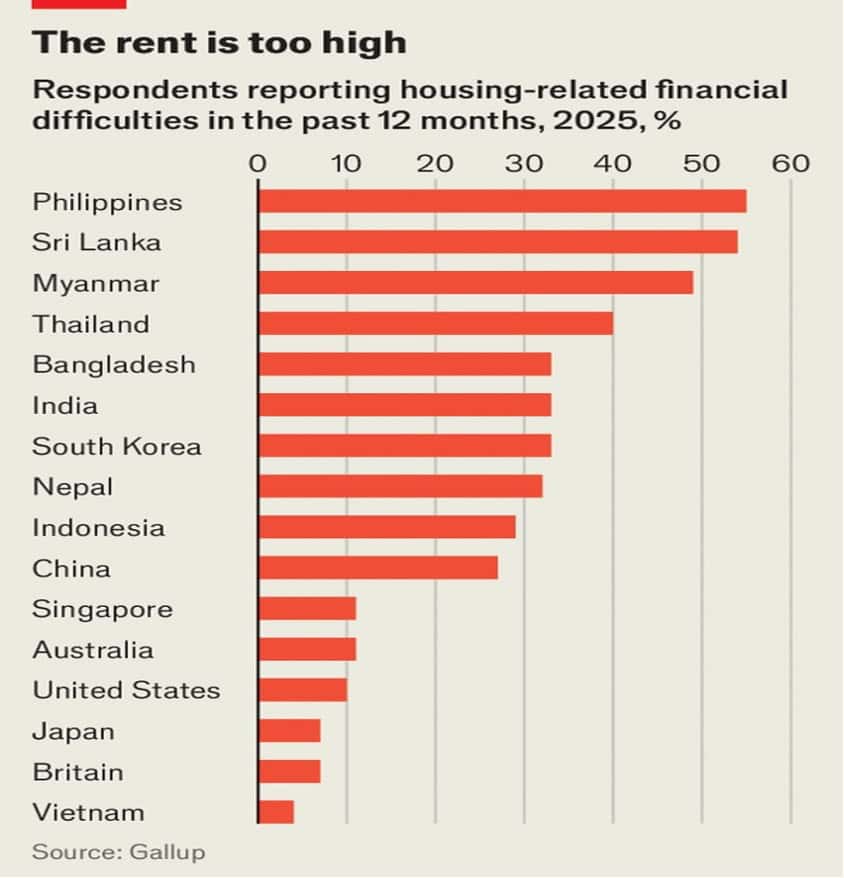
“The world’s most unaffordable housing is not where you think – Asia’s great cities will founder without more reasonably priced homes. Cities in developing countries such as India, Indonesia and the Philippines are gaining hundreds of millions of people. This urbanisation is only getting started. In South Asia, for example, barely 35% of the population is urban, compared with 80% in North America. Yet problems in Asia’s great metropolises are mounting. The likes of Delhi, Jakarta and Manila suffer from awful pollution, traffic and crime. The greatest challenge is a shortage of decent and affordable housing.”, The Economist, March 25, 2026
++++++++++++++++++++++++++++++++++++++++++++++++++++++++++++++++++++++++++++++++++++++++++++++
Global Supply Chain, Energy, Commodities, Inflation, Taxes, Tariffs & Trade Issues
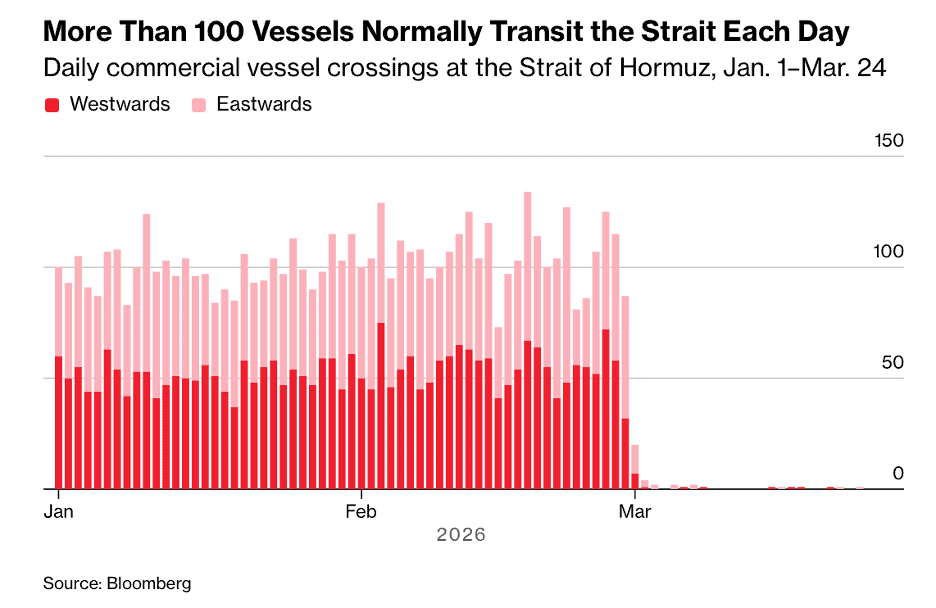
“EU Sees Risk of Stagflation Shock for Europe From Iran War – The European Union economy is at danger of enduring low growth combined with high inflation because of the war in the Middle East, according to Commissioner Valdis Dombrovskis. A shorter conflict would push up inflation by 1 percentage points this year, while a more severe scenario could add as much as 1.5 percentage points, according to Dombrovskis and people familiar with the matter. The European Commission “stands ready to work closely with member states to design policy measures at national level to mitigate impact of high energy prices,” Dombrovskis said. European capitals have already started to downgrade their forecasts due to the fallout from the war and the near-total closure of the Strait of Hormuz.”, Bloomberg, March 27, 2026
=================================================================================================
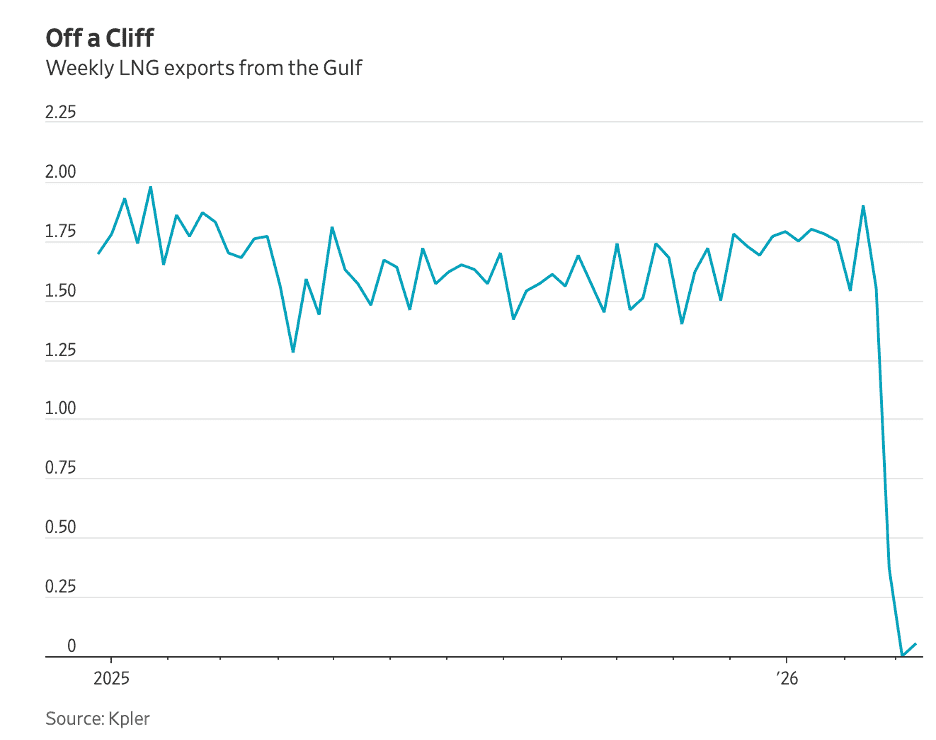
“The World’s Energy Safety Net Is Buckling – The Iran war has hit every node in the supply chain for liquefied natural gas. The war in Iran has fractured every node of the regional LNG supply chain. Iranian strikes on Qatar, one of the world’s top LNG producers, have damaged its Ras Laffan facility, knocking out some 17% of its capacity for up to five years, and delayed the country’s massive expansion plans. Meanwhile, shipping through the Strait of Hormuz, which usually carries around a fifth of global LNG, is paralyzed.”, The Wall Street Journal, March 25, 2026
===============================================================================================
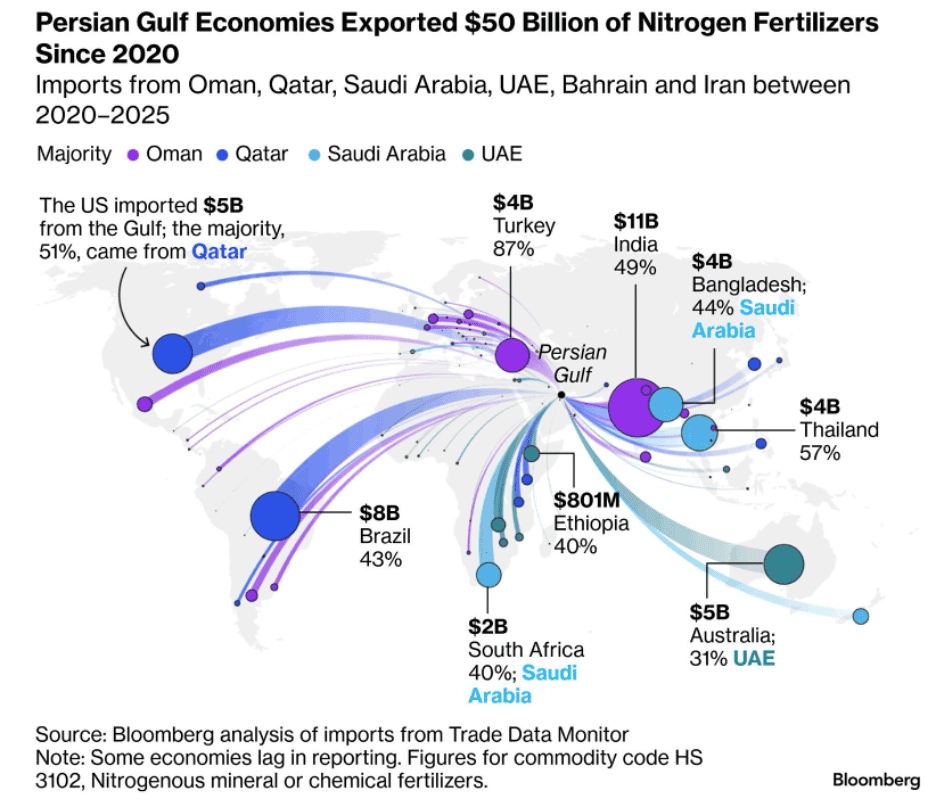
“Iran Conflict Sparks Global Rush For Critical Fertilizers – A third of global fertilizer supply passes through the Strait of Hormuz, while gas from the region is crucial to production of nutrients for global agriculture. The US and Israel’s attacks on Iran and Tehran’s retaliation have disrupted supplies of fertilizer, causing farmers worldwide to rush to secure critical nutrients. The conflict has come at a sensitive moment for global agriculture, with the cost of fertilizers already high and farmers in the northern hemisphere about to begin fertilizing their fields. If the disruption continues, it could add to inflationary pressures and affect output of critical crops, with consumers worldwide likely to feel the impact, particularly in countries in the global south.”, Bloomberg, March 6, 2026
============================================================================================
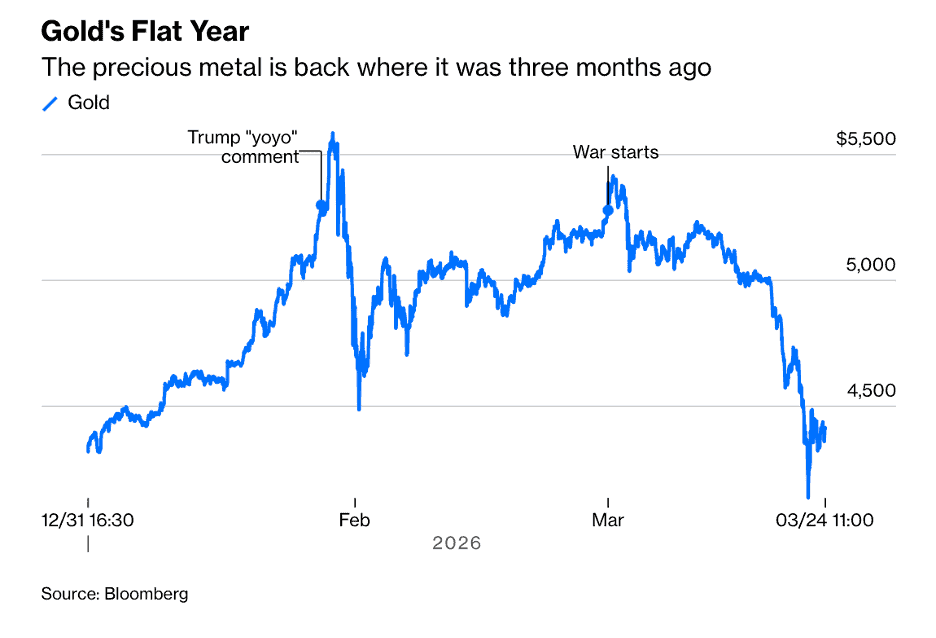
“Gold’s Safe-Haven Status Is Failing Its Biggest Test – The war in the Middle East has revealed that gold isn’t much of a haven. It’s almost exactly the opposite. The metal has lost about a fifth of its value since it surged to an all-time high in late January. The simplest explanation of this selloff then, as Gavekal’s Charles Gave and Louis-Vincent Gave note, is that gold was massively overbought in the lead-up to the war. In a period of market dislocation, overbought assets get hurt; people wanted to take profits, of which there were many in gold.”, Bloomberg, March 24, 2026
===============================================================================================
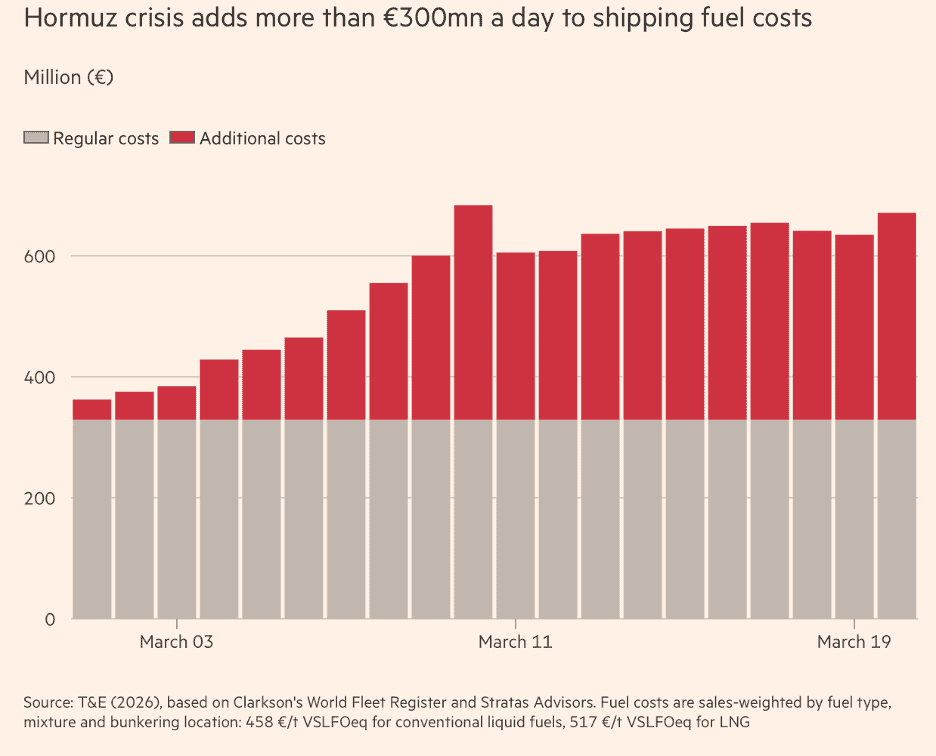
“Ships forgo cargo to carry fuel as Iran war sends prices soaring – Ships have been forgoing cargo in order to take shipping fuel to critical ports, as shortages caused by strikes in the Gulf pile almost $5bn of extra costs on the industry since the Iran war began. While fuel oil costs have come down from a peak of $1,130 a tonne on March 9 to $796 on March 25, they are still about 55 per cent higher than at the end of February, according to Argus. Some container ships are also filling up their bunker tanks more than usual as a way of transporting fuel.”, The Financial Times, March 26, 2026
===============================================================================================
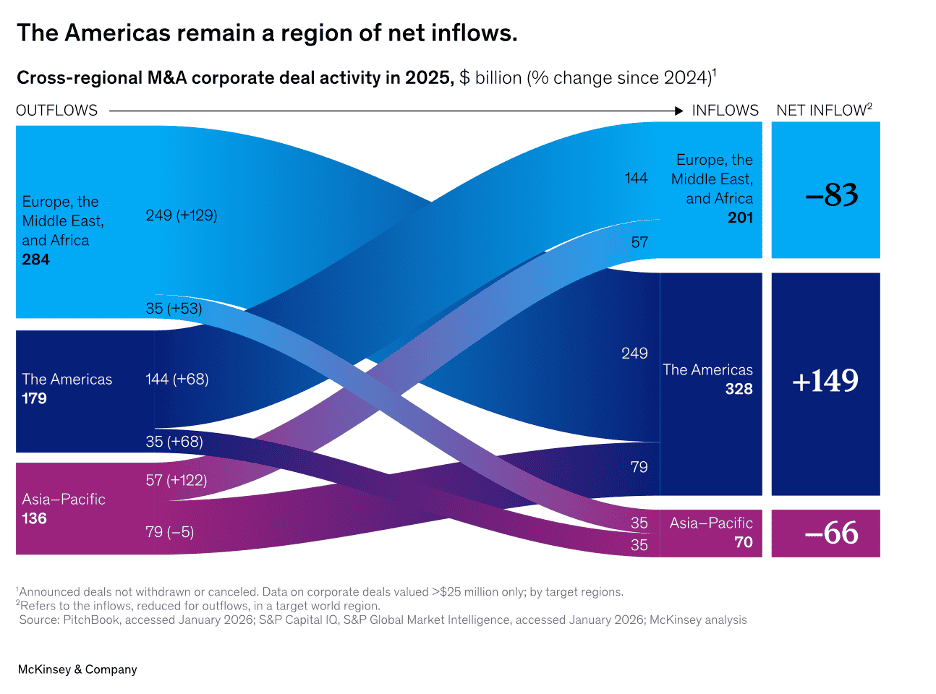
“The Americas lead global trade deals – After dealmaking slowed momentarily in early 2025, global M&A activity quickly assumed a grand scale—delivering big gains for the year. All this week, we explore M&A trends, from megadeals to cross-regional trading and more. The Americas led cross-regional trade deals in 2025, accounting for 16 of the world’s 20 largest deals. Rounds of US-led tariffs, softer regulations, and a large addressable market contributed to net inflows to the Americas increasing by 70 percent, to (US)$149 billion.”, McKinsey & Co., March 26, 2026
+++++++++++++++++++++++++++++++++++++++++++++++++++++++++++++++++++++++++++++++++++++++++++++++
Global & Regional Travel News
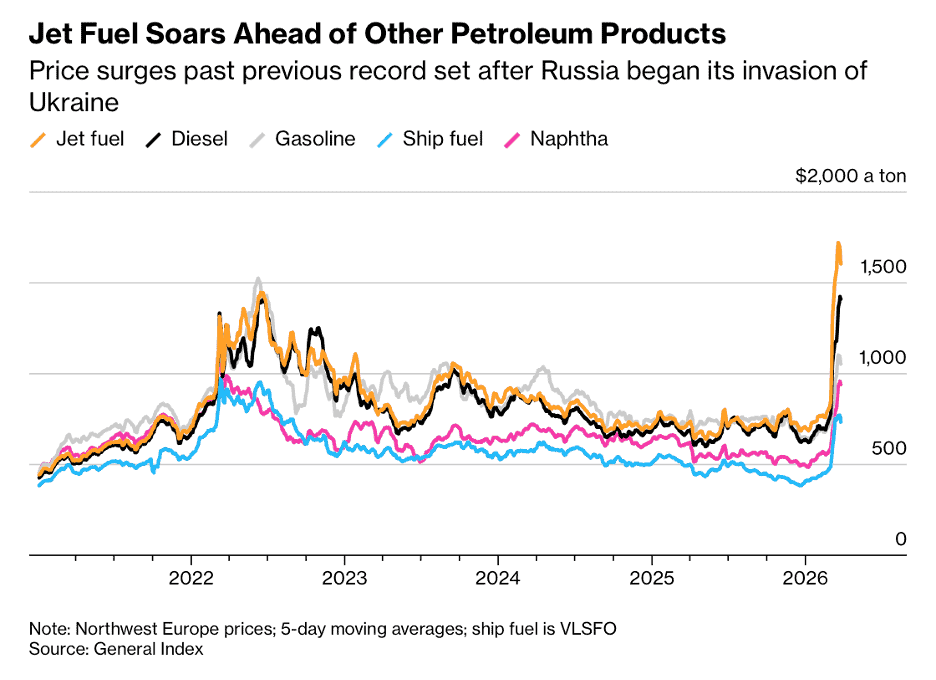
“Asia’s Air Travel Crisis Risks Spreading on Iran War’s Jet Fuel Squeeze – The aviation crisis in Asia is threatening to intensify and spread to Europe and beyond due to energy turmoil caused by the Iran war. Airlines are canceling flights as jet fuel prices surge to record highs, with some costs doubling since the start of the year. The European Union and the UK could be weeks away from similar conditions, and even the US is vulnerable to supply shocks, particularly in regions reliant on Asian supply.”, Bloomberg, March 27, 2026
++++++++++++++++++++++++++++++++++++++++++++++++++++++++++++++++++++++++++++++++++++++++++++
Book Review
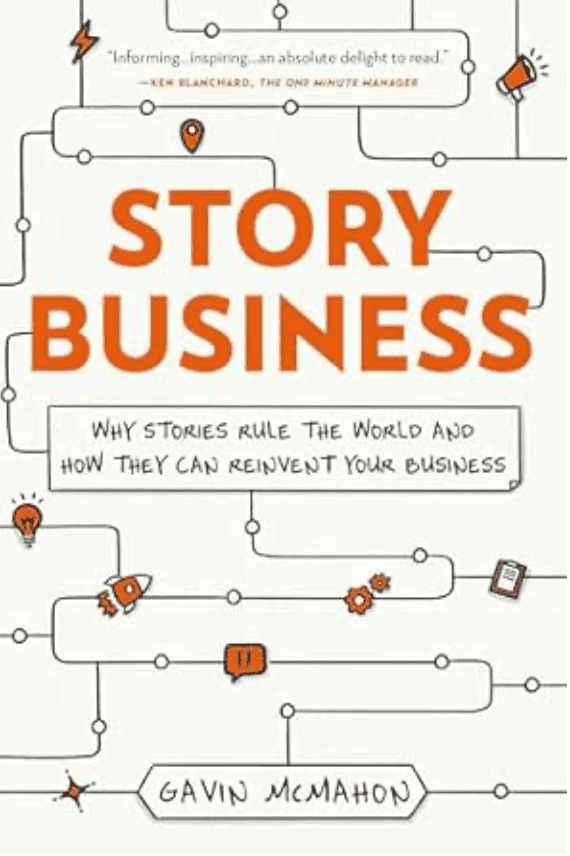
“Story Business: Why Stories Rule the World and How They Can Reinvent Your Business” by Gavin McMahon. In Story Business, Gavin McMahon makes a compelling—and highly practical—argument that many global executives still underestimate: the companies that win are not always those with the best strategies, but those that tell the best stories.
Drawing on examples ranging from early human history to modern global corporations, McMahon shows that storytelling is not simply a marketing tool—it is a core business capability. Stories shape how customers perceive value, how employees align behind strategy, and how leaders drive change across organizations. Ideas alone are not enough; they must be framed in a way that people can understand, remember and act upon.
What makes this book particularly relevant for today’s global business environment is its emphasis on execution. McMahon outlines six key storytelling domains—value, product, brand, sales, leadership and culture—providing a framework that can be applied across international markets and diverse teams.
For global business leaders navigating increasingly complex and fragmented markets, the message is clear: data informs decisions, but stories drive action. In a world shaped by geopolitical uncertainty, cultural differences and digital noise, the ability to communicate a clear, compelling narrative may be one of the most underutilized competitive advantages available.
Key Takeaways for Global Businesspeople
- The best story—not the best idea—often wins in global markets
- Storytelling is a leadership tool, not just a marketing function
- Clear narratives align teams across cultures and geographies
- Customers buy meaning and identity, not just products
- In uncertain environments, stories provide clarity and direction
+++++++++++++++++++++++++++++++++++++++++++++++++++++++++++++++++++++++++++++++++++++++++++
+++++++++++++++++++++++++++++++++++++++++++++++++++++++++++++++++++++++++++++++++++++++++++++
Country & Regional Updates
Africa
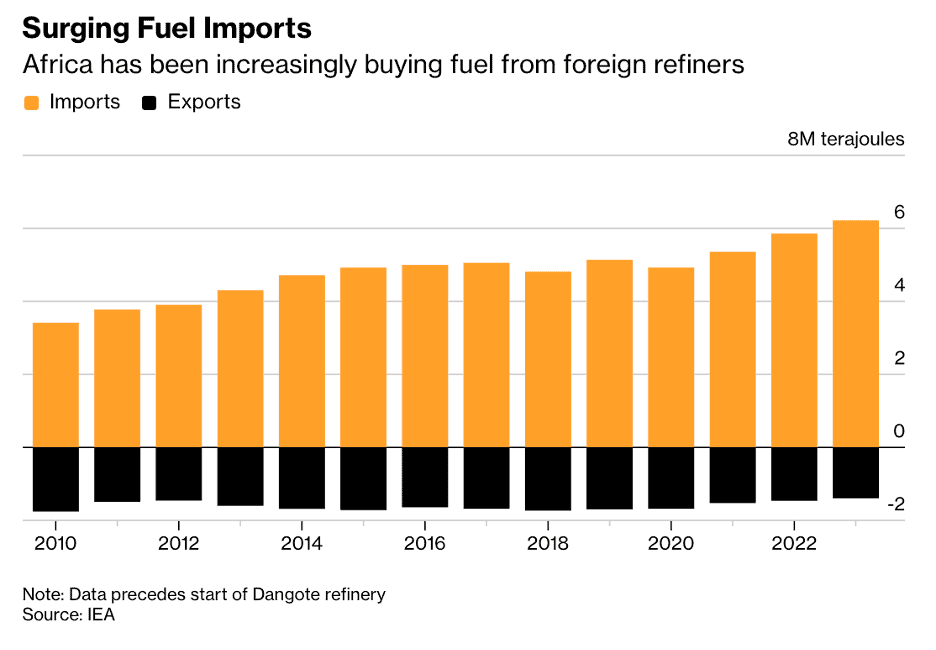
“Iran War Ignites African Race to Keep Gas Pumps Flowing – Adding to the grim outlook are the scores of shut refineries from Mombasa and Lusaka to Durban. The Persian Gulf was once a dependable, steady and conveniently located fuel supplier to meet Africa’s steadily rising demand. Most of the diesel that’s shipped out of the Strait of Hormuz usually headed to the continent. The US-Israel strikes on Iran have changed all that — effectively closing the crucial maritime chokepoint and leaving a gigantic fuel hole for developing nations to fill. The war has triggered a scramble by African nations to find new sources of petroleum, putting strained budget and fragile economic recoveries at risk. Many are merely weeks away from pumps running dry, with bigger and more powerful economies ahead in the queue.”, Bloomberg, March 18, 2026
=============================================================================================
Asia
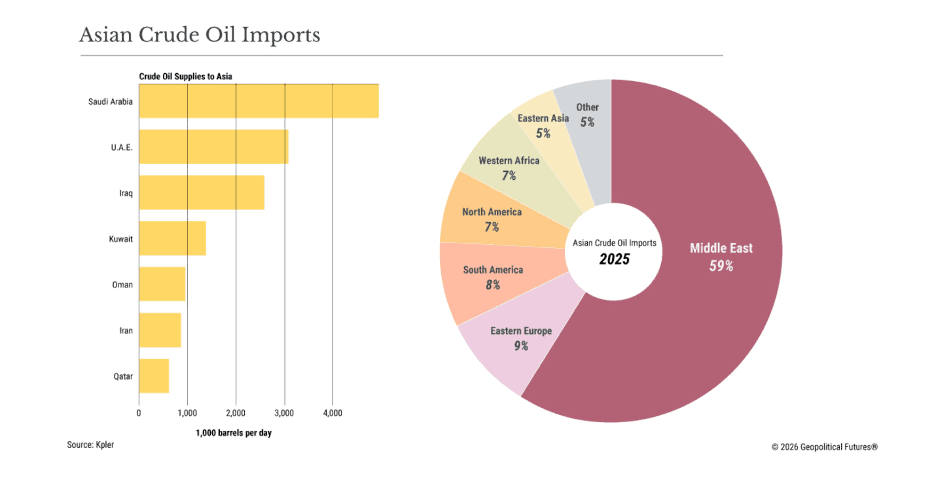
“Why Asia Hopes for a Short Mideast War – The conflict has already exposed structural vulnerabilities that can’t be fixed easily. The war in Iran has already had far-reaching consequences in the Asia-Pacific. The region is highly dependent on Middle Eastern oil, liquefied natural gas and petrochemicals, so the closure of the Strait of Hormuz immediately triggered inflationary pressure, supply chain disruptions and strategic uncertainty. In Southeast Asia, the impact of the war is widespread but uneven, reflecting significant differences in economic structure, energy dependencies and political priorities among ASEAN member states. Recent estimates suggest that around 60-70 percent of ASEAN’s crude oil imports originate from the Middle East, a substantial share of which transit the Strait of Hormuz.”, Geopolitical Futures, March 18, 2026
=============================================================================================
Canada
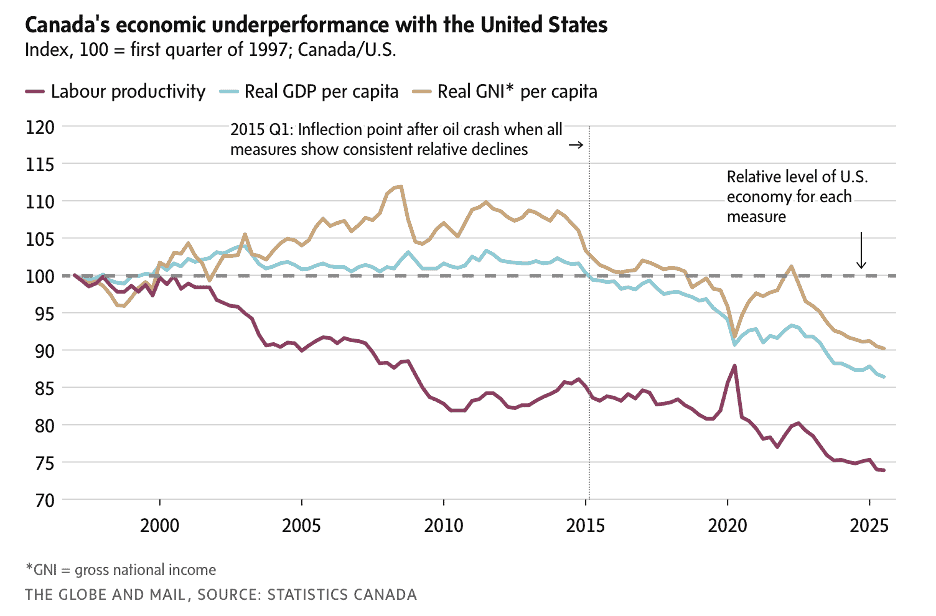
“Canada’s economy is falling even further behind the U.S. by these key measures – The years-long boom in oil and other commodity prices that ended in spectacular fashion last decade masked how badly Canada’s weak labour productivity has weighed down the country’s economy since the late 1990s, a new report by Statistics Canada found. Yet since the turn of the millennium, Canada’s productivity gap with the U.S. has steadily widened, with relative productivity tumbling by 26 per cent over that time, according to the report.”, The Globe and Mail, March 26, 2026
=============================================================================================
Cuba
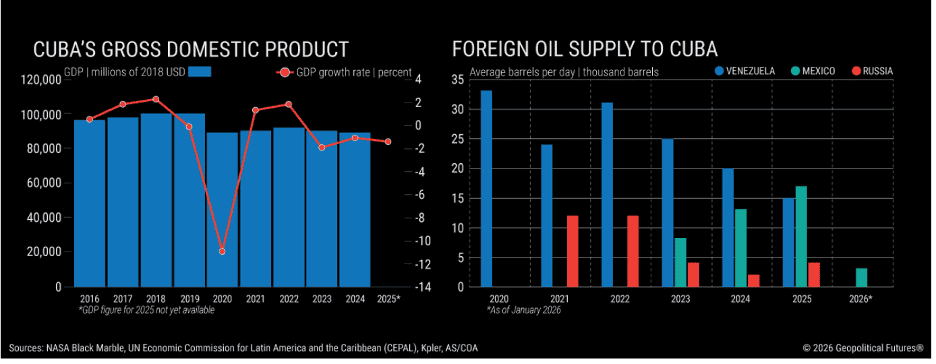
“Cuba’s Energy Crisis – The U.S. has an interest in supporting political unrest on the island. Cuba’s energy crisis has been going on for years but is now taking on a geopolitical dimension. The country’s electricity infrastructure has two major vulnerabilities: fuel supply and physical maintenance. Since the U.S. deposed Venezuelan President Nicolas Maduro in early January, Cuba has stopped receiving oil supplies from Caracas. Only Mexico and Russia have ventured to step in and provide Havana with oil. Cuba’s dilapidated electrical system also factors into the frequent, large-scale power outages experienced on the island.”, Geopolitical Futures, March 20, 2026
=============================================================================================
United States
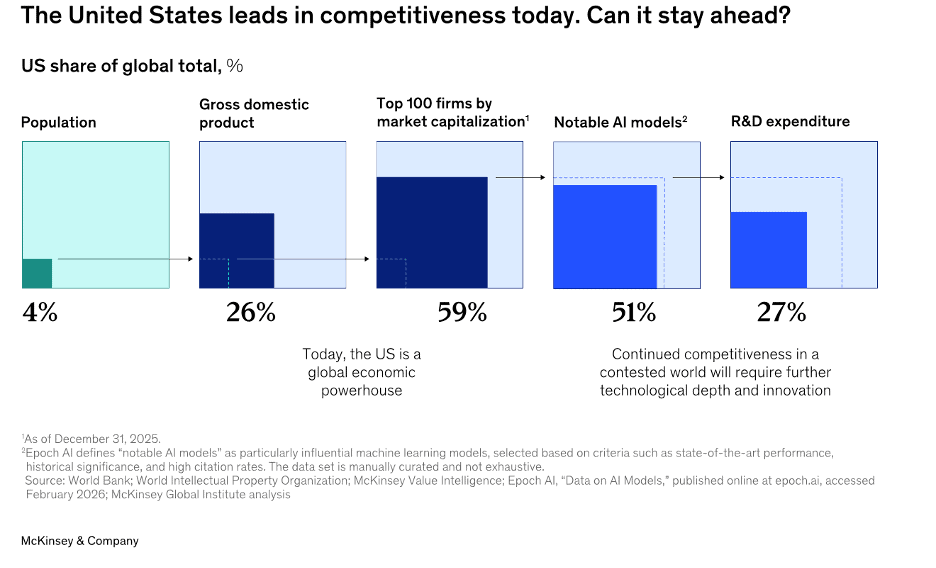
“At 250, sustaining America’s competitive edge – At 250 years old, the United States is the world’s most competitive economy. It generates 26 percent of global GDP and is home to 59 of the world’s top 100 firms. In the past several years, accelerating US productivity growth and announced foreign direct investment inflows have sharpened its edge over other advanced economies. Current generations owe it to future ones to address deteriorating fiscal health, eroding infrastructure, declining educational achievement, fading manufacturing know-how, and sustained disparities in income and wealth. Collective effort from American individuals, business, and government can ensure energy abundance, an infrastructure backbone, education that builds minds and skills to match new technology, and the financial strength to pay for it all. The prize is continued growth, national economic security, and economic opportunity for everyone.”, McKinsey & Co., March 9, 2026
===========================================================================================
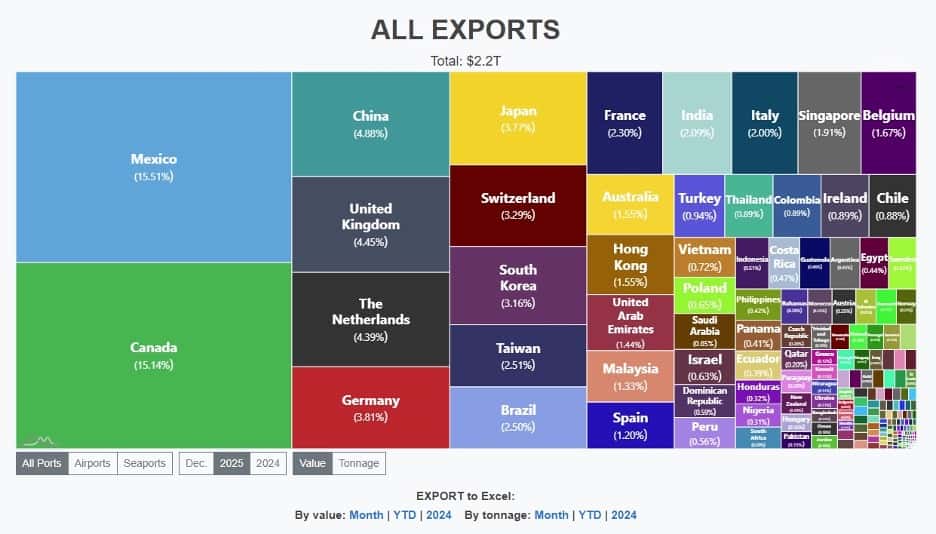
“U.S. Exports Set A Record But Mexico And Canada Not As Dominant – Mexico and Canada accounted for 30.65% of all U.S. exports in 2025, the lowest percentage since 1996 for the top two buyers of U.S. goods and USMCA partners, my analysis of Census Bureau data shows.”, Forbes, March 18, 2026. Article by Ken Roberts, Forbes Contributor.
++++++++++++++++++++++++++++++++++++++++++++++++++++++++++++++++++++++++++++++++++++++++++++++

The Accredited Franchise Supplier certification
+++++++++++++++++++++++++++++++++++++++++++++++++++++++++++++++++++++++++++++++++++++++++++++
Global Brand & Franchise Sector News
==============================================================================================
“Fast-growing Nothing Bundt Cakes is sold to KKR – The bundt cake chain, which is approaching $1 billion in system sales, is being sold at a reported value of $2 billion. It’s a rare exit for the private-equity firm Roark Capital. Dena Tripp and Debbie Schetz founded the concept in 1997 in Las Vegas based on the bundt cake, which itself is based on a German cake called the Gugelhopf. Nothing Bundt Cakes grew to 390 locations when Roark acquired the chain in 2021. The chain is mostly franchised. At the end of 2024 the chain operated 643 locations, up nearly 19% compared with the previous year, and meaning the brand has nearly doubled since Roark’s acquisition. A typical location makes about $1.4 million in revenue per year, according to Restaurant Business sister company Technomic.”, Restaurant Business, March 25, 2026
==============================================================================================
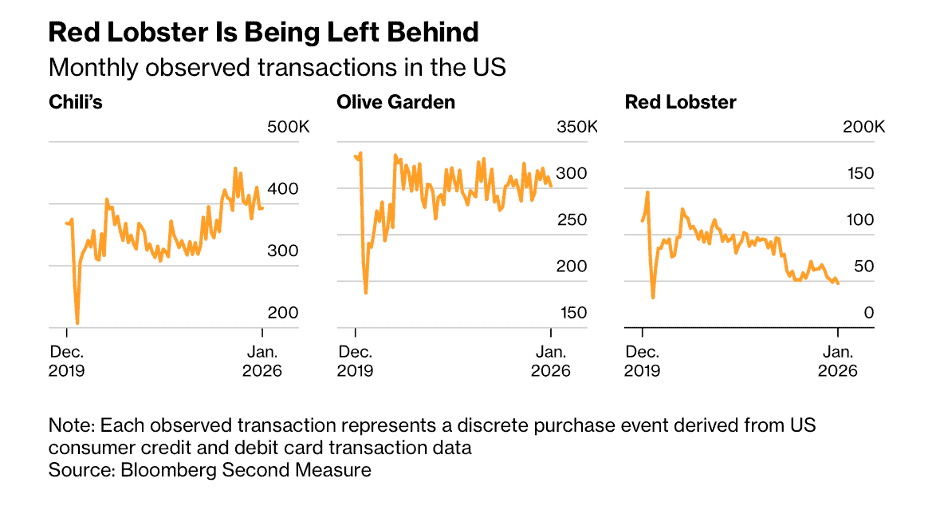
“Red Lobster’s Last Gasp – The new CEO is pitching a turnaround story. Behind the scenes, the restaurant chain is treading water. Red Lobster, founded in 1968, once defined American casual dining, with more than 700 restaurants in the US and abroad at its peak. Since the early 2000s, an explosion of alternatives, including Chipotle Mexican Grill Inc. and other fast-casual companies, has eroded its market share, along with those of its peers like TGI Friday’s. Wall Street pressure pushed Red Lobster’s longtime parent, Darden Restaurants Inc., to sell the chain; over the next decade it was passed around to various owners and investors, getting stripped of its quality and real estate along the way. The pandemic followed, which roiled the restaurant industry. Onerous real estate arrangements mean roughly 100 chronically unprofitable restaurants are draining any profit the rest of the chain brings in.”, Bloomberg, March 24, 2026
================================================================================================
“Krispy Kreme’s latest move to shed debt: Deals in Japan and US worth $160 million – As part of a corporate turnaround strategy, Krispy Kreme completed two major refranchising deals to drive “sustainable, profitable growth,” the company announced Tuesday. WKS Restaurant Group (Western U.S. Joint Venture) increased its ownership stake in the Western U.S. joint venture from 45% to 80%. Krispy Kreme received approximately $90 million, including $50 million in cash at closing. The joint venture added 23 former company-operated shops in California and Hawaii and plans to expand its fresh delivery network over the next several years. Unison Capital acquired Krispy Kreme’s operations in Japan on March 2 with nearly $70 million in cash. Last year, about 75% of Krispy Kreme’s sales were from company-operated locations…..Krispy Kreme aims to have franchisees generate nearly 50% of systemwide sales starting in fiscal 2027 through refranchising efforts, the report said.”, The Herald Online, March 26, 2026
==============================================================================================
“The Philippines loves Jollibee. Overseas Filipinos love it even more – In the Philippines, where Jollibee operates over 1,000 outlets and is the dominant fast-food chain, it is simply part of the furniture. Overseas, it is something closer to a lifeline. There are now more than 80 Jollibee outlets across the US, with the very first opening in Daly City, California, in 1998. Worldwide, Jollibee operates over 1,600 stores in 17 countries – and its parent group runs more than 10,000 outlets in 33 countries through acquisitions including Tim Ho Wan, Smashburger and The Coffee Bean & Tea Leaf.”, The South China Morning Post, March 29, 2026
++++++++++++++++++++++++++++++++++++++++++++++++++++++++++++++++++++++++++++++++++++++++++++++
To receive our biweekly newsletter in your email every other Tuesday, click here – https://insider.edwardsglobal.com
+++++++++++++++++++++++++++++++++++++++++++++++++++++++++++++++++++++++++++++++++++++++++++++++
Our Mission, Information Sources & Who We Are
Our biweekly global business update newsletter focuses on what is happening around the worldthat impacts new trends, health, consumer spending, business investment, the franchise sector, economic development, and travel. We daily monitor 30+ countries, 40+ international information sources and six business sectors to keep up with what is going on in this ever-changing business environment. And our GlobalTeam™ on the ground covering 25+ countries provide us with updates about what is actually happening in their specific countries. We do not get involved in or report on politics!
+++++++++++++++++++++++++++++++++++++++++++++++++++++++++++++++++++++++++++++++++++++++++++
William “Bill” Edwards: CEO & Global Trade Advisor “Is Uniquely Qualified to Steer Sr. Executives Successfully Through the Complex Waters of Going Global”. With five decades of successful international business experience spanning virtually every corner of the world and many business sectors, Bill Edwards understands the global business landscape like no other. He has been a County Master Franchisee in five countries in Asia, Europe, and the Middle East; the Senior VP for a franchisor operating in 15 countries and a full-service global management consultant since 2001 helping 40+ franchisors expand into new countries. Bill knows how to turn the challenges in taking a brand global into opportunities.
For a complimentary 30-minute consultation on how to take your business into new countries successfully. For a complimentary call with Bill Edwards click on the QR code or contact Bill at bedwards@edwardsglobal.com and +1 949 375 1896
And download our latest chart ranking 40+ countries as places to do business, used by many companies for strategic planning, at this link:
Our latest GlobalVue™ 40 country ranking
Biweekly Global Business Update Newsletter, Issue 156, Tuesday, March 17, 2026
“The future is particularly unpredictable these days.”
Welcome to the 156th Edition of the Biweekly Global Business Update – The war now unfolding between Iran, Israel and the United States is rapidly becoming one of the most consequential geopolitical shocks to the global economy in decades. What began as a regional military confrontation has already triggered the largest disruption to global oil supply in modern history, sending energy markets, trade routes and supply chains into immediate turmoil.
At the center of the crisis is the Strait of Hormuz, the narrow waterway through which roughly 20% of the world’s daily 107 million barrels a day oil production and a large share of global liquefied natural gas normally flows. Missile attacks, security risks and insurance restrictions have sharply reduced tanker traffic through the strait, trapping a significant portion of global oil supplies on the far side of the Persian Gulf. Global oil supply is projected to fall by roughly 8 million barrels per day, forcing governments to release emergency reserves and pushing energy markets into heightened volatility.
As a result of the Iran war air freight rates are surging as airlines reroute flights around the conflict zone. Shipping delays are mounting across key trade corridors. Fertilizer markets are tightening as disruptions to natural gas supplies ripple through global agriculture supply chains. These pressures are beginning to push up costs across sectors ranging from transportation and manufacturing to food production.
All of this is unfolding at a moment when the global economy was already facing slowing growth, rising trade tensions and persistent inflation pressures.
For global business leaders, the message is clear: geopolitics is once again shaping the direction of the world economy. The Iran war now has the potential to influence energy prices, logistics costs, inflation and investment decisions across global markets in the months ahead.
The developments in my 156th newsletter below illustrate how a single geopolitical flashpoint can rapidly ripple through energy markets, trade routes, supply chains and global growth. This will make the next few months a critical period for anyone doing business internationally.
This edition’s book review highlights: “Crisis: A Global Case Primer by Jason Miklian and John E Katsos , 2025. In a world defined by geopolitical shocks, supply-chain disruptions, pandemics, and financial volatility, Crisis: A Global Case Primer offers a timely and practical exploration of how organizations confront and sometimes survive moments of extreme uncertainty.
++++++++++++++++++++++++++++++++++++++++++++++++++++++++++++++++++++++++++++++++++++++++++++++
To receive our biweekly newsletter by email every other Tuesday, click here https://insider.edwardsglobal.com
+++++++++++++++++++++++++++++++++++++++++++++++++++++++++++++++++++++++++++++++++++++++++++++
The mission of this newsletter is to use trusted global and regional information sources plus our network of 20+ in-country Associates to update our global readers on key global and local trends that can impact the success of their businesses at home and abroad. We subscribe to about 40 international information sources to keep our readers up to date on the world’s business. We do not get involved with or report on politics!
PLEASE NOTE: Some of the information sources that we provide links to in our newsletter require a paid subscription to directly access them. Clicking on a link may not give the reader access to the content.
Edited and curated by: William (Bill) Edwards, CEO & Global Business Advisor, Edwards Global Services, Inc. (EGS), Irvine, California, USA. Contact Bill with questions, comments and contributions. Bedwards@edwardsglobal.com, +1 949 375 1896
Link to our current and past newsletters: https://edwardsglobal.com/geowizard/
+++++++++++++++++++++++++++++++++++++++++++++++++++++++++++++++++++++++++++++++++++++++++
First, A Few Words of Wisdom From Others For These Times
“The future is particularly unpredictable these days.”, Howard Marks
“The only thing new in the world is the history you do not know.”, Harry S. Truman
“We are not makers of history. We are made by history.”, Martin Luther King Jr.
+++++++++++++++++++++++++++++++++++++++++++++++++++++++++++++++++++++++++++++++++++++++++++
Highlights in issue #156:
The Energy Mix of the World’s 10 Largest Economies
Where the World’s Oil Comes From by Region
Oil Risk Highest for Philippine Bonds in Asia, China Insulated
Small Business Startup Sentiment Rebounds
Tricky negotiations begin Monday to renew a trade pact between the United States, Mexico and Canada
Why Private Equity Should Bet On International Franchising
Franchise Global News Section: Gong cha®, Papa John’s®, Jiffy Lube®, Mixue Bingcheng and Wendy’s®
++++++++++++++++++++++++++++++++++++++++++++++++++++++++++++++++++++++++++++++++++++++++++++
Interesting Data, Articles and Studies
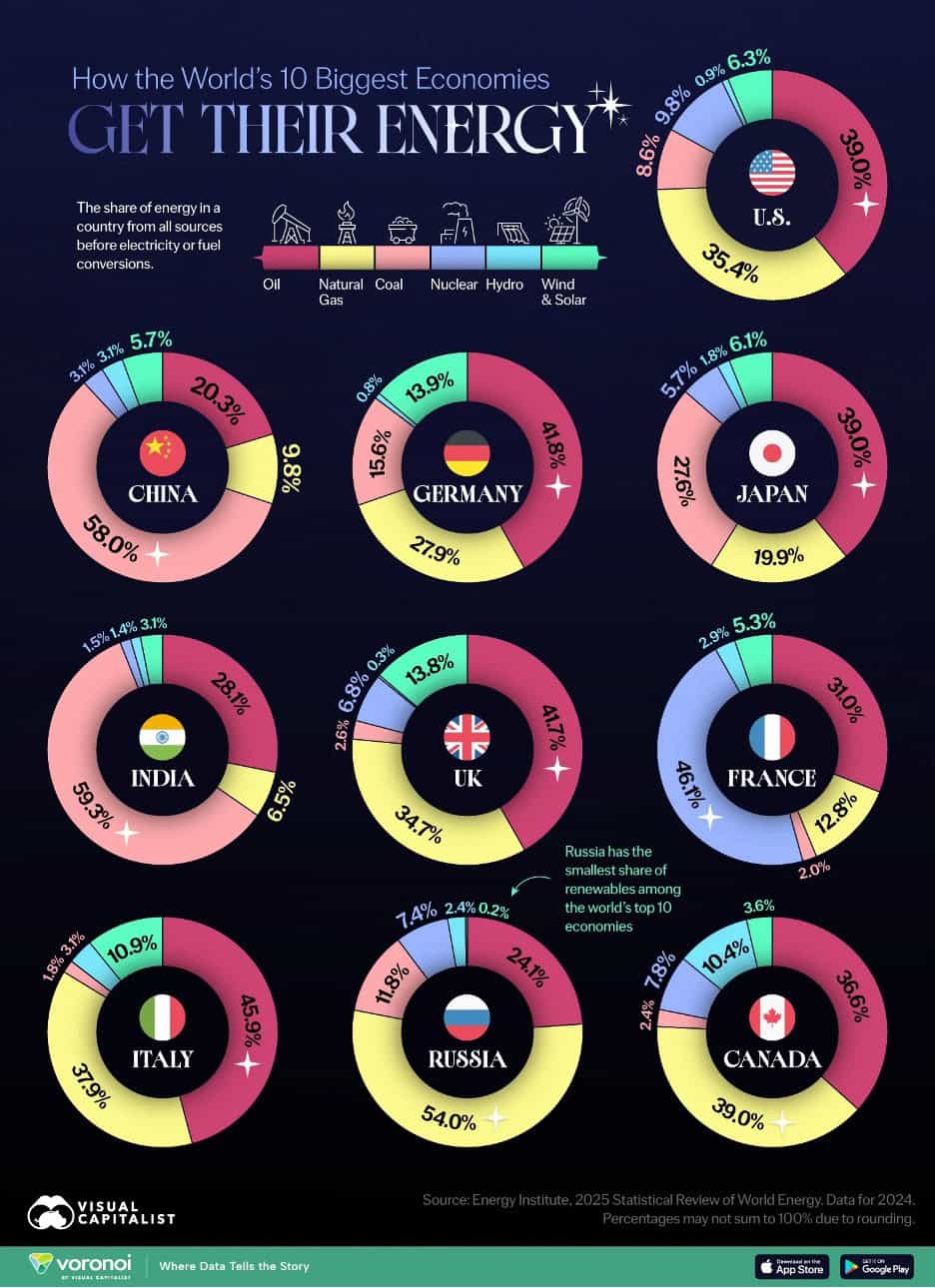
“The Energy Mix of the World’s 10 Largest Economies – Oil is the largest energy source in six of the world’s 10 biggest economies, including the U.S., Germany, Japan, the UK, and Italy. Coal dominates energy supply in China and India, accounting for nearly 60% of their energy mixes. France stands out for nuclear power, which provides over 46% of its energy mix, the highest share among the group. Oil remains the largest energy source in six of the 10 biggest economies, including the United States, Germany, Japan, the United Kingdom, and Italy. In these countries, oil plays a major role in transportation and industrial sectors. Italy has the highest reliance on oil among the group, with nearly 46% of its energy coming from petroleum. Germany and the UK also depend heavily on oil, though both have been expanding renewable energy capacity in recent years.”, Visual Capitalist and the Energy Institute, March 13, 2026
===============================================================================================
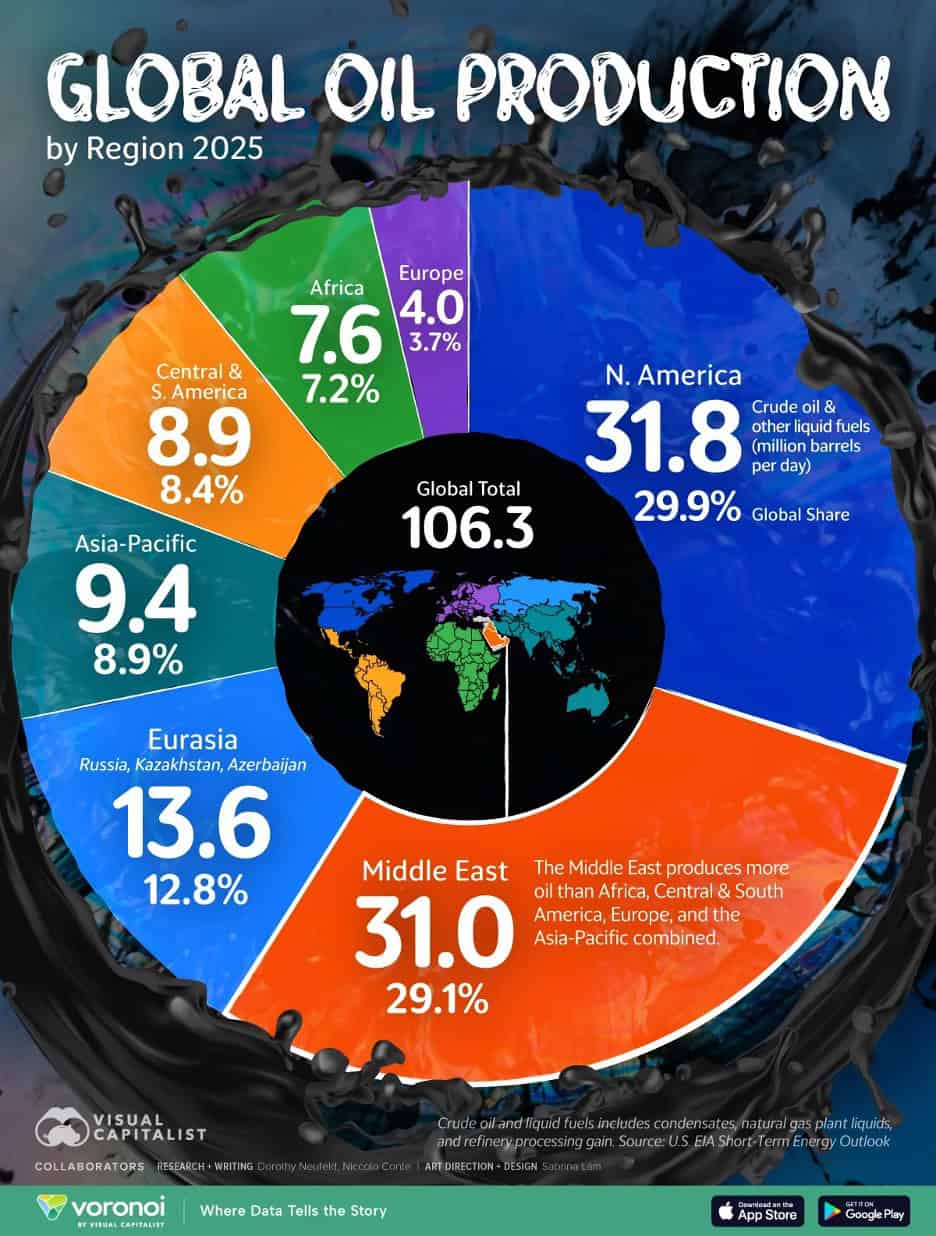
“Where the World’s Oil Comes From by Region – North America is the world’s largest oil-producing region in 2025, generating over 31 million barrels per day, equal to nearly 30% of global supply. The Middle East produces over 29% of the world’s oil, led by Saudi Arabia and Iran. Europe, excluding Russia, produces less than 4% of total oil production, the smallest share by region. The world produced roughly 106 million barrels of oil per day in 2025, according to estimates from the U.S. Energy Information Administration (EIA). Just two regions dominate global supply. North America and the Middle East together produce nearly 60% of the world’s oil, underscoring their outsized influence on energy markets.”, Visual Capitalist and the U.S. Energy Information Administration, March 10, 2026
++++++++++++++++++++++++++++++++++++++++++++++++++++++++++++++++++++++++++++++++++++++++++++++
Global Supply Chain, Energy, Commodities, Inflation, Taxes, Tariffs & Trade Issues
“Middle East War Is Causing Largest Oil Supply Disruption in History, IEA Says – Oil supply is projected to plunge by 8 million barrels a day in March. The International Energy Agency slashed its oil supply growth forecast to 1.1 million b/d this year amid the Middle East war. IEA member countries released 400 million barrels from emergency stocks, the largest in history, as the Strait of Hormuz remains effectively closed. The IEA now expects global oil demand to rise by 640,000 b/d this year, down from an earlier 850,000 b/d forecast. In March, supply is projected to plunge by 8 million barrels a day to 98.8 million barrels a day, the lowest levels since the first quarter of 2022.”, The Wall Street Journal, March 12, 2026
=================================================================================================
“Air freight rates soar as Middle East conflict blocks trade routes – “Air freight rates have risen by as much as 70% on some routes since the start of the U.S.-Israeli war on Iran, data shows, as the conflict limits flights, blocks some ocean shipments and pushes up jet fuel costs. Rates on routes between South Asia and Europe have been the most affected by Middle Eastern airspace closures and security issues, industry experts said, after the conflict has stranded more than 100 container ships in the area around the critical Strait of Hormuz oil export corridor. “The shift to air cargo is significant because air freight handles about one-third of global trade by value, making rate spikes a potential inflationary pressure on goods ranging from fresh food to pharmaceuticals and electronics.”, Reuters, March 13, 2026
===============================================================================================
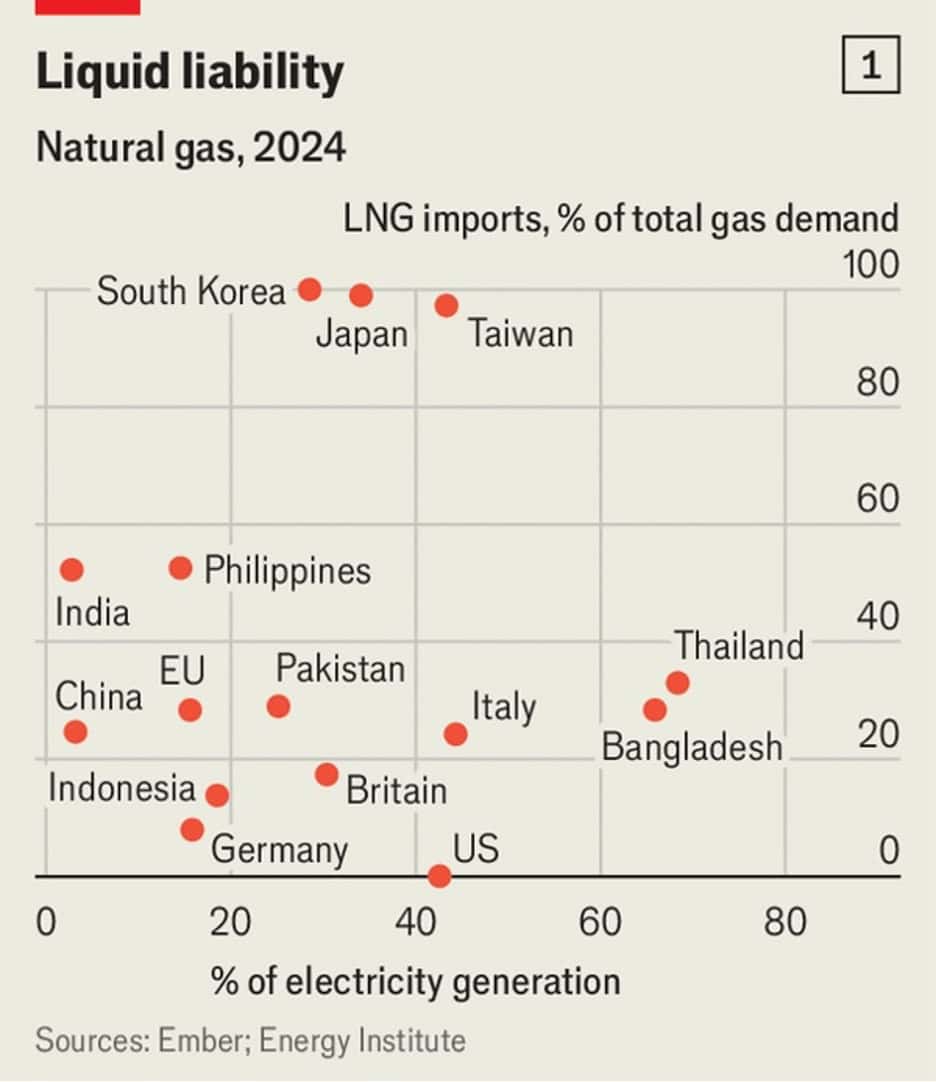
“The damage to the world economy from the Iran war will be severe, but uneven – It has already caused the biggest energy supply shock in history. And the shock emanating now from the Strait of Hormuz is huge. Iranian missiles have trapped about 15% of global oil supplies on the far side of the strait. That is roughly twice the disruption the world suffered in the 1970s, offsetting the fact that the energy-intensity of the world economy has fallen by half since then. About a fifth of the world’s shipments of liquefied natural gas (lng) have been halted, too, and the shock is spreading to other commodities. The price of fertiliser, which is made using natural gas, is surging, stoking fears of food shortages.”, The Economist, March 12, 2026
============================================================================================
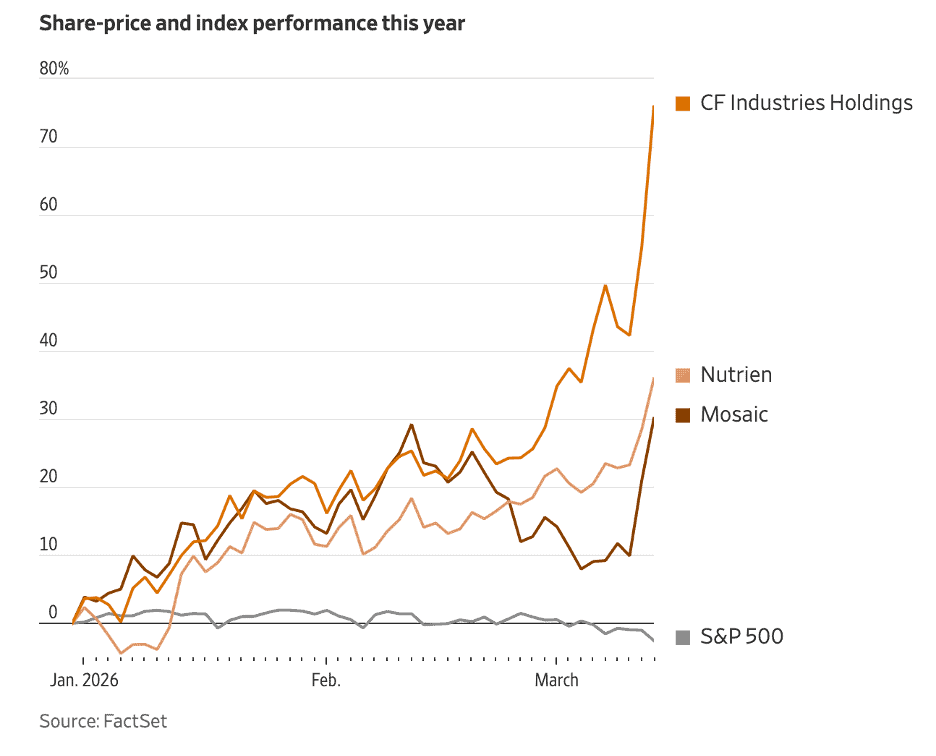
“Fertilizer Stocks Jump With Shipments Stuck at the Strait of Hormuz – Investors flock to U.S. fertilizer producers, which can access cheap natural gas; farmers are expected to shift to less-dependent crops. The Middle East fighting has choked off big chunks of the world’s supply of ammonia, urea, sulfur and phosphates. It has also blocked roughly 20% of the supply of liquefied natural gas, or LNG, upon which fertilizer makers in Europe and elsewhere rely. Benchmark natural-gas prices in Europe have climbed 58% since the U.S.-Israeli bombardment of Iran began. For American farmers already shouldering higher costs, the Mideast disruption has boosted prices for certain fertilizers by about 30%.”, The Wall Street Journal, March 12, 2026
===============================================================================================
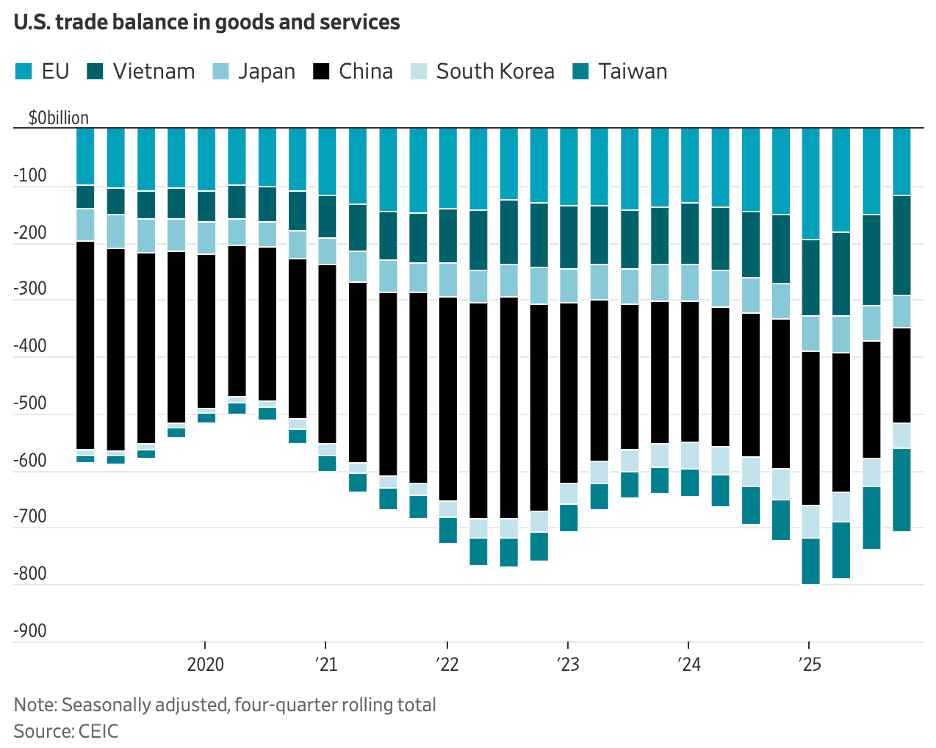
“Allies to Trump: We’ll Live With Tariffs, Just Don’t Make Them Any Higher – U.S. trading partners are pushing President Trump to stick to previously agreed tariff levels after his administration kicked off probes aimed at replacing the levies struck down by the Supreme Court. This past week, U.S. Trade Representative Jamieson Greer said the U.S. was starting investigations under Section 301 of the Trade Act of 1974, citing what he called unfair practices such as running trade surpluses and building up too much industrial capacity. The move is likely to lead to tariffs on most of America’s major trading partners including the European Union, Mexico, China, Japan, South Korea, India and others.”, The Wall Street Journal, March 14, 2026
===============================================================================================
“Tricky negotiations begin Monday to renew a trade pact between the United States, Mexico and Canada – Every day more than $4 billion worth of goods cross the United States’ borders with Canada and Mexico – U.S. auto parts headed for car factories in northern Mexico, cartons of Mexican avocados bound for California supermarkets, Canadian aluminum destined to become cans of Campbell Soup. Much of this bustling cross-border commerce is duty-free, thanks to the US-Mexico-Canada Agreement, or USMCA, that President Donald Trump negotiated with America’s northern and southern neighbors during his first term. But the future of the USMCA , which took effect July 1, 2020, is cloudy as the three countries begin what could be a tempestuous attempt to renew the pact this year. The United States is demanding changes to the treaty, and the top U.S. trade negotiator told Politico in December that Trump would be willing to pull the United States out of the pact if he can’t get the deal he wants. Trump also suggested last fall that the United States could negotiate separate deals with Canada and Mexico, ending the three-country North American bloc that previous administrations saw as crucial to competing economically with China and the European Union.” AP News, March 15, 2026
+++++++++++++++++++++++++++++++++++++++++++++++++++++++++++++++++++++++++++++++++++++++++++++++
Global & Regional Travel News
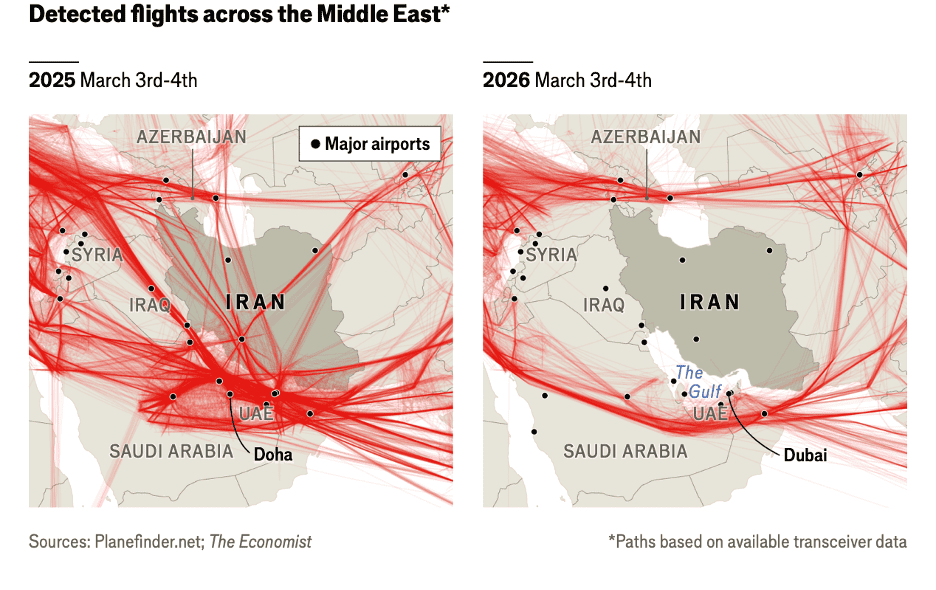
“How wars are adding hours to your flights – Visitors to the Gulf and passengers transiting through the region’s busy airports have been stranded. In March last year a typical 48-hour period saw more than 3,700 passenger planes pass over the Persian Gulf. More than half were either bound for, or departed from, Dubai in the United Arab Emirates, or Doha, Qatar’s capital. On March 3rd and 4th this year just 47 flights crossed the same stretch of sky. The most recent data, from March 11th, show around 220 departures from Dubai—roughly a third of the normal number and half of those scheduled. That same day just 16 flights departed from Doha, 5% of the average.”, The Economist, March 12, 2026
++++++++++++++++++++++++++++++++++++++++++++++++++++++++++++++++++++++++++++++++++++++++++++
Book Review
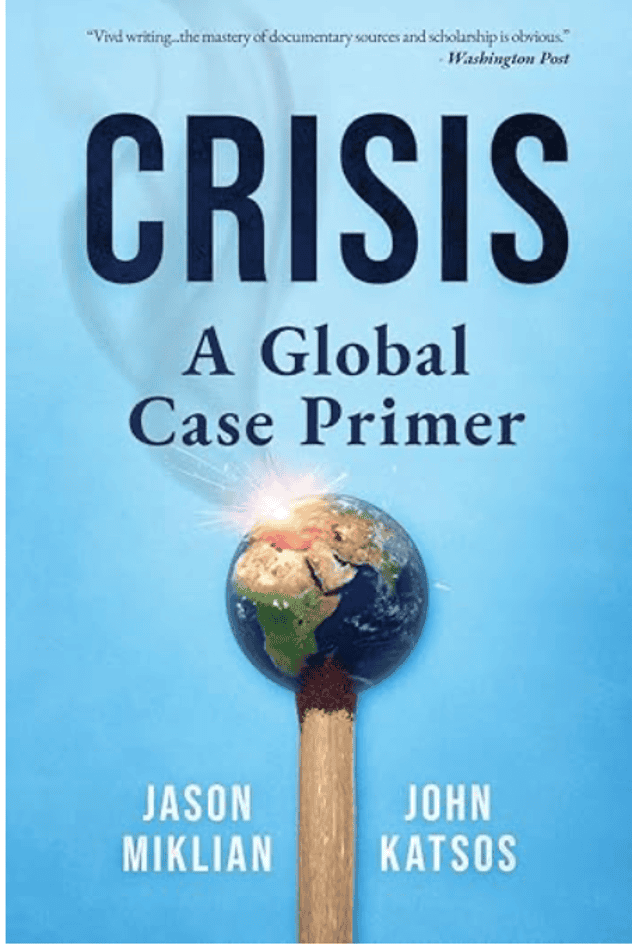
“Crisis: A Global Case Primer by Jason Miklian and John E Katsos , 2025. In a world defined by geopolitical shocks, supply-chain disruptions, pandemics, and financial volatility, Crisis: A Global Case Primer offers a timely and practical exploration of how organizations confront and sometimes survive moments of extreme uncertainty.
Rather than presenting abstract theory, the book examines a series of real-world crises across industries and countries. Each case illustrates how leaders faced rapidly evolving situations where information was incomplete, risks were cascading, and the margin for error was razor thin. The authors emphasize that crises rarely arrive in isolation. Economic pressure, political instability, reputational damage, and operational breakdowns often intersect, forcing leaders to make decisions under extraordinary stress.
One of the book’s strongest messages is that crisis management is not primarily about reaction. It is about preparation. Organizations that invest in scenario planning, resilient supply chains, and empowered leadership teams are far more capable of navigating disruption. Those that rely on rigid hierarchies or slow decision-making processes often find themselves overwhelmed when events accelerate.
For global business leaders, the book reinforces an increasingly clear reality: the operating environment of the 2020s will remain volatile. From geopolitical competition to climate shocks and technological disruption, executives must assume that crises will occur and build organizations capable of absorbing them.
The ultimate lesson is simple but powerful: resilience is now a core strategic capability.
Five Takeaways for Global Businesspeople
- Crises are inevitable — preparation determines survival.
- Speed of decision-making matters more than perfect information.
- Communication is a strategic tool during uncertainty.
- Global supply chains require redundancy and diversification.
- Leadership culture determines how organizations respond under stress.
+++++++++++++++++++++++++++++++++++++++++++++++++++++++++++++++++++++++++++++++++++++++++++
+++++++++++++++++++++++++++++++++++++++++++++++++++++++++++++++++++++++++++++++++++++++++++++
Country & Regional Updates
Argentina
“Argentina Inflation Topped Estimates Ahead of Iran War Shock – Argentina’s monthly inflation rose 2.9% in February, above the 2.8% median estimate of economists, while annual inflation accelerated to 33.1% from 32.4%. Food and non-alcoholic beverages, driven by beef, contributed the most to last month’s price increases, while housing and utilities rose the most, according to Indec. The inflation rate in March is likely to edge higher due to the fallout from the US and Israeli attacks on Iran, especially creeping gasoline and diesel prices and higher costs for fertilizers.”, Bloomberg, March 12, 2026
=============================================================================================
China
“More abundance, less prosperity: why 2 Chinas are emerging – For observers accustomed to a market economy, China’s can look like a contradiction. On the one hand, it is an unstoppable juggernaut, a manufacturing superpower with a US$1 trillion-plus trade surplus demonstrating its prowess and leverage across supply chains. China is also moving up the value chain, producing steel and widgets while also leading the world in solar panels, electric vehicles and the batteries that power them, industrial robots and more. On the other hand, the costs of this tech and export dominance are increasingly apparent. The wealth of households suffers with falling real estate values, recent graduates face a market with 17.8 per cent youth unemployment as of last summer, wages are falling, deflation is growing and an estimated 12 per cent of registered companies are “zombies”.”, The South China Morning Post, March 12, 2026
=============================================================================================
Canada
“Canada sheds more than 100,000 jobs in first two months of year – Canada’s unemployment rate rose to 6.7%, according to the latest labour figures released on Friday – the second-highest among wealthy G7 nations, behind France. February saw the sharpest drop in employment since the Covid-19 pandemic, wiping out much of the job growth recorded late last year, with the wholesale and retail trade sector taking the biggest hit. The US is by far Canada’s largest export market, leaving it especially vulnerable to American tariffs. Around three-quarters of Canadian goods were sold to the US, though that share has fallen to about 67% in recent months.”, BBC, March 13, 2026
=============================================================================================
“What would $100 oil mean for Canada? The price of West Texas Intermediate crude oil is off its highs since hitting US$120 a barrel on Monday. But traders won’t be resting easy just yet. How would Canada fare under such a scenario? The broad answer is ‘better than most countries,’ although it depends on which Canadian you ask; all relative price changes create winners and losers. The key to the outlook is the Canadian dollar. Canada’s oil exports averaged 4.3 million barrels a day over the past year, accounting for 20 per cent of total exports by value. Assuming US$100 oil prices and a modest bump in output, that figure would rise to around 25 to 30 per cent.”, The Globe and Mail, March 12, 2026
=============================================================================================
European Union
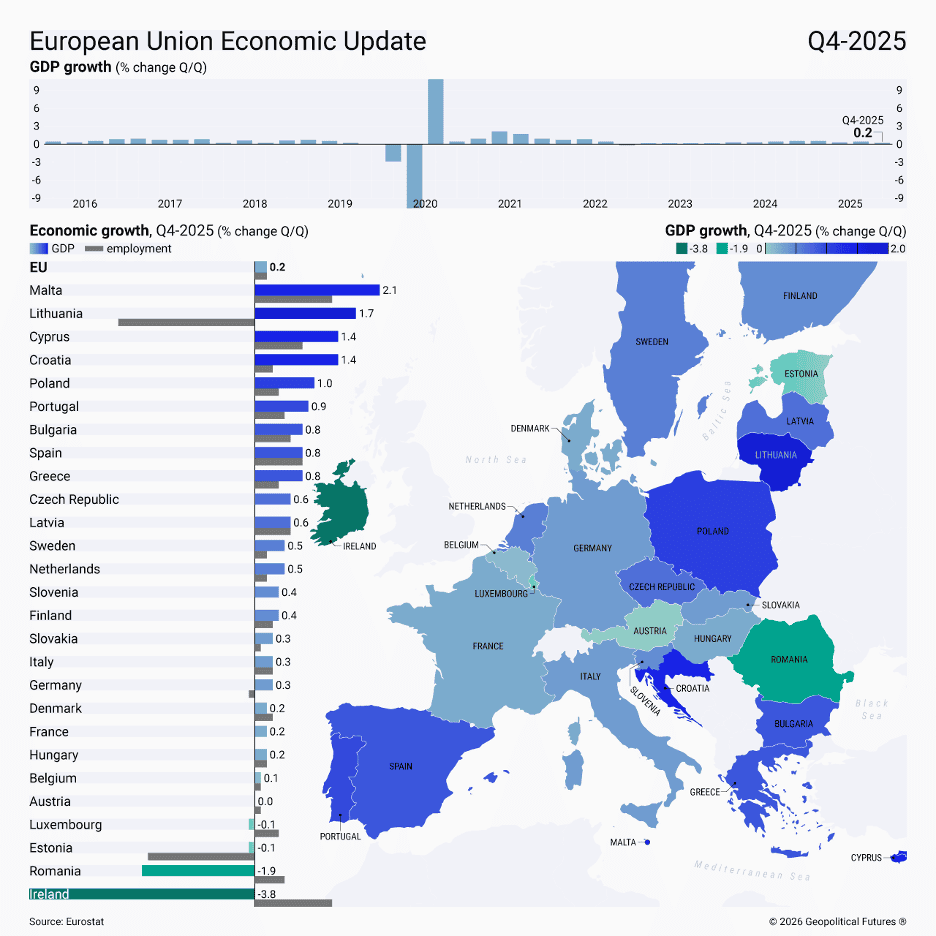
“EU Economies Can’t Catch a Break – The risk of stagflation grows if the energy squeeze continues. The European economy failed to sustain its modest momentum in the fourth quarter of 2025, with growth slowing to 0.2 percent compared with the previous quarter. The war in the Middle East has already disrupted oil and gas supplies, driving up the price of Brent crude by approximately 40 percent and pushing European gas to its highest level since January 2023.”, Geopolitical Futures, March 13, 2026
===========================================================================================
Latin America
“Meet the retail giant that’s actually beating Amazon – A $90 billion company dominant in Latin America is rapidly growing with tailored e-commerce and fintech services. Founded in 1999 in Buenos Aires, Argentina, MercadoLibre Inc. is an e-commerce and financial services company operating in 18 countries throughout Latin America, with Brazil, Mexico, and Argentina serving as its largest markets. The company faces margin challenges but maintains strong revenue growth and bullish analyst ratings. Amazon remains larger globally, expanding in AI and AWS, but also faces cost pressures and competition. Many U.S. consumers may not yet be familiar with the company, primarily because it doesn’t currently operate in the U.S. market. However, across Latin America, it has become one of the region’s most influential technology companies. Like Amazon, MercadoLibre functions as a one-stop shopping platform offering a broad range of products and services. The company emphasizes localization by adapting its marketplace to each country’s language, payment preferences, logistics, and consumer habits, an approach that helped it scale across diverse markets.”, The Street, March 12, 2026
============================================================================================
The Philippines
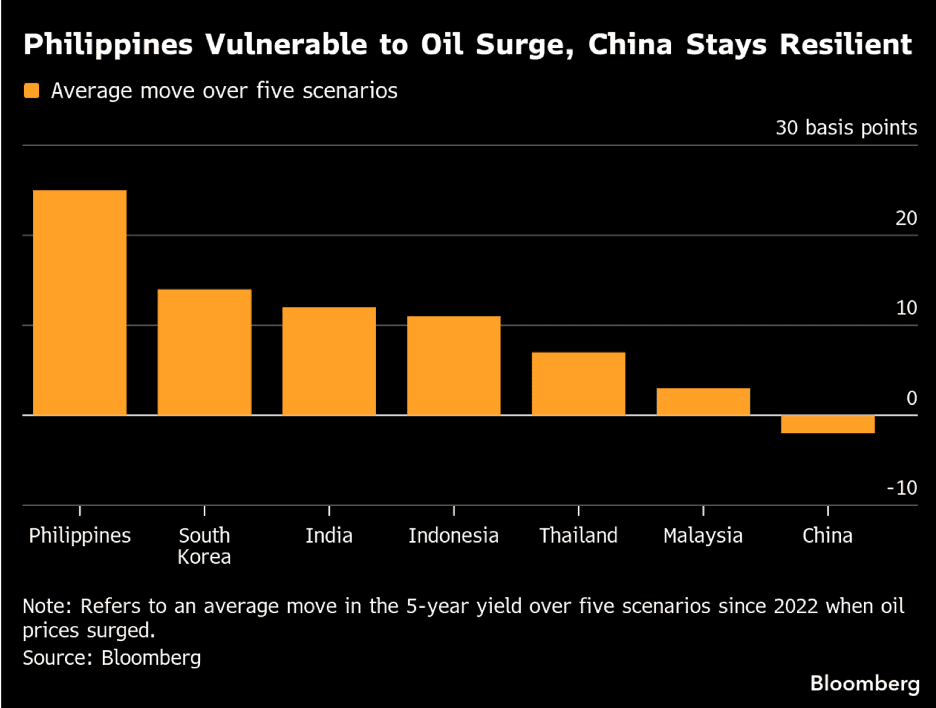
“Oil Risk Highest for Philippine Bonds in Asia, China Insulated – Peso-denominated debt has shown the highest sensitivity and the most consistent reaction to crude spikes in recent years, according to a Bloomberg analysis of five events since 2022. Rising oil prices pose a threat to many of Asia’s emerging markets. But Philippines’ consumption-driven economy is particularly vulnerable given a heavy reliance on imports, quicker transmission of fuel costs into transport and food prices, and a currency that’s trading near record lows. Meanwhile, bonds in China — the world’s largest oil importer — have fared relatively better during the oil spike episodes even as they fell Monday amid a global selloff. The nation’s authorities seek to limit the impact of surging costs through price controls, subsidies and state influence in key sectors, reducing pressure on yields.”, Bloomberg, March 10, 2026
=============================================================================================
Poland
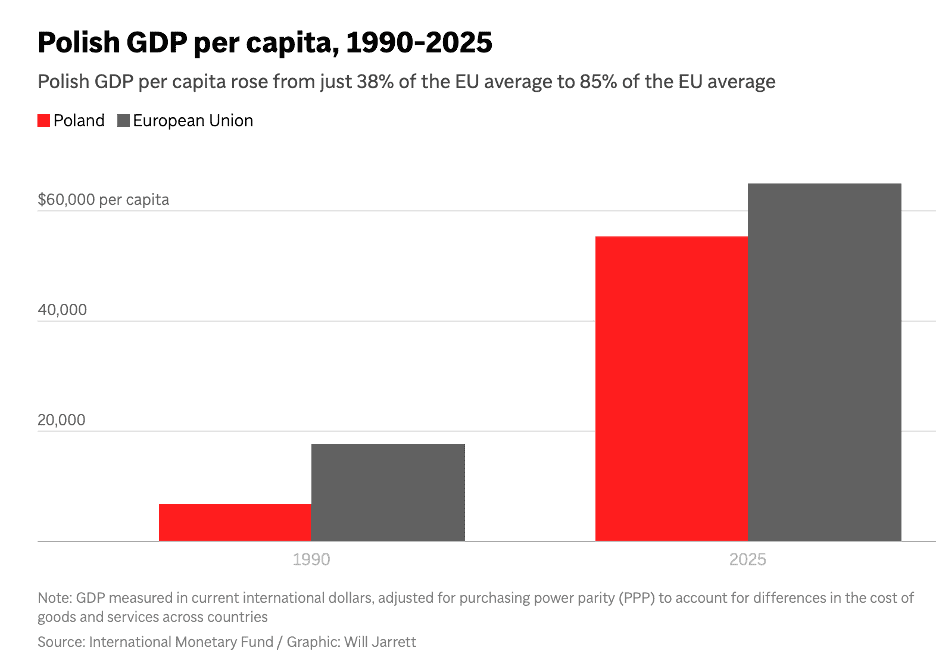
“Poland is now among the world’s 20 largest economies. How it happened – A generation ago, Poland rationed sugar and flour while its citizens were paid one-tenth what West Germans earned. Today, the economy of the country has edged past Switzerland to become the world’s 20th largest with more than $1 trillion in annual output. In 35 years — a little less than one person’s working lifetime — Poland’s per capita GDP rose to $55,340 in 2025, or 85% of the EU average. That’s up from $6,730 in 1990, or 38% of the EU average and now roughly equal to Japan’s $52,039, according to International Monetary Fund figures measured in today’s dollars and adjusted for Poland’s lower cost of living. Poland’s economy has grown an average 3.8% a year since joining the EU in 2004, easily beating the European average of 1.8%.”, AP News, March 16, 2026
Editor’s Note: I lived in Eastern Europe in 1999-2001 running a company doing business in the Czech republic, Hungary and Poland. In those days Poland was by far the poorest of the three countries. The GDP/capita of Poland was ~US$4,090 in 1999 versus US$55,340 today
============================================================================================
United Kingdom
“U.K. Economy Unexpectedly Stalled in January – GDP showed no growth, compared with a 0.1% rise in December. The U.K. economy stalled unexpectedly in January, with a sustained return to modest growth likely to be hindered further by the rise in energy prices and uncertainty that has accompanied the conflict in the Middle East. Gross domestic product showed no growth in the month, compared with a 0.1% rise in December, the Office for National Statistics said Friday. Production output slipped on month in January, while services stagnated, according to the ONS.”, The Wall Street Journal, March 13, 2026
=============================================================================================
United States
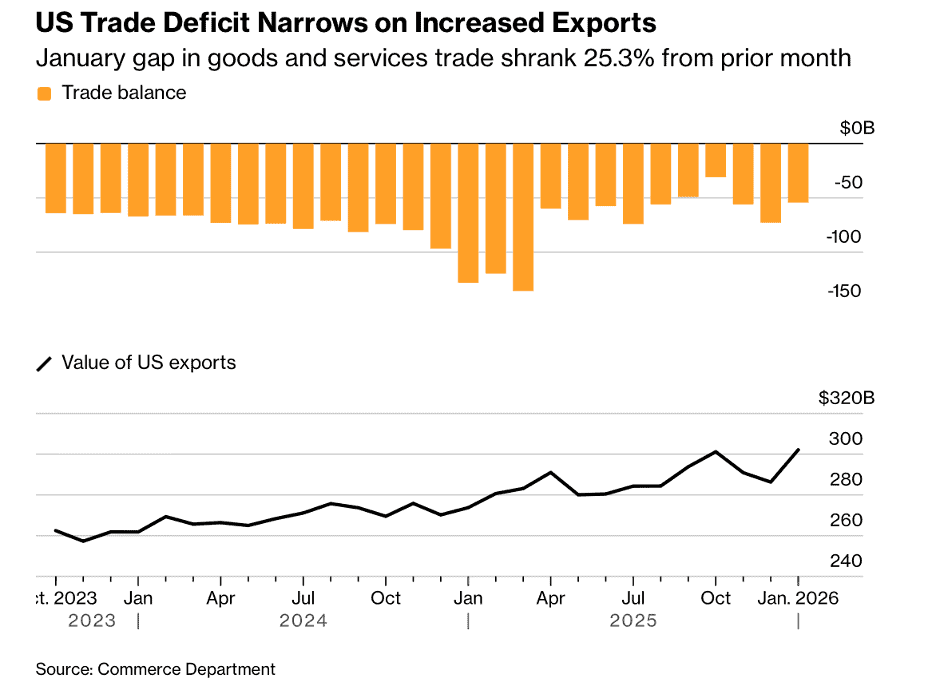
“US Trade Gap Narrowed in January by More Than Projected – The US trade deficit narrowed in January as exports increased, coming off of a turbulent year for domestic importers contending with erratic tariff policy. Exports increased 5.5% in January from the prior month, fueled by outbound shipments of nonmonetary gold and other precious metals, as well as computers and aircraft. The gap in goods and services trade shrank to $54.5 billion, with overall imports falling 0.7%, reflecting a decline in pharmaceuticals.”, Bloomberg, March 12, 2026
=============================================================================================
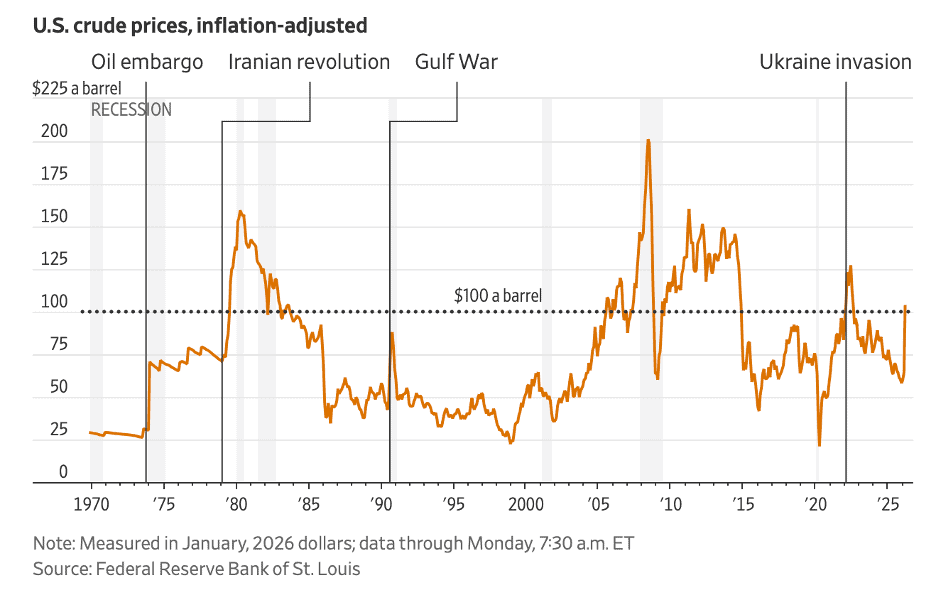
“Here’s Where the U.S. Economy Is Most Vulnerable to Iran War – Previous Mideast conflicts have caused recession. Today’s economy has more insulation from oil shock, but is showing some strains. The Middle East conflict has pushed oil prices to nearly four-year highs, increasing gasoline and diesel prices by 65 cents and $1.13 respectively. Analysts warn that costlier fuel could raise U.S. inflation and curb consumer spending, potentially slowing economic growth. Airlines and farmers face rising costs, while the average 30-year fixed mortgage rate rose to 6.11% as of March 12.”, The Wall Street Journal, March 13, 2026
============================================================================================
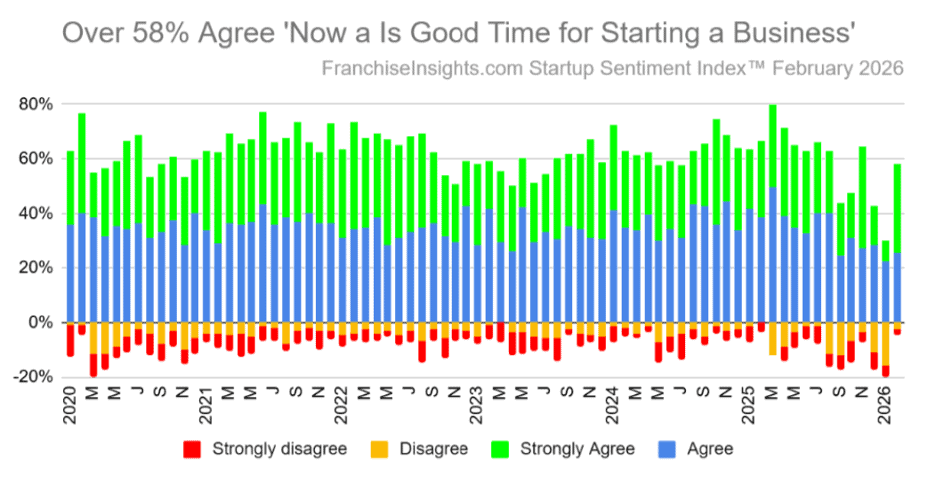
“Small Business Startup Sentiment Rebounds – Startup sentiment rebounded in February 2026 surveys as business buyer surveys showed 58.1% of persons exploring ownership agree or strongly agree that “now is a good time for startup”, up from 30% in December. This increase in sentiment about business conditions is consistent with a modest February increase in consumer confidence and revised January Conference Boardsurvey readings. In January, half (50%) of respondents “neither agreed nor disagreed” with the statement “now is a good time for starting a business”, but they were more confident in February, with less than 5% saying they “disagreed” or “strongly disagreed” with the positive sentiment. Coincidently, 58.1% of respondents say they are more likely to start a business now than three months ago.”, Franchise Insights and News, March 11, 2026
++++++++++++++++++++++++++++++++++++++++++++++++++++++++++++++++++++++++++++++++++++++++++++++
The Accredited Franchise Supplier certification
+++++++++++++++++++++++++++++++++++++++++++++++++++++++++++++++++++++++++++++++++++++++++++++
Global Brand & Franchise Sector News
“Why Private Equity Should Bet On International Franchising – Private equity (PE) has become one of the strongest growth engines in franchising. Over the past two decades, investors have helped modernize operations, drive scale, and professionalize management across dozens of leading brands. Yet one area often doesn’t receive the attention it deserves: international expansion. Some of the most successful PE investors in franchising have made acquiring the rights to franchises with international expansion a key aspect of their growth strategy. International expansion is not a distraction. It is a multiplier. It creates diversified, sustainable royalties that compound over time while up-front fees generate cash today. In the end, international expansion is not just about new markets; it’s about building a more valuable company.”, Franchising.com, March 15, 2026. This article is by your newsletter Editor, William Edwards.
===========================================================================================================
“Wendy’s plans 60 new restaurants in Mexico through partnerships – Wendy’s (WEN) currently operates 40 restaurants across Mexico, including locations in Ciudad Juarez, Chihuahua, Monterrey, and Mexico City. Wendy’s long-term goal targets 400 restaurants across the country. By comparison, McDonald’s (MCD) operates 374 restaurants, while Burger King (QSR) operates 435 restaurants across Mexico.”, Seeking Alpha, March 4, 2026
==============================================================================================
“Slim Chickens Makes Ireland Debut with First Restaurant in Dublin – Proven Multi-Unit Franchise Partners Extend Growth into a New International Market. Located in the Dundrum Town Centre, one of Ireland’s premier shopping and dining destinations, the restaurant serves as a lunch point for the brand’s entry into the Irish market and demonstrates the system’s ability to adapt to high-footfall, urban retail environments while maintain operational consistency.”, Franchising.com, February 11, 2026.
==============================================================================================
“Franchising North of the Border: Legal Realities for U.S. Brands Entering Canada – Despite recent political commentary about Canada becoming America’s 51st state, Canada remains a sovereign nation with its own legal system, judiciary, and rule of law. For U.S. businesses, this distinction matters in practical and legal terms. In contrast to the U.S., which has both federal and state-level franchise legislation, Canada regulates franchising exclusively at the provincial level.”, Franchising.com, March 13, 2026. From and article by Jennifer Shayko is a franchise lawyer with Aird & Berlis LLP.
==============================================================================================
“How to Know Your Emerging Franchise Brand is Ready for International Expansion – International expansion is one of the fastest ways to stress-test a brand. Distance, as well as cultural and legal differences, magnify every gap from support and training to documentation to unit economics. If a system isn’t truly ready, those gaps compound quickly. While each brand’s path is different, there are a few practical benchmarks and readiness signals that come up again and again.”, Franchising.com, March 13, 2026. From an article by Jason Carter, the chief operating officer of Shoot 360.
==========================================================================================
“Papa John’s Draws Fresh Takeover Interest From Qatari-Backed Fund – Irth Capital submits bid to take pizza-chain private. Irth offered to pay $47 per share for the business, the people said, which would value Papa Johns at around $1.5 billion. The offer price represents a roughly 50% premium to where Papa Johns’s shares traded before Irth’s bid was submitted, the people said. Irth, an existing shareholder in Papa Johns, recently increased its effective stake to around 10%, one of the people familiar with the matter said.”, The Wall Street Journal, March 12, 2026
============================================================================================
“The Biggest Fast Food Chain In The World Is One You’ve Probably Never Heard Of – Move over, McDonald’s. Mixue Ice Cream & Tea, headquartered in China, has more locations than any other chain in the world, with more than 45,000 outposts. The brand is known for affordable soft-serve ice cream, teas, and other beverages. If its Chinese name, Mixue Bingcheng (which translates to honey snow ice city), doesn’t ring a bell, get ready for a frosty introduction. The beloved brand is known for soft-serve ice cream cones starting at just $1.19 and for teas and other beverages starting at $1.99. Its affordability is one of the biggest drivers of its mass appeal.”, Delish, March 10, 2026
================================================================================================
“Shell to Sell Jiffy Lube to Monomoy in $1.3 Billion Deal – The sale includes the Jiffy Lube brand, franchisee Premium Velocity Auto and a network of stores owned and operated by independent franchisees. Jiffy Lube has more than 2,000 locations. Shell said it is “capitalizing on a strong market opportunity.” It said the divestment allows it to monetize an asset that isn’t central to its lubricants portfolio in the U.S. and reinvest in higher-return opportunities. Jiffy Lube makes up 6.5% of the volume of Shell’s U.S. and Canada total lubricants business.”, The Wall Street Journal, March 10, 2026
============================================================================================
“Gong cha buys 170 US stores from master franchisee – The purchase will help the bubble tea brand strengthen its U.S. system and ultimately speed up growth as it targets 1,000 units in the country. Gong cha recently announced an overhaul of its store model and operations that includes a new automated drink-making platform that cuts prep time for drinks by roughly a minute, the company said in a separate press release. This technology could help it take advantage of the expanding cold beverage market in the U.S. ‘Bringing this territory in-house allows us to further sharpen our development strategy and strengthen support for our franchise partners,’ said Geoff Henry, the company’s president for the Americas.”, Restaurant Dive, March 9, 2026
++++++++++++++++++++++++++++++++++++++++++++++++++++++++++++++++++++++++++++++++++++++++++++++
To receive our biweekly newsletter in your email every other Tuesday, click here – https://insider.edwardsglobal.com
+++++++++++++++++++++++++++++++++++++++++++++++++++++++++++++++++++++++++++++++++++++++++++++++
Our Mission, Information Sources & Who We Are
Our biweekly global business update newsletter focuses on what is happening around the worldthat impacts new trends, health, consumer spending, business investment, the franchise sector, economic development, and travel. We daily monitor 30+ countries, 40+ international information sources and six business sectors to keep up with what is going on in this ever-changing business environment. And our GlobalTeam™ on the ground covering 25+ countries provide us with updates about what is actually happening in their specific countries. We do not get involved in or report on politics!
+++++++++++++++++++++++++++++++++++++++++++++++++++++++++++++++++++++++++++++++++++++++++++
William “Bill” Edwards: CEO & Global Trade Advisor “Is Uniquely Qualified to Steer Sr. Executives Successfully Through the Complex Waters of Going Global”. With five decades of successful international business experience spanning virtually every corner of the world and many business sectors, Bill Edwards understands the global business landscape like no other. He has been a County Master Franchisee in five countries in Asia, Europe, and the Middle East; the Senior VP for a franchisor operating in 15 countries and a full-service global management consultant since 2001 helping 40+ franchisors expand into new countries. Bill knows how to turn the challenges in taking a brand global into opportunities.
For a complimentary 30-minute consultation on how to take your business into new countries successfully. For a complimentary call with Bill Edwards click on the QR code or contact Bill at bedwards@edwardsglobal.com and +1 949 375 1896
And download our latest chart ranking 40+ countries as places to do business, used by many companies for strategic planning, at this link:
Our latest GlobalVue™ 40 country ranking
Biweekly Global Business Newsletter Issue 155, Tuesday, March 3, 2026
“The more you know about the past, the better prepared you are for the future.”
Welcome to the 155th Edition of the Biweekly Global Business Update – As we have learned once again over the past few days, we cannot control wars, elections, or geopolitical rivalry. We can control preparedness, financial discipline, partner selection, and long-term orientation. The companies that will thrive in this cycle will not be those that predicted events correctly. They will be those built to withstand them, those that are resilient. That is the task in front of us as global businesspeople.
We are operating in a different global environment than we were just a few years ago. Tariff policy remains fluid. AI is accelerating competitive cycles. Capital markets are repricing risk. Wars in Europe and the Middle East continue to affect energy markets, shipping routes, defense spending, and political alignment. Tensions in Asia remain unresolved. Geopolitical fragmentation is shaping supply chains, regulatory regimes, and capital flows in real time.
For those of us in global business, this is not background noise. It is the operating framework. The proper response is not optimism or pessimism. It is discipline and resilience.
Planning must be continuous. Static projections have limited value in a world of sanctions risk, tariff shifts, currency volatility, and regulatory change. Scenario modeling, downside preparation, and execution flexibility are now core management functions. No more 5-year strategic plans.
Geopolitical literacy has moved to the center of board-level decision-making. Active conflicts and regional instability influence insurance costs, logistics, commodity pricing, cybersecurity exposure, and capital access. Political risk can no longer be delegated or ignored.
Balance-sheet strength matters. Liquidity, conservative leverage, diversified sourcing, and regional redundancy are strategic assets in a conflict-prone, interest-rate-sensitive environment. As Winston Churchill once said, “However beautiful the strategy, you should occasionally look at the results.”
Markets will always react to headlines. Effective leadership does not. It evaluates exposure, recalibrates when necessary, and moves forward deliberately.
International expansion should be phased and intentional — city by city, partner by partner, capital deployed carefully. Lack of focus is punished quickly in volatile cycles.
This edition’s book review highlights: In “Overreach: How China Derailed Its Peaceful Rise” Dr. Susan L. Shirk (2022) delivers one of the clearest explanations of how China’s carefully managed “peaceful rise” shifted into a far more assertive global posture. For decades, China’s rise to power was characterized by its reassurance that this rise would be peaceful. Then, as Dr. Shirk, shows in this sobering, clear-eyed account of China today, something changed.
Drawing on decades of research and direct policy experience, she makes an important point: China’s current trajectory is not simply the product of one leader’s ambition. It reflects deeper institutional dynamics, domestic political pressures, bureaucratic competition, and rising nationalism that gradually reduced strategic restraint.
++++++++++++++++++++++++++++++++++++++++++++++++++++++++++++++++++++++++++++++++++++++++++++++
To receive our biweekly newsletter by email every other Tuesday, click here https://insider.edwardsglobal.com
+++++++++++++++++++++++++++++++++++++++++++++++++++++++++++++++++++++++++++++++++++++++++++++
The mission of this newsletter is to use trusted global and regional information sources plus our network of 20+ in-country Associates to update our global readers on key global and local trends that can impact the success of their businesses at home and abroad. We subscribe to about 40 international information sources to keep our readers up to date on the world’s business. We do not get involved with or report on politics!
PLEASE NOTE: Some of the information sources that we provide links to in our newsletter require a paid subscription to directly access them. Clicking on a link may not give the reader access to the content.
Edited and curated by: William (Bill) Edwards, CEO & Global Business Advisor, Edwards Global Services, Inc. (EGS), Irvine, California, USA. Contact Bill with questions, comments and contributions. Bedwards@edwardsglobal.com, +1 949 375 1896
Link to our current and past newsletters: https://edwardsglobal.com/geowizard/
+++++++++++++++++++++++++++++++++++++++++++++++++++++++++++++++++++++++++++++++++++++++++
First, A Few Words of Wisdom From Others For These Times
“The more you know about the past, the better prepared you are for the future.”, Theodore Roosevelt
“The essence of strategy is choosing what not to do.”, Michael Porter
“However beautiful the strategy, you should occasionally look at the results.”, Winston Churchill
+++++++++++++++++++++++++++++++++++++++++++++++++++++++++++++++++++++++++++++++++++++++++++
Highlights in issue #155:
The World’s Richest Countries vs. the Happiest Countries
Global Worries, Local Priorities
Transforming Europe: Bold moves to lift a continent
Vietnam is on track to overtake Canada as a source of U.S. imports
Where Food Inflation Will Hit Hardest in 2026
Global Cash Is Fueling a Historic Start for Latam Stocks
Argentina’s Economy Expands More Than Expected After Midterm Election
Franchise Global News Section: Applebee’s®, KFC® and Papa John’s®
++++++++++++++++++++++++++++++++++++++++++++++++++++++++++++++++++++++++++++++++++++++++++++
Interesting Data, Articles and Studies
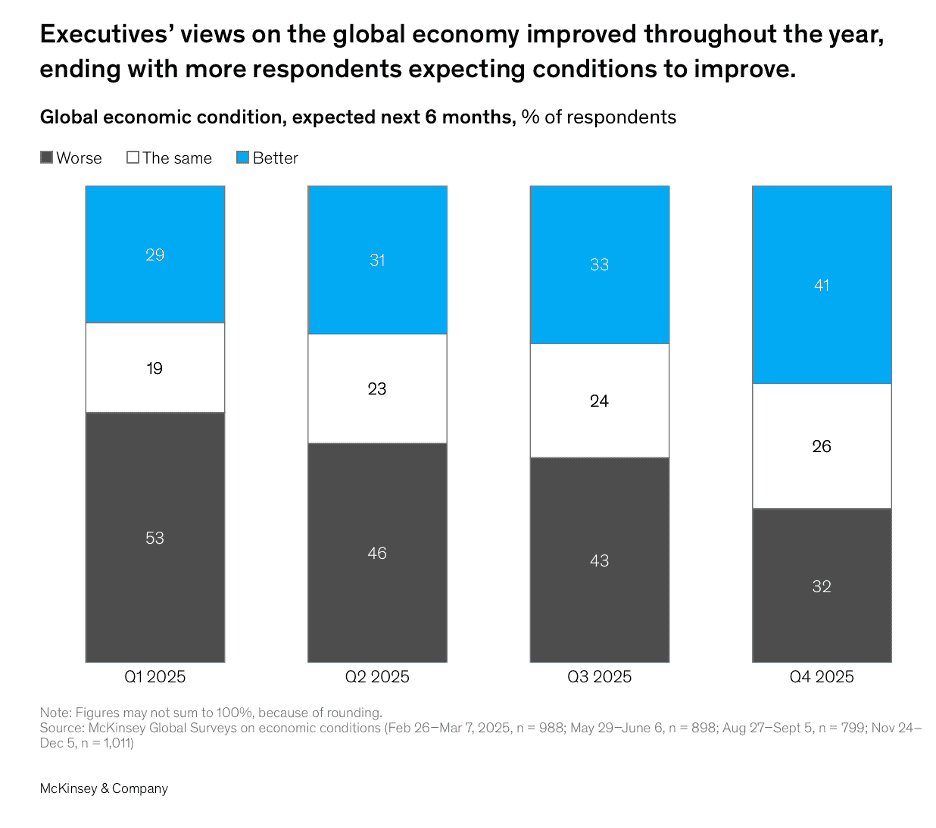
“Global Economics Intelligence executive summary, January 2026 – Overall global economic sentiment is improving, with businesses more positive about future growth in line with the IMF’s upward growth revisions; several central banks cut interest rates in December. After a year dominated by concerns over trade and global turbulence, businesses are entering 2026 with more optimism—despite continued uncertainty. Indeed, business sentiment was more buoyant in the final quarter of 2025 than in previous quarters, according to the recent McKinsey Global Survey on economic conditions. Executives were more upbeat about future economic expectations than they had been in previous 2025 surveys, with respondents expressing the brightest near-term expectations of the year—this in comparison with three previous quarters of largely negative assessments of current global economic and trade conditions.”, McKinsey & Co., February 24, 2026
Editor’s Note: This survey was published before the Iran event that started on February 28th.
===============================================================================================
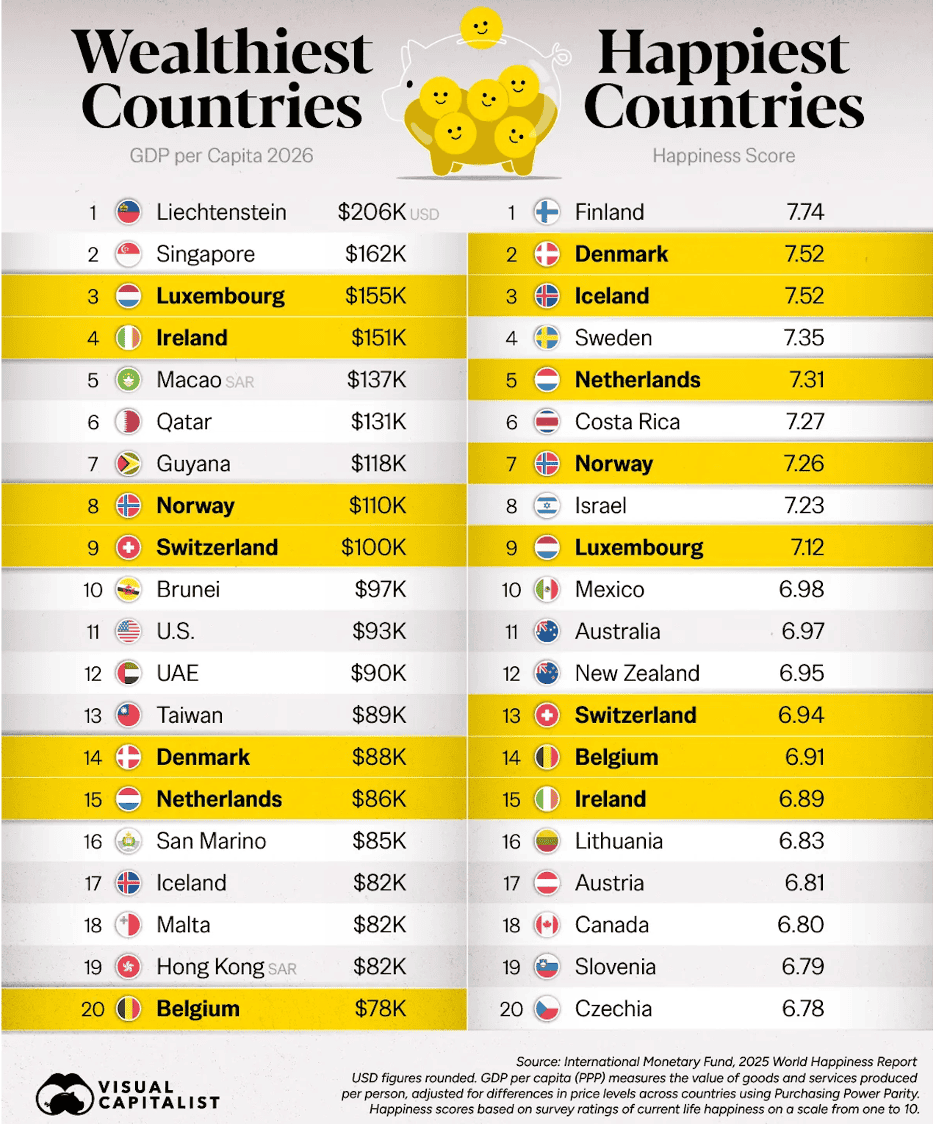
“The World’s Richest Countries vs. the Happiest Countries – Several Nordic countries rank among both the richest and happiest in the world. Some ultra-wealthy nations, including Singapore and Qatar, do not make the top 20 for happiness. Only a handful of countries appear near the top of both rankings. The world’s richest countries generate staggering income per person. But when it comes to life satisfaction, some of the wealthiest nations fall surprisingly short. This graphic compares GDP per capita (PPP), based on IMF data, with happiness scores from the World Happiness Report, which asks people to rate their lives on a scale from 0 to 10.”, Visual Capitalist, International Monetary Fund and the World Happiness Report, February 27, 2026
============================================================================================
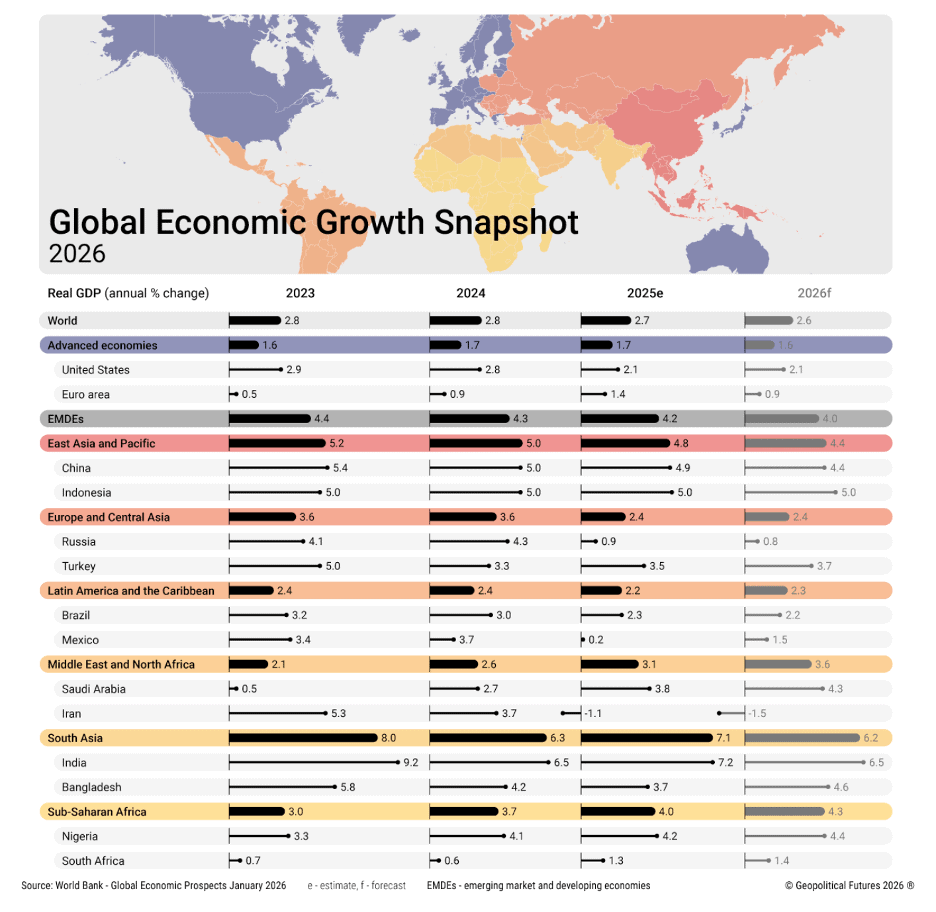
“Global Growth Expected to Slow in 2026 – 2025 could have been worse. According to the World Bank’s Global Economic Prospects report, the global economy in 2025 demonstrated greater resilience than expected, given trade tensions and political uncertainty, thanks to stronger-than-expected growth in the largest economies. To some extent, the surge of trade before the U.S. tariff hikes, as well as gradual monetary easing, supported economic activity. However, the World Bank does not see this hopeful trend continuing in 2026. As the favorable factors supporting the largest economies fade, the lagging impact of new trade barriers will come to the fore. This points to a continuation of trade tensions and policy uncertainty, leading the World Bank to forecast a decline in the rate of real GDP growth in several regions and economies.”, Geopolitical Futures, February 20, 2026
===============================================================================================
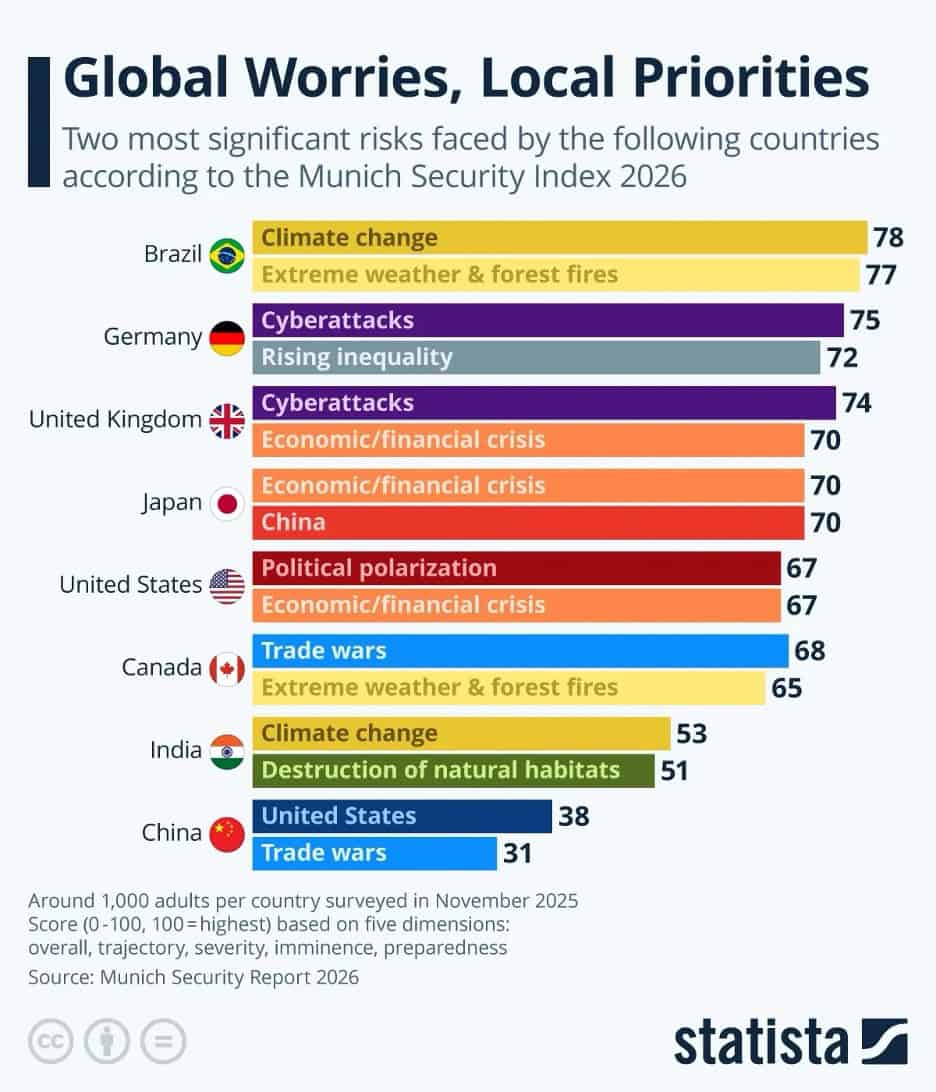
“Global Worries, Local Priorities – The Munich Security Index 2026 has unveiled divergence in the most pressing risks perceived by populations across the globe. Based on a survey of around 1,000 adults per country conducted in November 2025, the report highlights how different nations prioritize threats, ranging from climate change to geopolitical tensions. The index scores obtained (0 to 100) cover five dimensions of risks: overall impact, trajectory, severity, imminence and preparedness. In Brazil, concerns about climate change (index score=78), extreme weather and forest fires (77) top the list…. Similarly, India ranks climate change (53) and the destruction of natural habitats (51) as its primary worries….For Germany and the United Kingdom, cyberattacks (75 and 74, respectively) emerge as the foremost concern….Meanwhile, economic and financial crises are a shared priority in Japan (70), the United Kingdom (70) and the United States (67), while political polarization (67) is also seen as a major risk in America.”, Munich Security Report 2026, February 15, 2026
Editor’s Note: This report was released prior to the late February 2026 Iran conflict start
+++++++++++++++++++++++++++++++++++++++++++++++++++++++++++++++++++++++++++++++++++++++++++++++
Global Supply Chain, Energy, Commodities, Inflation, Taxes, Tariffs & Trade Issues
“Trump spares EU and UK from higher tariff rates for now – Tariffs on exports to the United States will remain at 10 percent. U.S. President Donald Trump has U-turned on his threat to raise his new global tariffs to 15 percent, sparing Britain and the European Union from higher rates. Trump’s decision not to follow through on the threat means continuity for British businesses. U.K. exports already faced 10 percent duties, plus Most Favored Nation (MFN) rates, under Trump’s “Liberation Day” tariffs.”, Politco EU, February 24, 2026
===============================================================================================
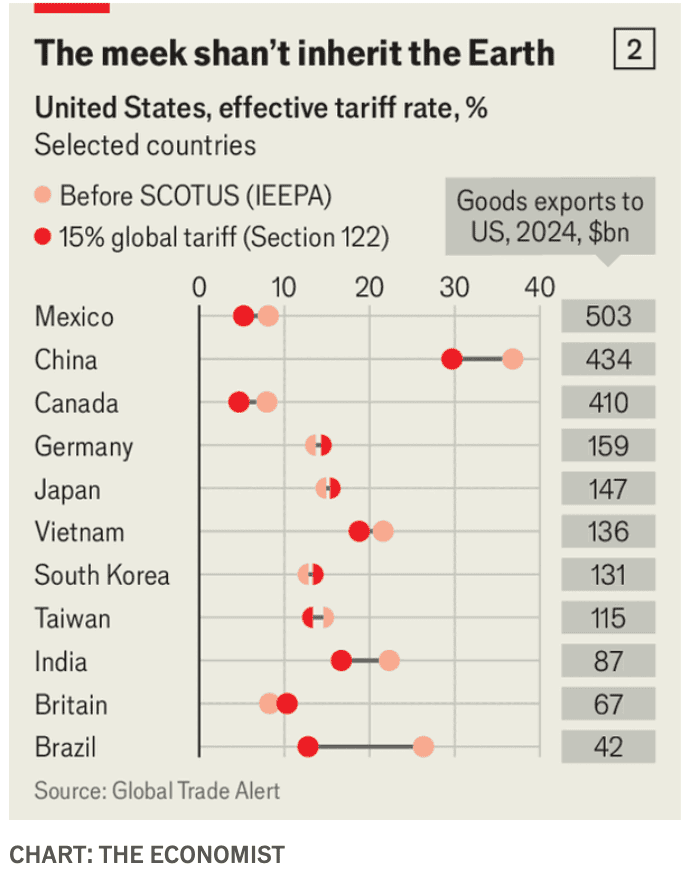
“America’s trade chaos is just beginning – Tariff wrangling will stretch through the rest of Donald Trump’s term, and beyond. On February 20th America’s Supreme Court struck down Donald Trump’s signature policy. The president claimed the International Emergency Economic Powers Act (IEEPA) of 1977 let him slap any tariffs he wanted on anyone for any length of time. The justices ruled 6-3 that Congress did not hide in IEEPA ‘a delegation of its birth-right power to tax within the quotidian power to ‘regulate’, as Chief Justice John Roberts wrote in the majority opinion. Within hours of the decision Mr Trump invoked Section 122 of the Trade Act of 1974, to levy 10% tariffs on all imports for 150 days from February 24th. The next day he said he would raise the level to 15%, the highest the law permits. Before the justices weighed in, America’s effective tariff rate was 13.7%, estimates the Yale Budget Lab. Swap IEEPA for Section 122 tariffs of 15% and this edges down to 12.2% (see chart 1). By comparison, the figure was 2-3% before Mr Trump took office for the second time in January 2025.”, The Economist, February 26, 2026
============================================================================================
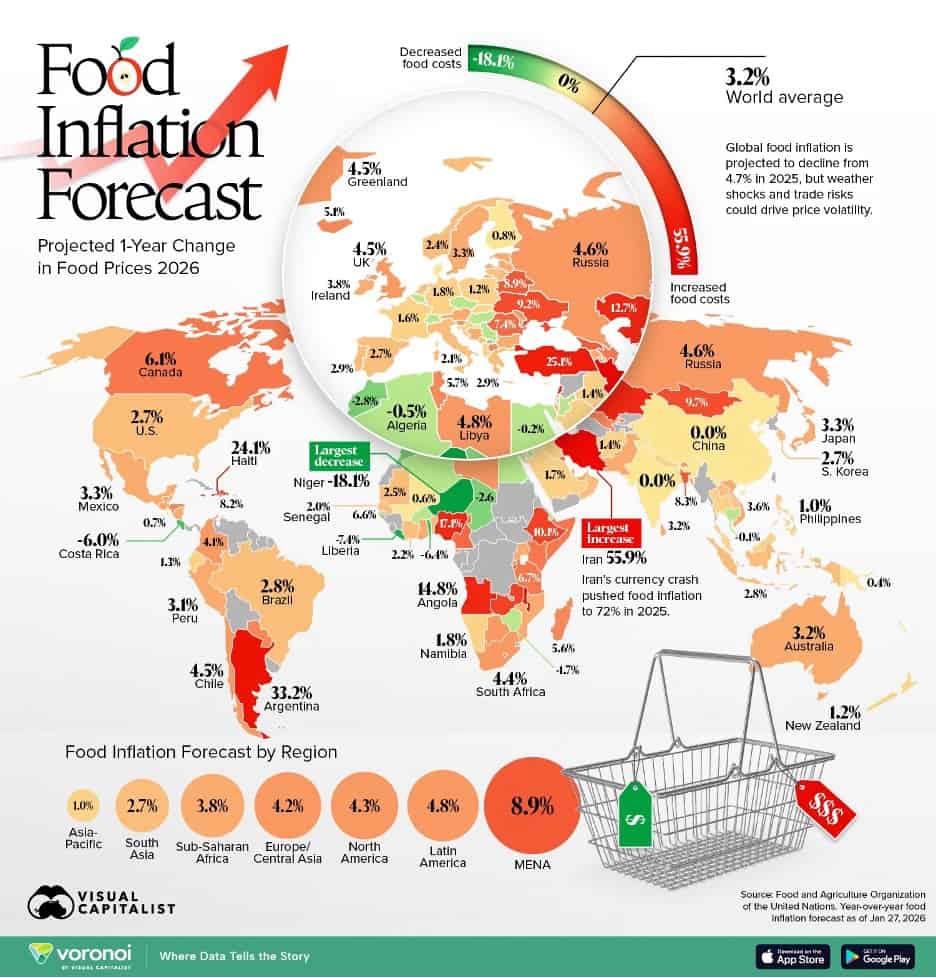
“Where Food Inflation Will Hit Hardest in 2026 – Iran tops the list with a projected 55.9% surge, far above the global average of 3.2%. Currency pressures and prior inflation spikes continue to ripple through food prices. Argentina (33.2%) and Türkiye (25.1%) rank second and third, continuing multi-year inflation trends in both economies. Countries like Malawi, Nigeria, Angola, Zambia, and Ethiopia all rank among the highest projected increases, underscoring ongoing food vulnerability in the region. Food prices remain one of the most persistent cost pressures for households worldwide. In 2026, grocery bills are projected to rise sharply in some countries, while remaining relatively stable in others. Food inflation is influenced by currency movements, commodity prices, trade disruptions, and domestic supply conditions. Countries experiencing currency depreciation or ongoing economic instability tend to see sharper increases in food costs.”, Visual Capitalist & Food and Agriculture Organization of the United Nations, February 25, 2026
===============================================================================================
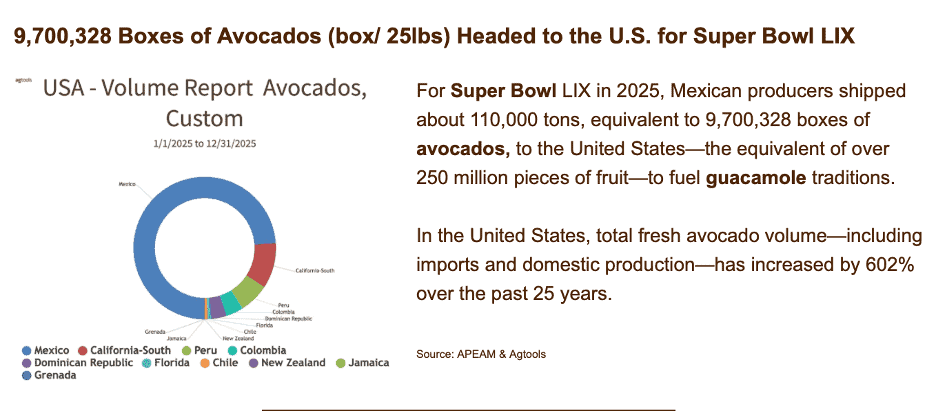
This really interesting infographic from 2025 is compliments of Martha Montoya, CEO of AgTools, Inc.
+++++++++++++++++++++++++++++++++++++++++++++++++++++++++++++++++++++++++++++++++++++++++++++++
Global & Regional Travel News
“Airspace closures across Middle East cause flight cancellations after strikes on Iran – The real-time flight tracking service FlightRadar24 showed airspace closures across the region on Saturday, including in the UAE, Qatar, Jordan, Iran, Iraq, Syria, Israel, Kuwait and Bahrain. Several major airports have suspended operations until further notice, including Dubai International Airport (DXB) — the world’s second busiest airport — Zayed International Airport (AUH) in Abu Dhabi and Hamad International Airport (DOH) in Doha. Though many other airports in the Middle East remain open, passengers should check with individual airlines for the latest updates before heading to the airport, as cancellations may vary. Both Gulf airlines and international carriers that fly through the region have issued travel waivers in light of the conflict, allowing passengers to easily change or cancel flights.”, The Points Guy, February 28, 2026
++++++++++++++++++++++++++++++++++++++++++++++++++++++++++++++++++++++++++++++++++++++++++++
Book Review
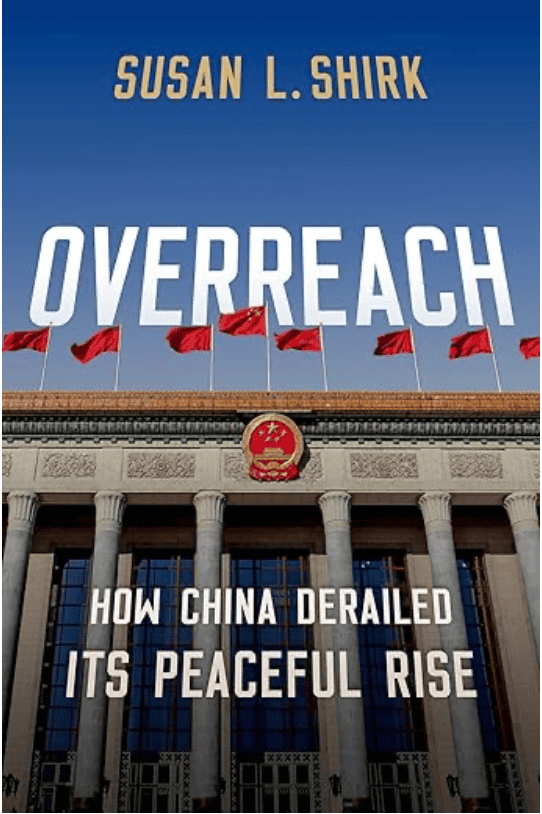
“In “Overreach: How China Derailed Its Peaceful Rise”, Dr. Susan L. Shirk, 2022, delivers one of the clearest explanations of how China’s carefully managed “peaceful rise” shifted into a far more assertive global posture. For decades, China’s rise to power was characterized by its reassurance that this rise would be peaceful. Then, as Susan L. Shirk, shows in this sobering, clear-eyed account of China today, something changed.
Drawing on decades of research and direct policy experience, she makes an important point: China’s current trajectory is not simply the product of one leader’s ambition. It reflects deeper institutional dynamics, domestic political pressures, bureaucratic competition, and rising nationalism that gradually reduced strategic restraint.
Shirk shows how China’s expanding economic and military power, combined with internal legitimacy concerns, produced policies that unsettled neighbors and hardened U.S. attitudes. Actions in the South China Sea, toward Taiwan, and through economic coercion accelerated distrust and fueled structural rivalry with the United States. What we are now experiencing is not a temporary diplomatic downturn. It is sustained strategic competition.
Her warning is equally important: misreading China’s internal drivers increases the risk of overreaction abroad — and miscalculation on either side. For global business leaders, that distinction matters. Today’s friction is rooted in long-term structural forces, not short-term political cycles.
That reality should shape how we assess risk, partnerships, supply chains, and long-term China exposure.
Five Takeaways for Global Business Leaders
1. China’s external behavior is heavily influenced by internal political dynamics.
2. Strategic rivalry with the United States is structural and likely enduring.
3. Economic interdependence no longer guarantees stability.
4. Domestic legitimacy pressures in Beijing affect global markets.
5. Miscalculation — more than ideology — is the principal risk to global business stability.
+++++++++++++++++++++++++++++++++++++++++++++++++++++++++++++++++++++++++++++++++++++++++++
+++++++++++++++++++++++++++++++++++++++++++++++++++++++++++++++++++++++++++++++++++++++++++++
Country & Regional Updates
Latin America
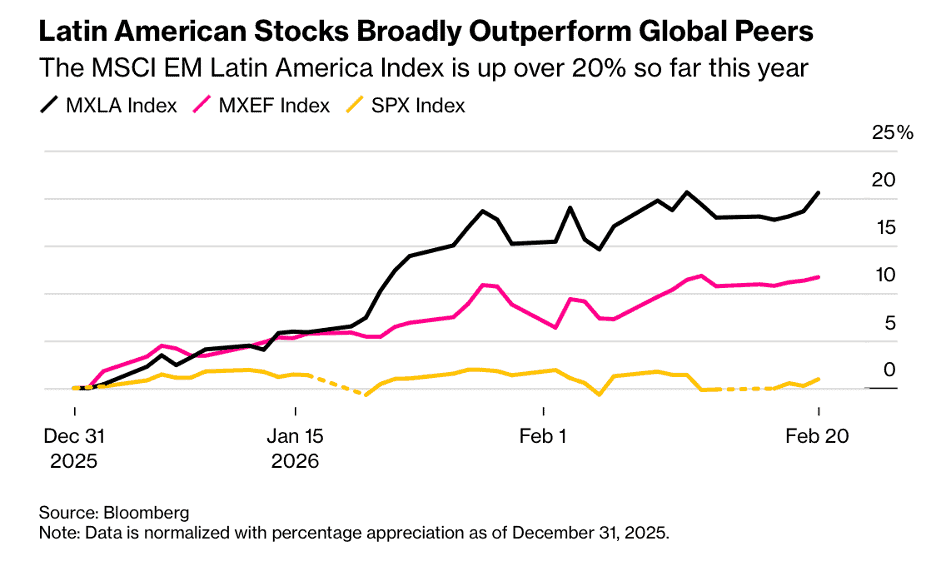
“Global Cash Is Fueling a Historic Start for Latam Stocks – Global investors are piling into Latin American stocks at the fastest clip in a decade, sending markets across the region to multi-year highs. The MSCI EM Latin America Index has jumped over 20% in 2026, marking the strongest start to the year since 1991, and has capped a ninth successive week of gains. Investors see potential for local policy shifts and lower interest rates ahead of presidential elections in Brazil and Colombia, and the strike-down of President Trump’s tariffs is another tailwind for the region’s equity revival.”, Bloomberg, February 22, 2026
=============================================================================================
Argentina
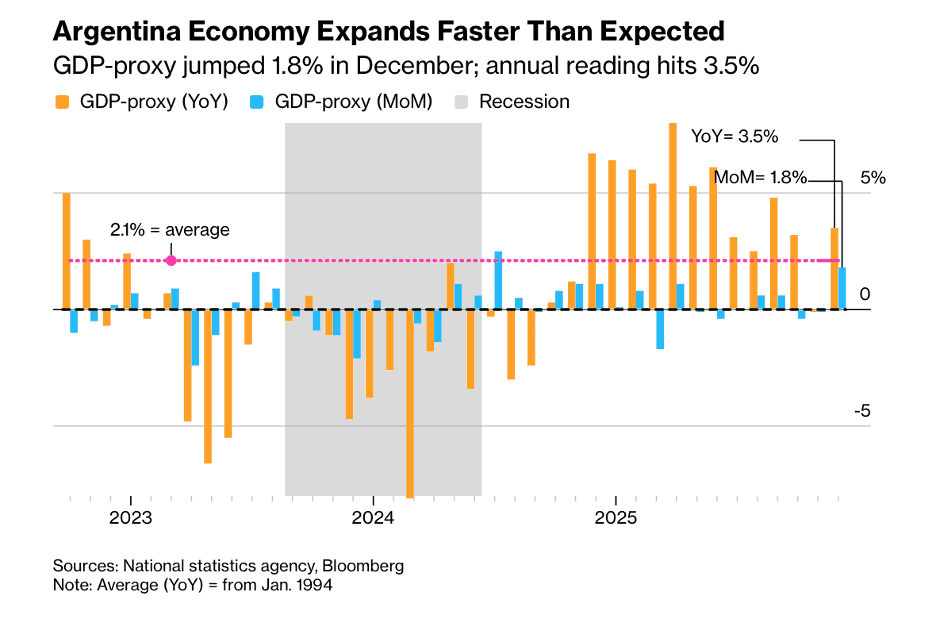
Argentina’s economy grew more than expected in December due in part to a historic wheat harvest that offset the fallout from a pivotal midterm election. From a year earlier, the economy grew 3.5%, far surpassing the estimate of zero growth from economists surveyed by Bloomberg. The data should provide some relief to President Javier Milei’s administration and bolster hopes for his macreoeconomic program. The farm and finance sectors contributed significantly to the economy’s growth in last year’s final month, while manufacturing and retail fell. Overall economic growth was slow last year as monthly activity expanded only 0.02% in the first 11 months of the year, according to a research note from Goldman Sachs Group Inc.”, Bloomberg, February 24, 2026
=============================================================================================
Southeast Asia
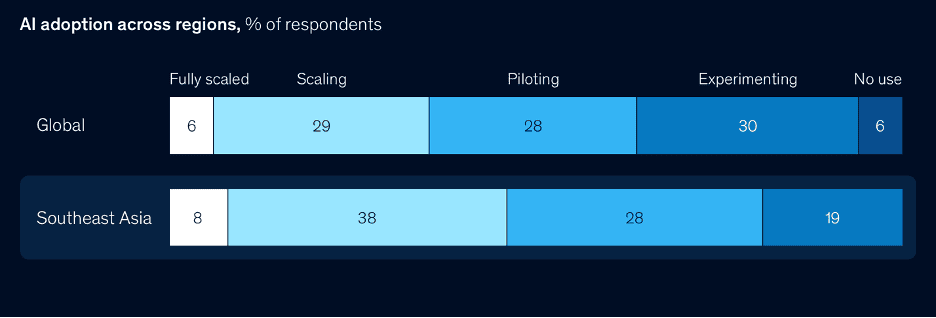
“AI in Southeast Asia: An era of opportunity – A region on the rise for
AI opportunities. AI adoption in Southeast Asia is at an inflection point—moving rapidly from exploration to deployment. With strong digital foundations, tech-savvy enterprises, and a young, connected population, the region’s major economies are accelerating toward global competitiveness. Nearly half of Southeast Asian companies surveyed have moved beyond AI pilots, putting the region slightly ahead of the global average. This momentum is driven by a mobile-first consumer base, skilled talent, and local solution providers—creating fertile ground for rapid AI scaling, despite limited policy intervention.”, McKinsey & Co., February 10, 2026
============================================================================================
Canada
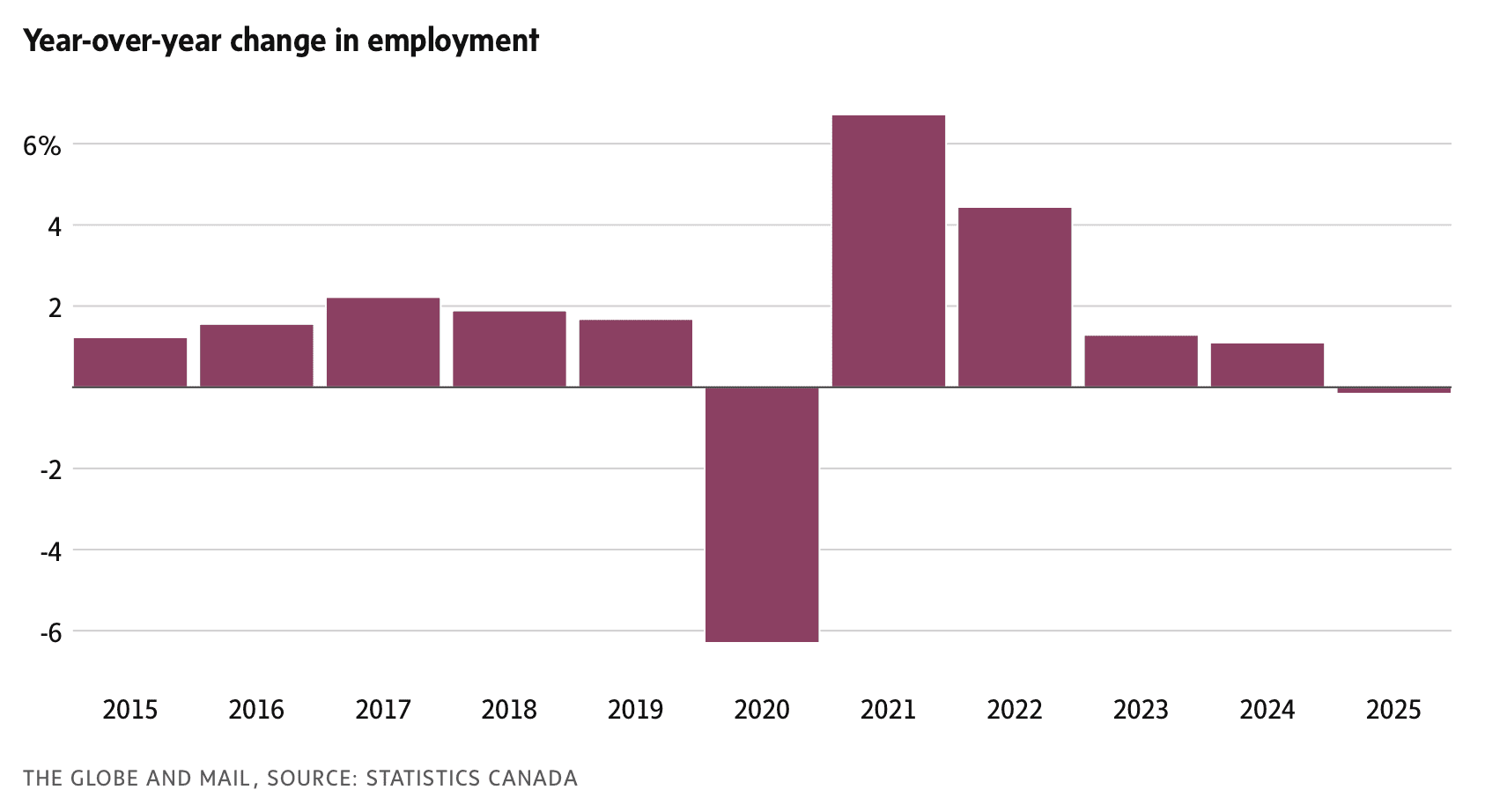
“Canadian job growth flatlines in 2025 on trade war, population slowdown – Canada’s job growth stalled in 2025 as key sectors of the economy, such as manufacturing, were hit hard by the trade war, weakening labour demand and prompting employers to shelve hiring plans. The number of employees nationwide receiving pay and benefits from an employer fell by 28,300 or 0.2 per cent last year, Statistics Canada reported on Thursday. At the same time, Canada’s population has started to decline because of major immigration policy changes that are aimed at reducing the number of temporary residents in the country.”, The Global and Mail, February 26, 2026
===========================================================================================
China
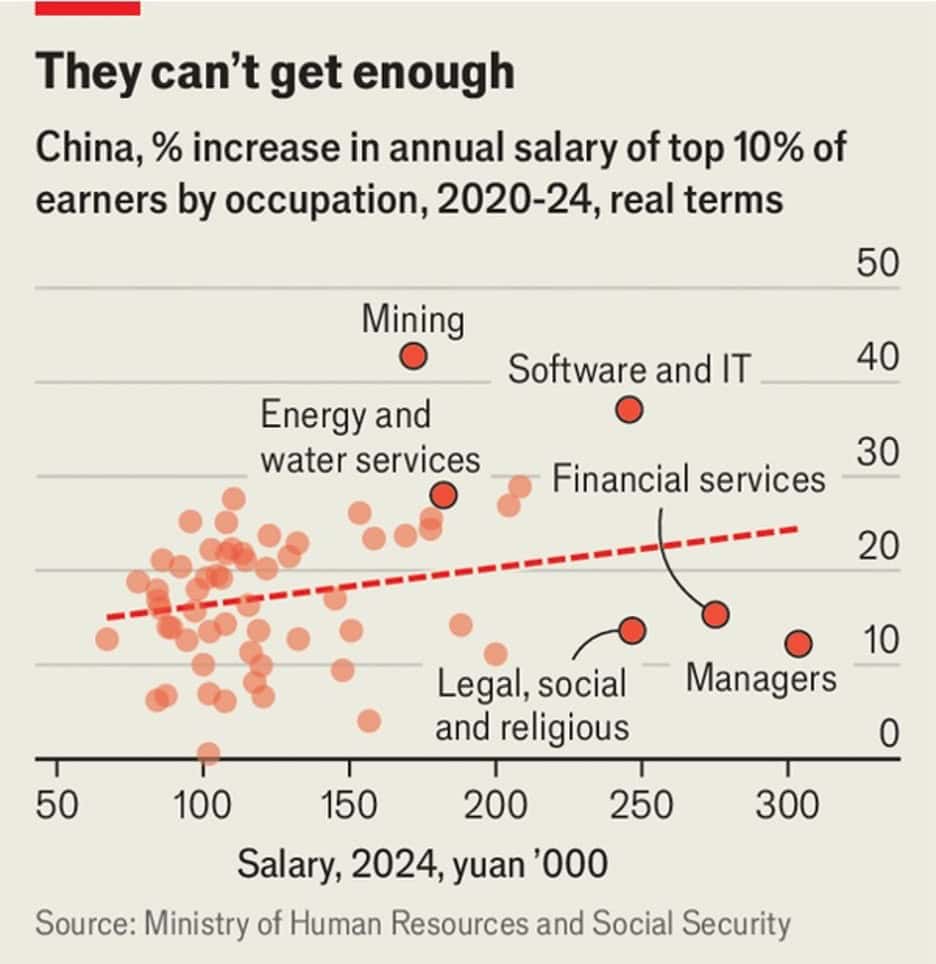
“How to get rich in modern China – Some of the country’s brightest are cashing in on a state-backed surge. A property bust and chronic deflation have eroded people’s assets, incomes and prospects. Residential property, where Chinese people store the bulk of their wealth, has lost a fifth of its value on average since 2021. Wage growth is weak. And youth unemployment is hovering around 17%. But in a sea of people losing, one group is winning. They are what Xi Jinping, China’s leader, calls nongchaoer: a Chinese term referring to those who “ride the tide” of great economic changes. Today that tide is flowing towards the strategic technologies, such as artificial intelligence and robotics, that dominate the country’s five-year plans for tech supremacy……Smart, young and sometimes from modest backgrounds, the nongchaoer do not flash their growing wealth.”, The Economist, February 24, 2026
============================================================================================
Europe
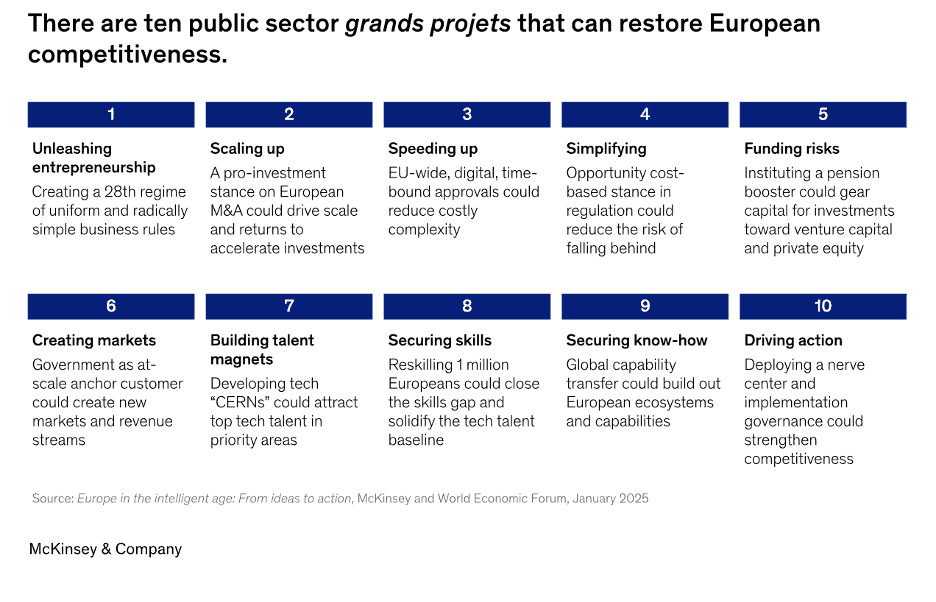
“Transforming Europe: Bold moves to lift a continent – Europe is starting to reform its investment environment, but there’s no time to lose. Standout companies can take the lead with bold strategic moves that drive their own performance—and a continent’s. This article extends our analysis of the critical contribution companies can make to a European economic renaissance, including through a more strategic approach to collaborating with the public sector to shape the investment environment. Such an economic renaissance would benefit everyone. As the McKinsey Global Institute argues in its new book, A Century of Plenty, it is economic growth and rising incomes that enable many of the things Europeans care about: better health and education outcomes, better physical and social infrastructure, investments into climate change mitigation and adaptation, and investments into security and sovereignty. With growing consensus on what’s needed, now’s the time for both sides to accelerate.”, McKinsey & Co., January 20, 2026
=============================================================================================
South Korea
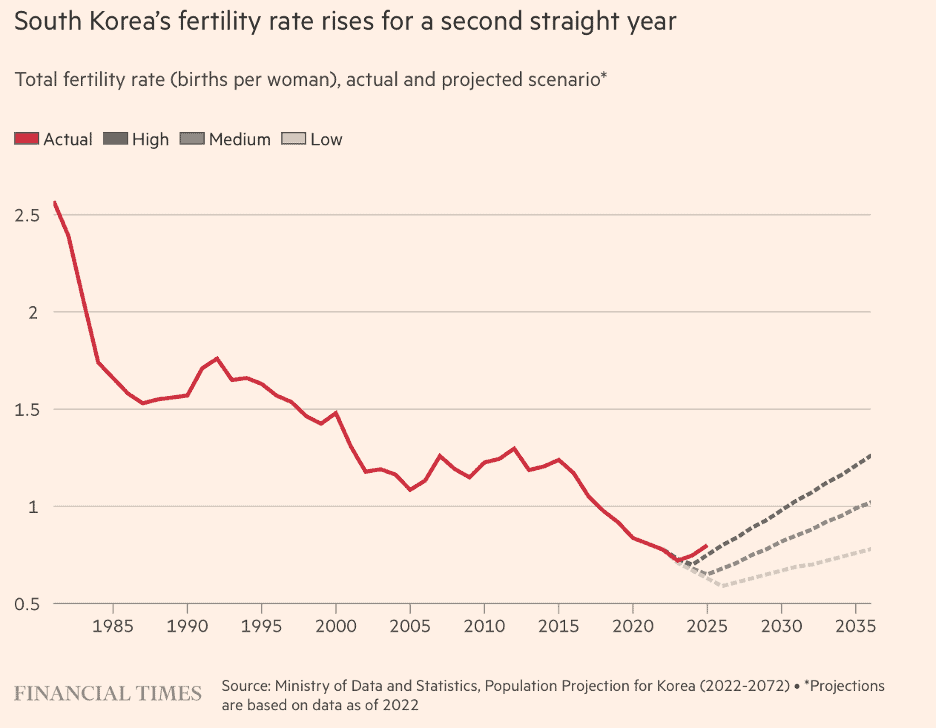
“South Korea baby bump grows – Fertility rate and total births rise for second year but experts say demographic outlook remains gloomy. Korea’s total fertility rate — the average number of children a woman is expected to have over her lifetime — climbed to 0.8 last year, up from 0.75 in 2024 and an all-time low of 0.72 in 2023, official data released on Wednesday showed. The figure was better than even the government’s most optimistic projections for 2025 but remains far below the 2.1 threshold that demographers consider necessary to maintain a stable population, absent net immigration. South Korea has been grappling with a long-term demographic crisis, as an ageing and shrinking population raises pensions and healthcare costs and hits projections for economic output.”, The Financial Times, February 24, 2026
============================================================================================
Turkey
“Turkey M&A Volume Surges as Mega Deals Rebound, Deloitte Says – A total of 450 transactions were completed in 2025, up 6% from 2024, with the total deal size increasing 88% to $16.2 billion. The upswing was driven by mega deals, with seven transactions valued at more than $500 million representing 44% of the total deal size. Financial investor activity more than doubled in Turkey in 2025, with total transaction value rising 109% to $4.6 billion. Larger deals were fueled in part by improving investor confidence, which eased the way for companies and financiers to revive previously postponed plans, Deloitte said. The largest deal of the past year was the $1.7 billion privatization of Turkey’s Vehicle Inspection Stations by the MOI Consortium.”, Bloomberg, February 23, 2026
=============================================================================================
United States
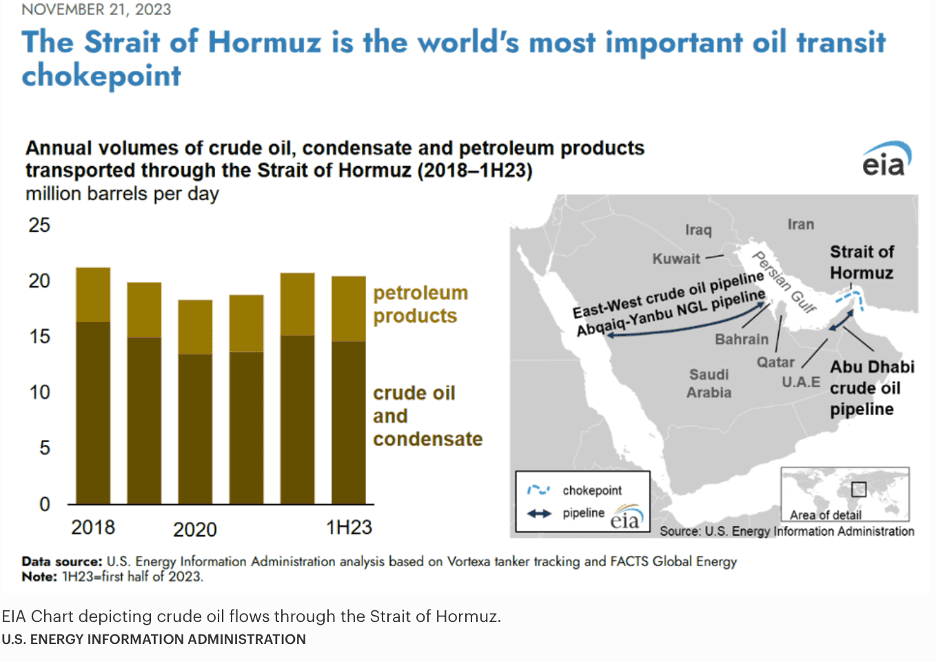
“Gasoline Prices Will Rise – But How High And For How Long? Amid the myriad uncertainties created by the new conflict in the Middle East region, the one thing we can be sure of is that gasoline prices at the pump will go up in the United States and around the world. The only real questions in that regard are: How high will they go, and how long will they linger? However, in this current conflict in which the United States and Israel are involved in a kinetic exchange with Iran, a single factor holds the key. That single factor is the Strait of Hormuz, the choke point at the mouth of the Persian Gulf through which 20-25% of global crude supply flows onto the global market every day, and whether Iran might mount a successful attack to shut that flow down.”, Forbes, February 28, 2026
=============================================================================================
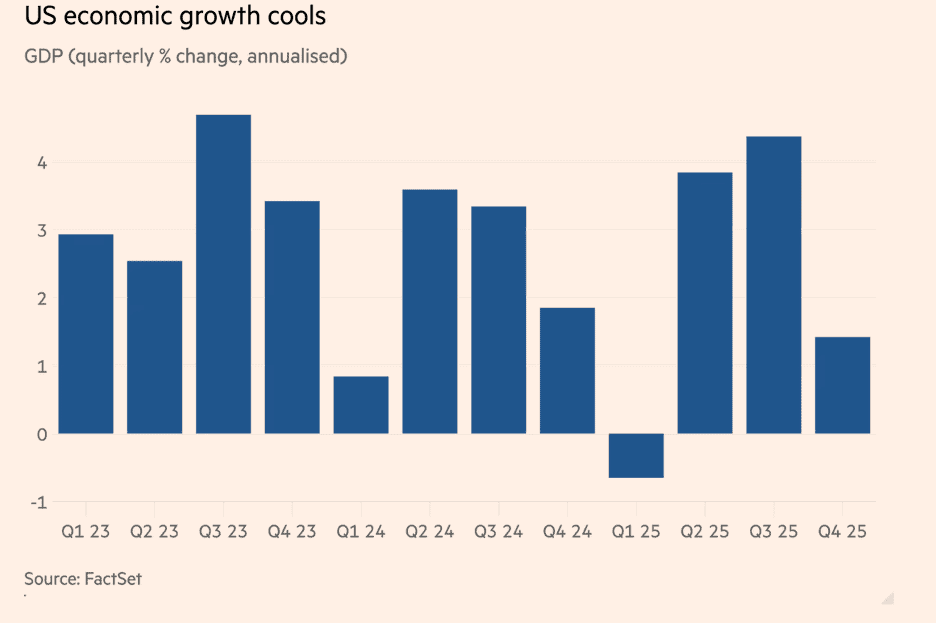
“US GDP growth falls sharply to 1.4% rate in fourth quarter – Figure hit by drop in government spending during federal shutdown comes in far below analysts’ expectations. Friday’s figure from the Bureau of Economic Analysis was sharply down from 4.4 per cent in the previous three-month period and fell well short of expectations of 2.8 per cent in a Bloomberg poll of economists. It comes after an unprecedented 43-day federal government shutdown in October and November that the BEA said knocked a point off growth. A slowdown in consumer spending also weighed on GDP, offset slightly by an uptick in business investment.”, The Financial Times, February 20, 2026
============================================================================================
Vietnam
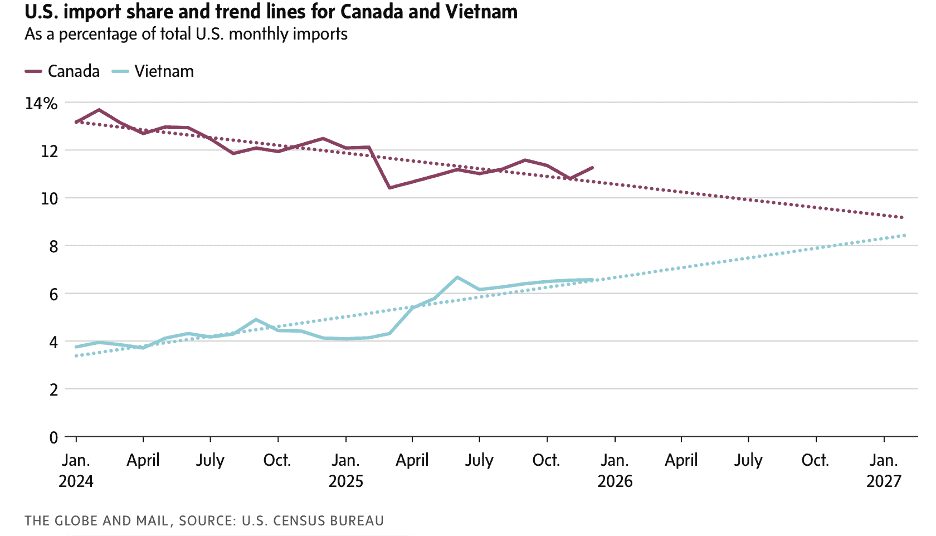
“Vietnam is on track to overtake Canada as a source of U.S. imports – While U.S. tariffs have hammered Canada’s export sector, Vietnam has emerged a surprising winner in the trade dispute, despite facing an effective tariff rate four times higher than that of Canada. In fact, if the current trajectory of U.S. imports holds, Vietnam could surpass Canada as a share of U.S. imports, highlighting the fraying trade links between Canada and the United States. Under the Trump 1.0 and Biden administrations, the U.S. sought to lessen its reliance on China for low-cost imports through the use of tariffs and other trade restrictions. As such, manufacturers shifted a lot of production to Vietnam instead. Last year, Vietnam’s exports to the U.S. soared 42 per cent to US$194-billion, while U.S.-bound shipments from Canada declined 7 per cent to US$383-billion.”, The Global and Mail, February 27, 2026
++++++++++++++++++++++++++++++++++++++++++++++++++++++++++++++++++++++++++++++++++++++++++++++
The Accredited Franchise Supplier certification
+++++++++++++++++++++++++++++++++++++++++++++++++++++++++++++++++++++++++++++++++++++++++++++
Global Brand & Franchise Sector News
“Papa Johns is closing 300 restaurants and cutting staff – The pizza chain’s North America same-store sales have fallen for seven of the past eight quarters. It is cutting 7% of its workforce while closing underperforming restaurants and eliminating menu items. Papa Johns CEO Todd Penegor also said that the chain is planning ‘at least $25 million in cost savings outside of marketing’ through 2027, with $13 million expected this year. Penegor said that the company is changing its organizational structure to ‘increase efficiency and simplify operations’. The company is dealing with a pizza market that has been weak for the past two years along with a fast-food environment that itself has been challenged as customers, burdened by inflation, reduce visits.”, Restaurant Business, February 26, 2026
================================================================================================
“KFC’s secret weapon in U.S. comeback could be its strength in global markets – The European market may especially hold clues to how the U.S. business can reassert its iconic status back home. KFC’s U.S. business closed 2025 on a high note, marking 1% same-store sales growth for the fourth quarter after enjoying 2% comps in the third quarter. The House That Colonel Sanders Built has roughly 34,000 locations worldwide that earned $36.4 billion in sales in 2025. Only 13% of its sales came from the U.S.; 27% came from China, 12% from Europe, and 11% from the rest of Asia. Latin America, which made up 8% of KFC’s sales last year, had the strongest growth with its 12% system sales increase, while Africa was the next-fastest growing market with 10% system sales growth in 2025. The U.S. was the only market with negative sales.”, NRN, February 17, 2026. Compliments of Paul Jones, Jones & Co., Toronto
=============================================================================================
“Dine Brands Increases Focus on Traffic, Value Amid Ongoing Consumer Caution – The company’s operational improvements across its business are boosting traffic and sales trends. ‘Guests remain highly intentional about how they spend their discretionary dollars,’ (Chief Executive John Peyton) said. ‘Value remains a critical driver in that decision-making.’ Against that backdrop, the owner of Applebee’s Neighborhood Bar + Grill and IHOP said it has doubled down on value, focusing on portion size, food quality and overall experience, in addition to price. Dine Brands has also emphasized shorter wait times and better service, manager visibility in dining rooms and improved off-premise order accuracy, alongside stepped-up marketing and new menu items. Dine Brands forecast a mid-single-digit increase in commodity costs at Applebee’s as well as a low-single-digit increase at IHOP.”, The Wall Street Journal, February 25, 2026
++++++++++++++++++++++++++++++++++++++++++++++++++++++++++++++++++++++++++++++++++++++++++++++
To receive our biweekly newsletter in your email every other Tuesday, click here – https://insider.edwardsglobal.com
+++++++++++++++++++++++++++++++++++++++++++++++++++++++++++++++++++++++++++++++++++++++++++++++
Our Mission, Information Sources & Who We Are
Our biweekly global business update newsletter focuses on what is happening around the worldthat impacts new trends, health, consumer spending, business investment, the franchise sector, economic development, and travel. We daily monitor 30+ countries, 40+ international information sources and six business sectors to keep up with what is going on in this ever-changing business environment. And our GlobalTeam™ on the ground covering 25+ countries provide us with updates about what is actually happening in their specific countries. We do not get involved in or report on politics!
+++++++++++++++++++++++++++++++++++++++++++++++++++++++++++++++++++++++++++++++++++++++++++
William “Bill” Edwards: CEO & Global Trade Advisor “Is Uniquely Qualified to Steer Sr. Executives Successfully Through the Complex Waters of Going Global”. With five decades of successful international business experience spanning virtually every corner of the world and many business sectors, Bill Edwards understands the global business landscape like no other. He has been a County Master Franchisee in five countries in Asia, Europe, and the Middle East; the Senior VP for a franchisor operating in 15 countries and a full-service global management consultant since 2001 helping 40+ franchisors expand into new countries. Bill knows how to turn the challenges in taking a brand global into opportunities.
For a complimentary 30-minute consultation on how to take your business into new countries successfully. For a complimentary call with Bill Edwards click on the QR code or contact Bill at bedwards@edwardsglobal.com and +1 949 375 1896
And download our latest chart ranking 40+ countries as places to do business, used by many companies for strategic planning, at this link:
Our latest GlobalVue™ 40 country ranking